
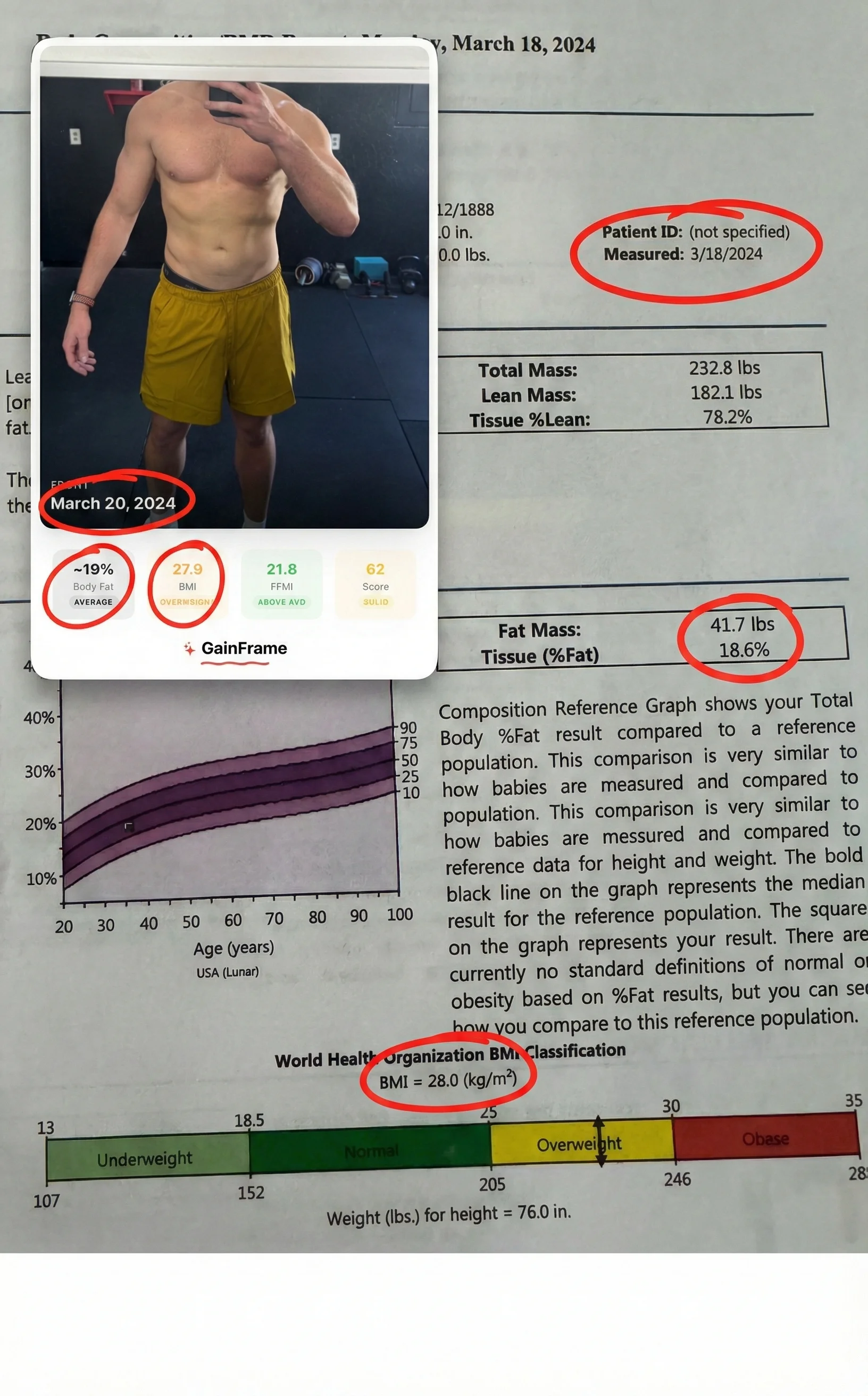
This test has a major update: After this original one-person comparison, we tested GainFrame three times across 36 clean DEXA-labeled photos. The current configuration averaged a 3.77-point miss and placed 80.6% of estimates within five points. See the complete 36-DEXA benchmark.
If you take your fitness seriously, you've probably considered getting a DEXA scan. It's the undisputed gold standard for measuring body fat percentage, lean mass, and bone density. But it comes with friction: you have to schedule an appointment at a clinic, pay $100 to $150, lay completely still in an X-ray machine for 10 minutes, and then wait for someone to interpret the dense, medical-grade printout.
It's incredibly accurate, but it's not something you do every week.
On the flip side, what if you could just take a photo in your bathroom mirror and get the same level of insight for free? That's the promise of visual AI body composition. To see if that promise holds up, I decided to do a massive real-world test. I booked a clinical DEXA scan, and on the exact same morning, I ran my progress photo through GainFrame's AI Deep Dive.
Here is an honest, side-by-side look at the numbers, where the two methods perfectly aligned, and what each tool caught that the other missed.
If you already have a printout in hand, use this field-by-field guide to reading DEXA body-fat results before comparing it with another method.
Clinical DEXA Scan
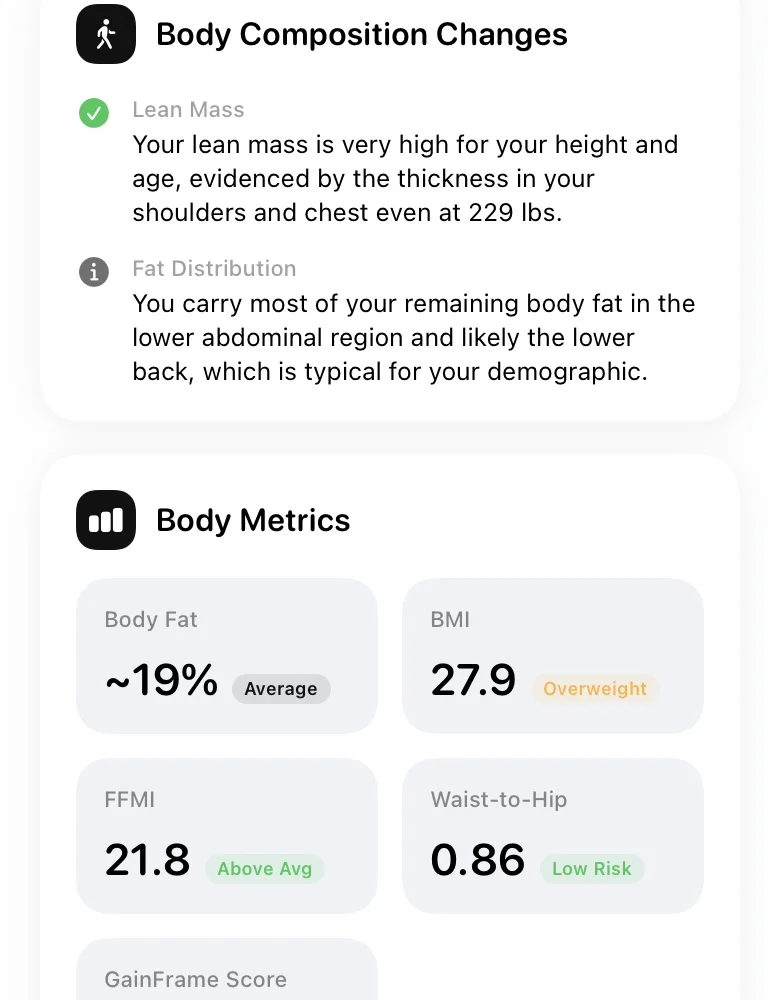
GainFrame Details
- Body Fat Percentage: The DEXA scan measured my total body fat at exactly 18.6%. GainFrame estimated it at 19% visually. For a mobile app to land within 0.4% of a clinical X-ray is phenomenal proof of modern Computer Vision.
- Weight and BMI: Both methods registered my weight at precisely 230.0 lbs and my BMI at exactly 28.0.
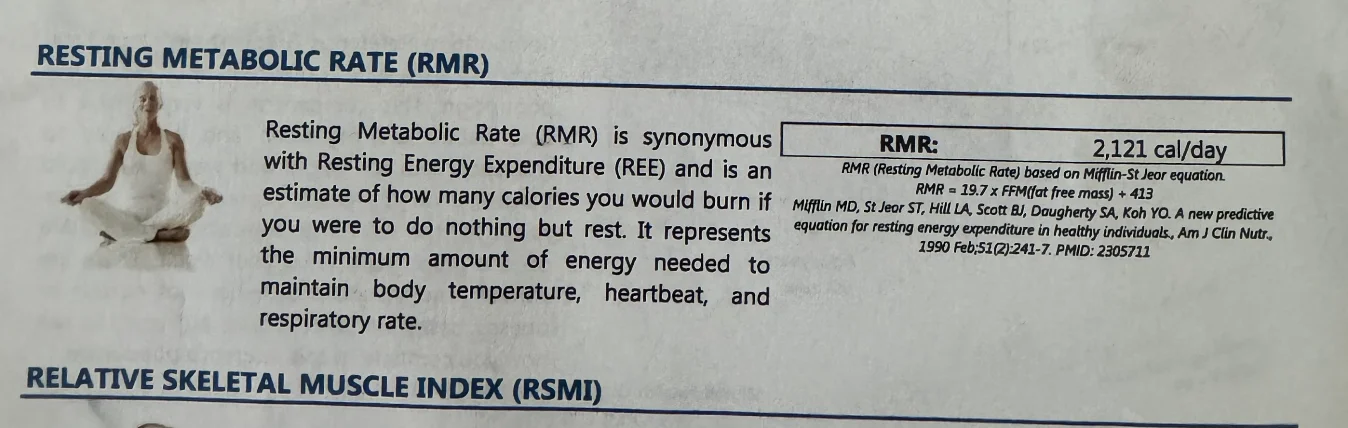
- The Metabolic Math (RMR): The DEXA machine calculated my Resting Metabolic Rate (RMR) at 2,121 kcal/day. GainFrame's internal algorithm estimated an almost identical ~2,110 kcal base RMR, generating a daily caloric recommendation of 2,594 kcal to achieve a sustainable 500-calorie deficit for fat loss.
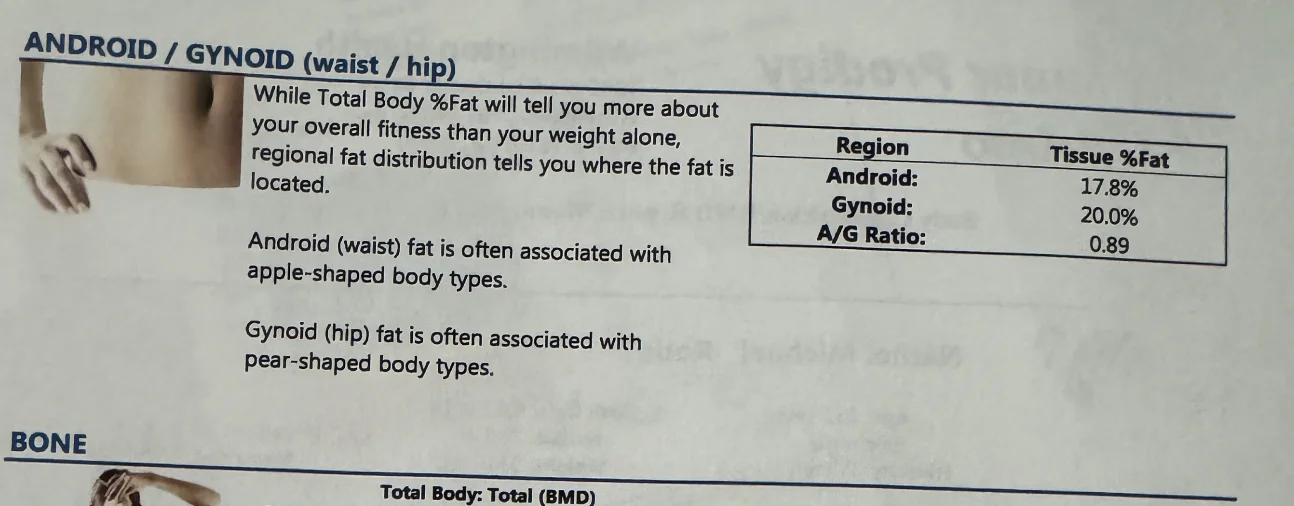
- Waist-to-Hip (A/G) Ratio: DEXA provides an Android/Gynoid (A/G) ratio of 0.89, which doctors use to assess metabolic health risk. GainFrame visually calculated an incredibly close 0.88 waist-to-hip ratio just by inspecting my mirror selfie.
2. Subcutaneous vs. Visceral Fat (The AI Guessed Right)
One of the most impressive moments of the test was seeing how the AI interpreted my midsection. GainFrame's summary noted that my abs were "currently obscured by a layer of subcutaneous fat."
This is a bold claim for an AI to make without seeing inside the body. But the DEXA scan provided the absolute clinical proof: it measured my Visceral Adipose Tissue (the dangerous hard fat around the organs) at an incredibly low 0.27 lbs.
This meant that the 20.8 lbs of total fat residing in my core region was indeed almost entirely subcutaneous (surface-level soft fat) - exactly as GainFrame had diagnosed visually. The app correctly identified surface-level aesthetic softness versus deep abdominal visceral bloating.
3. Does the DEXA Data Back Up the AI's Aesthetic Muscle Core?
While a DEXA scan essentially views your body as blocks of mass, GainFrame's expertise lies in analyzing aesthetics, proportion, and visual shape.
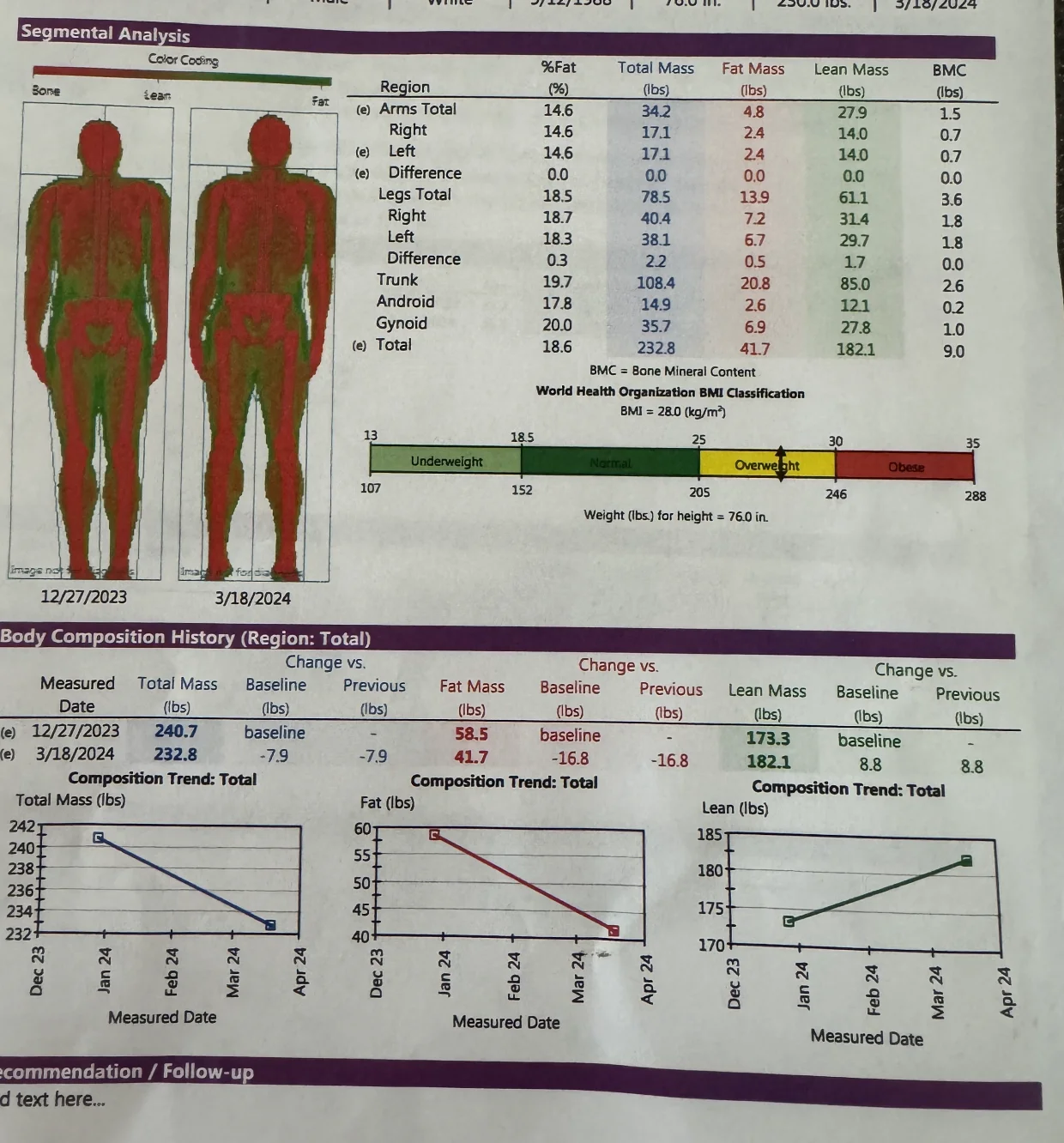
DEXA Regional Breakdown
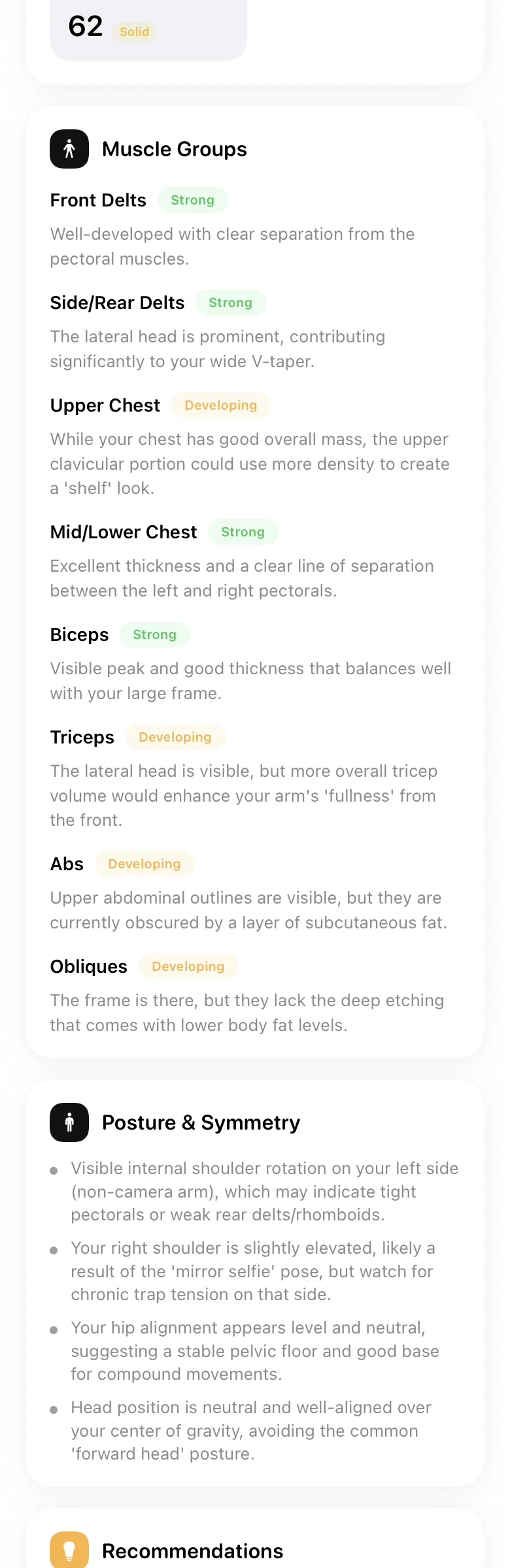
GainFrame Muscle Groups
GainFrame categorized my Delts, Biceps, and Triceps as "Strong", noting my arms were a "clear strong point." Did the DEXA scan confirm this?
Yes. The DEXA scan showed that my "Arms Total" region possessed the lowest body fat percentage on my entire frame at just 14.6%. Because they carry the least fat, the muscle is significantly more visually prominent - validating exactly why the AI flagged them as the most developed aesthetic points.
Conversely, GainFrame marked my Abs and Obliques as "Developing," stating they were "softened" by fat. The DEXA corroborated this completely, showing that exactly half of all the fat on my body (20.8 lbs out of 41 lbs) was sitting right in my trunk.
4. The Doctor vs. The Coach (What One Has That the Other Doesn't)
Comparing the two reports makes it clear that while they align on accuracy, they serve entirely different purposes.
What GainFrame has that DEXA doesn't (Aesthetics & Action)
DEXA treats your entire torso as one giant block. It cannot tell you if your upper chest is lagging behind your lower chest. GainFrame, acting as a posing and bodybuilding coach, intelligently breaks this down visually and prescribes actual exercises (like incline presses) to fix the aesthetic imbalance.
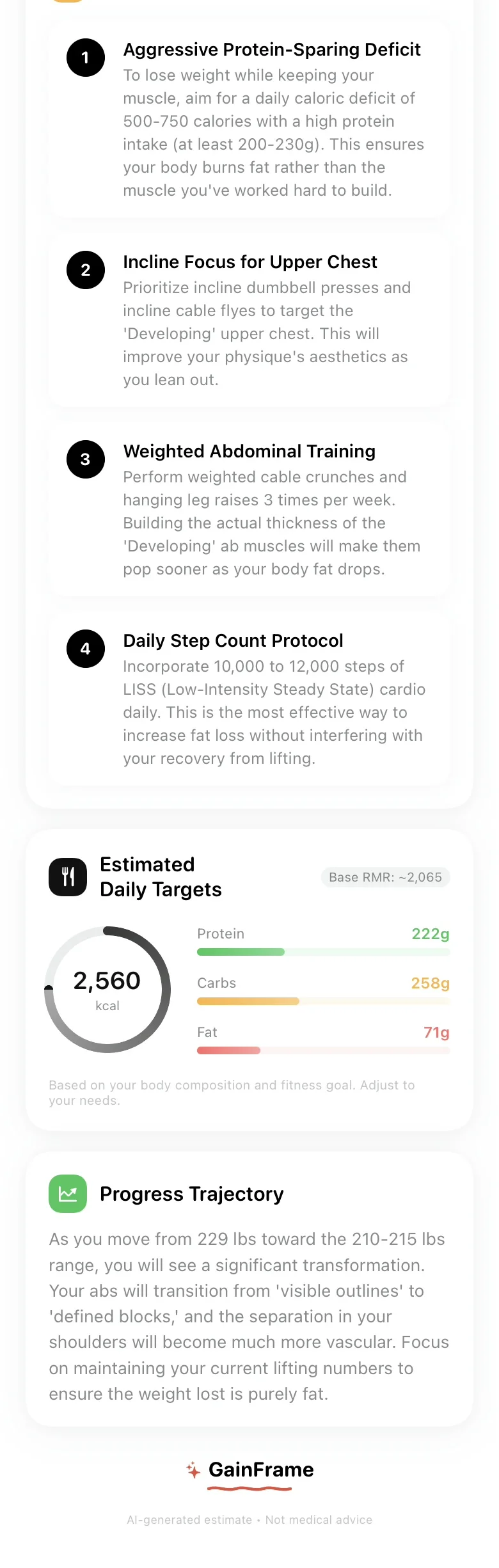
GainFrame Posture & Action Plan
GainFrame also evaluates posture - catching an elevated right shoulder and an anterior pelvic tilt. A clinical DEXA machine cannot evaluate posture because you are required to lie completely flat during the scan.
What DEXA has that GainFrame doesn't (Internal Medicine)
DEXA is still the undisputed king of internal medicine. It physically measures your bone weight (my Bone Mineral Content was exactly 9.0 lbs with density in the 98th percentile). It also beautifully detects hidden muscular asymmetry; for instance, DEXA caught that my right leg carries 1.7 lbs more lean tissue than my left leg - something incredibly hard to spot in a selfie.
The Verdict
If you have medical concerns regarding bone density, or if you need absolute clinical certainty of your visceral fat volume, you absolutely must spend the $150 and go to a DEXA clinic.
But if you are primarily interested in tracking your fitness journey, dialing in your training to build a balanced physique, and keeping an eye on your body fat percentages and FFMI?
The fact that a free app running on your phone was able to estimate clinical Body Fat within 0.4%, nail the RMR, calculate the Waist/Hip ratio within a fraction, and validate its muscle insights via clinical mass distributions... is nothing short of incredible. GainFrame provides the awareness and the actionable coaching you need - right from your bathroom mirror.