
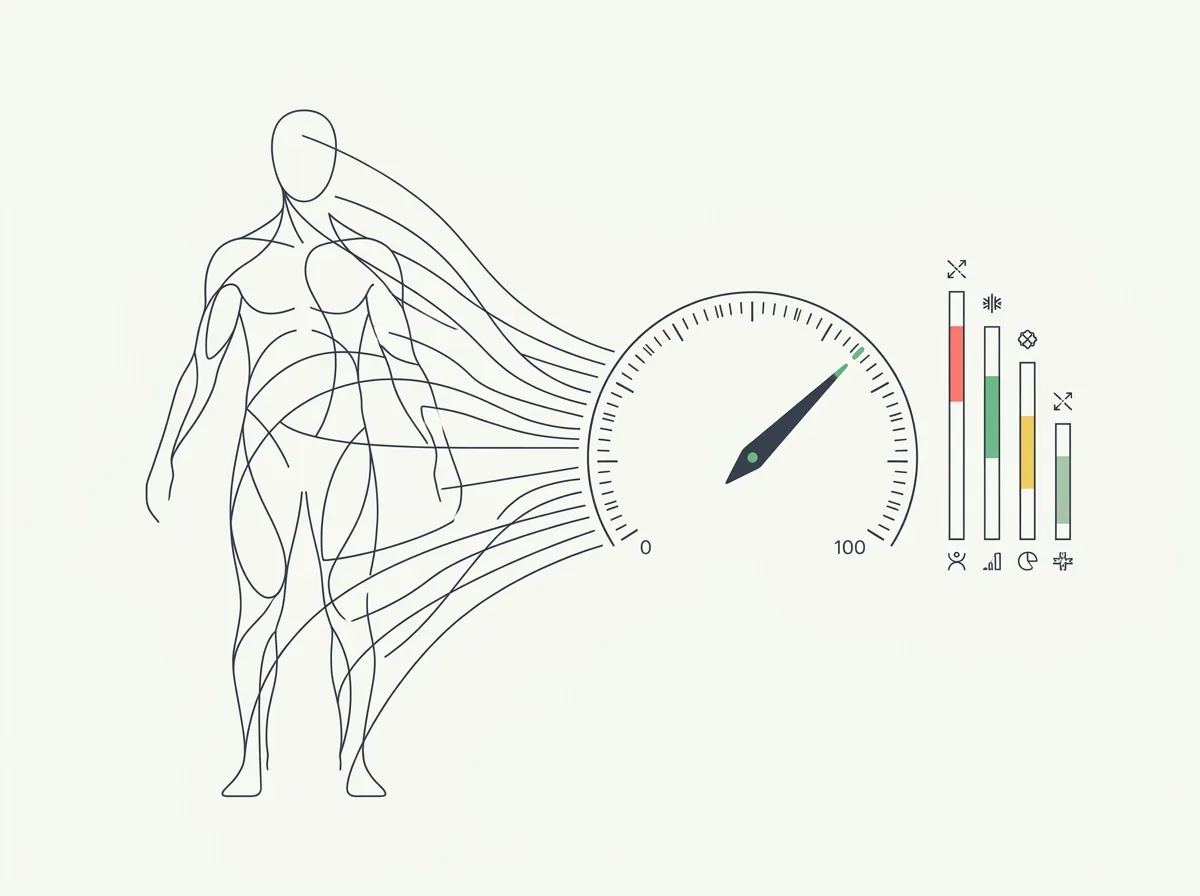
Quick answer: An AI physique score summarizes visible body fat, muscle development, proportions and fit with your selected goal on a 1 to 100 scale. It is an estimate from the submitted photo. Compare the same pose under similar lighting over time, and read the sub-scores before deciding what changed.
You get a 68 on one photo and a 72 on another. Before you change your training, check whether the light, pose or goal changed. A number alone cannot tell you whether you gained muscle.
The free AI physique rater gives you a single-photo assessment. This guide explains how to read it and how the app adds a history of check-ins.
What goes into an AI physique score?
The web rater returns four sub-scores. Body fat reflects visible leanness, muscle reflects visible development, proportions reflects balance, and goal fit relates the assessment to the goal you selected. Body fat and muscle receive the greatest weighting in the web tool.
A body-fat sub-score of 65 does not mean 65% body fat. The sub-score is a rating on the tool's scale. A body-fat percentage estimate is a separate field, with its own uncertainty.
The app also offers a more detailed breakdown across 12 muscle groups. Those muscle ratings are distinct from the four summary dimensions. One front photo cannot show your entire back or every muscle group clearly.
How do you read a real report?
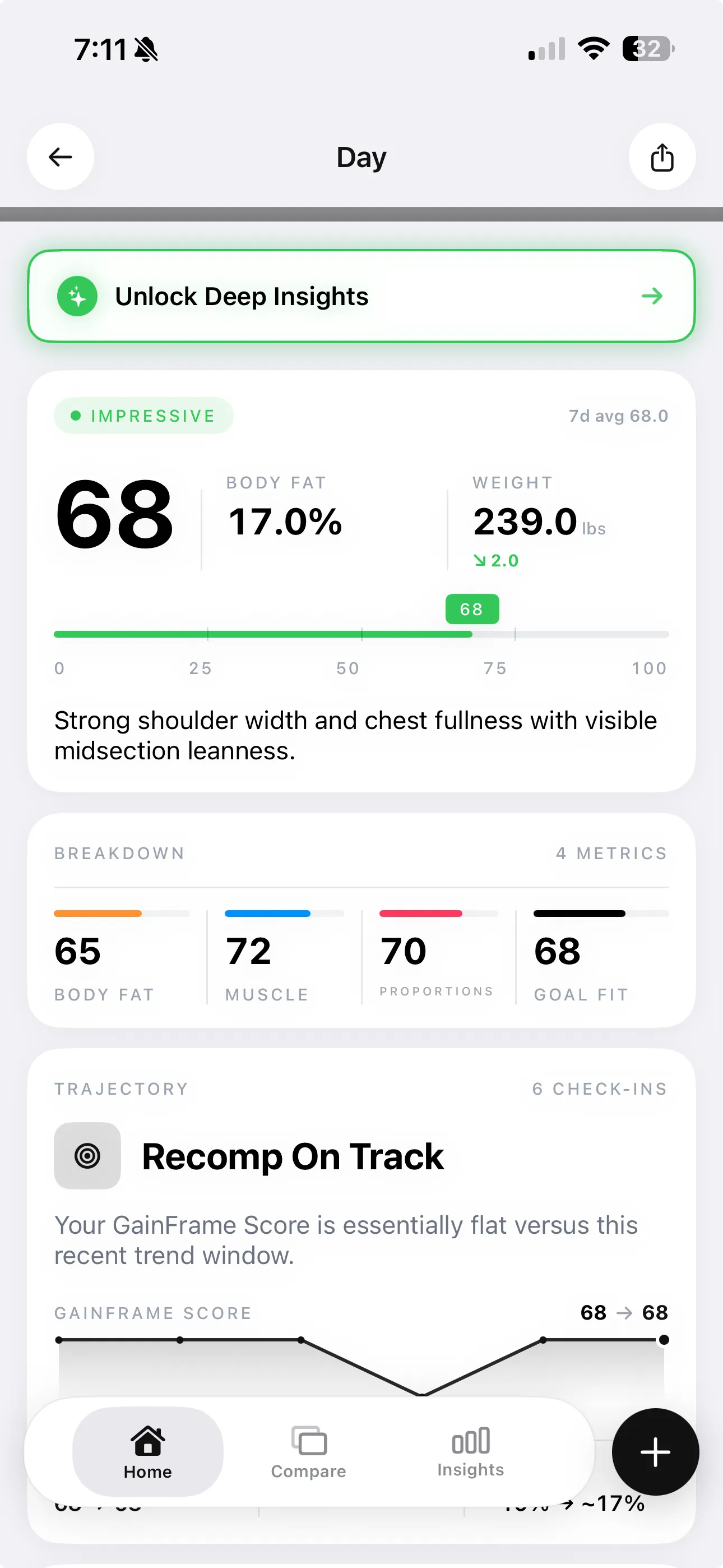
Real app screenshot from our version 1.21 library. The numbered notes below explain its fields. App labels can differ from the current web rater's bands.
- Overall score: 68. This summarizes that check-in against the selected goal. It is not a percentile or a prediction of future results.
- Estimated body fat: 17%. This is the photo-based composition estimate. The nearby weight is separate recorded context.
- Four sub-scores: 65, 72, 70 and 68. Read these as different aspects of the same photo, rather than four measurements of muscle mass.
- Trajectory. Several comparable check-ins provide context that one score cannot. A flat line can still accompany useful changes in strength or habits.
The screenshot is an example of the interface. Its values are not a target for your body, and the app's displayed band should not be substituted for the current web scale below.
What do the current web score bands mean?
| Web score | Label | How to use it |
|---|---|---|
| 1 to 30 | Starting | A starting point within this scoring rubric |
| 31 to 50 | Building | Visible features fall within the second band |
| 51 to 70 | Solid | A middle band in the tool's scale |
| 71 to 85 | Impressive | A higher assessment within this rubric |
| 86 to 100 | Elite | The highest band used by the tool |
These are product labels. We have not published a representative population study showing what percentage of lifters lands in each band. A score of 80 therefore does not mean you rank above 80% of people.
Why can the same body receive different scores?
Lighting changes shadows, flexing changes visible definition, and camera angle changes proportions. Clothing can hide the areas the model needs to assess. A different selected goal also changes the context of the result.
AI outputs can vary even when the inputs look similar. A small score movement is insufficient evidence of muscle gain or fat loss. Use repeatable progress-photo poses and look for a pattern across several check-ins.
How should you track your next check-in?
- Keep the same camera, height, distance and light direction.
- Compare relaxed front photos with relaxed front photos.
- Keep the selected goal consistent while comparing scores.
- Record whether you trained immediately before a photo.
- Pair the visual trend with your training log and weight context.
First, save a baseline you can reproduce. Second, take the next set under the same conditions. Third, compare the two photos before reading the score difference. GainFrame keeps dated check-ins and their estimates together when you want an ongoing record.
What else should you know?
What is an AI physique score?
An AI physique score is a summary of visible features in a submitted photo, usually expressed on a numbered scale. Here, it combines body fat, muscle, proportions and goal fit. Its meaning depends on the scoring system, your selected goal and the quality of the photo you provide.
Is a physique score the same as body-fat percentage?
No. A physique score is a rating, while body-fat percentage estimates the share of your body weight that is fat. The report displays these separately. A body-fat sub-score is also a rating, so you should never read a sub-score such as 65 as 65% body fat.
What is a good physique score?
A useful score is one you can interpret consistently within the same tool. The web rater labels 51 to 70 Solid and 71 to 85 Impressive. These bands describe its rubric. They do not establish a health threshold, a population percentile or an objective standard that everyone should pursue.
Can lighting change my physique score?
Yes. Different light direction can make shadows deeper or flatter, which changes the definition visible to the model. Camera position, clothing and flexing also affect the image. Keep those conditions repeatable, and treat a small score change cautiously until several comparable check-ins show a similar direction.
How can I use a physique score to track progress?
Save a dated baseline and repeat the same pose with the same camera setup and selected goal. Review the photos alongside the sub-scores, your weight context and your training record. Look for a consistent direction across multiple check-ins before interpreting a numerical change as a meaningful physical change.