
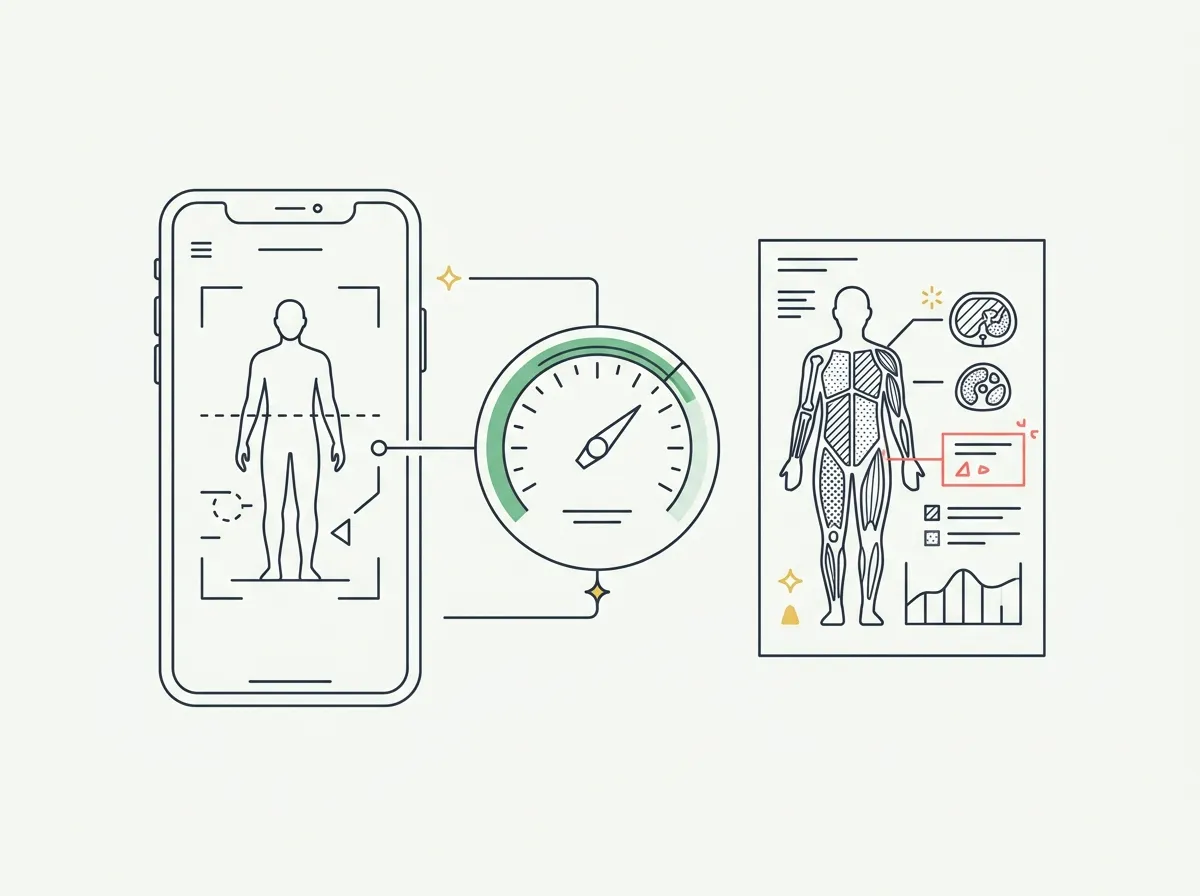
Quick answer: GainFrame suits photo timelines, Spren emphasizes composition reports, trackBod offers front-and-side scanning, Recomp AI focuses on 3D comparisons, and MeThreeSixty combines shape measurements with composition estimates. Choose by the output you will use repeatedly, the paid-feature boundary and the evidence. None of these listings establishes an accuracy winner for every person.
You download a “free” scanner, take two photos and meet a subscription screen before seeing the result. Another app shows a 3D avatar, while a third saves the actual photos. Those are different purchases even when every listing promises body-fat insight.
Try the free browser body-fat estimator if you want to understand a photo estimate before choosing an app. Its result is a rough reference. For ongoing tracking, decide how you will retain and compare the evidence.
How did we choose these five apps?
We checked the US iTunes API, current listing descriptions and publisher screenshots on October 15, 2026. This is a sourced feature comparison. We have not run a controlled accuracy test across all five apps, and their star ratings do not provide that test.
Formfy, bodyfatAI and the old Recomp AI ID did not return a current US listing in this check. Availability can vary by country and change later. MeThreeSixty's current listing includes composition estimates, so it replaces the unavailable entry here.
Which kind of output should you choose?
| Your main job | What to inspect before subscribing |
|---|---|
| Keep a real photo history | Original-image access, comparison controls and export options |
| Read a composition report | Published method, uncertainty and included metrics |
| Track a 3D body model | Capture instructions, circumference estimates and model history |
| Spend as little as possible | Free analysis allowance, renewal price and paid history limits |
1. When should you consider GainFrame?
Best fit: Photo timelines and physique insights. US App Store: 4.89/5 from 70 ratings, checked October 15, 2026. App Store listing · Publisher website
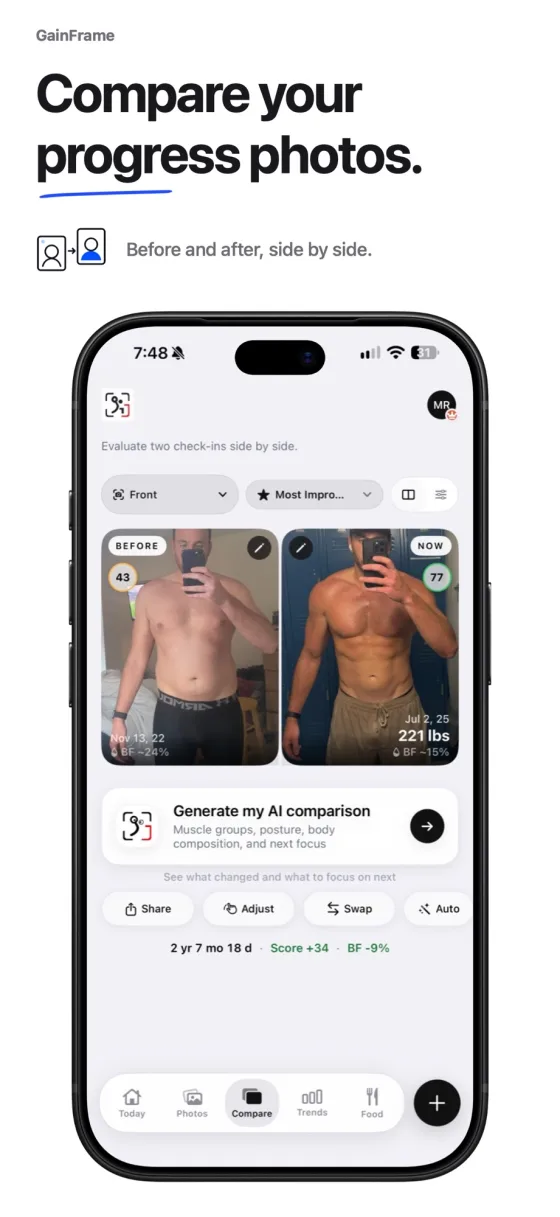
Publisher screenshot checked October 15, 2026. Promotional claims shown in the image belong to the publisher.
The app keeps progress photos in a timeline with comparisons, estimated body fat, FFMI and muscle-group scores. It suits you if reviewing changes between check-ins is the main job. We make this app, so consider that relationship when reading the comparison.
The 36-photo internal benchmark reports a 3.77 percentage-point mean absolute error and 29 of 36 estimates within five points of paired DEXA results. The dataset contains women only. That test does not establish universal clinical accuracy or validate every current workflow. Photo analysis also depends on capture conditions.
Offer: Free download with limited check-ins. Optional Pro subscription; current price and limits are shown in the app. Your photo library stays on your device; selected photos leave the device for AI processing and are not stored on GainFrame servers.
2. When should you consider Spren?
Best fit: Composition reports. US App Store: 4.74/5 from 1,490 ratings, checked October 15, 2026. App Store listing · Publisher website
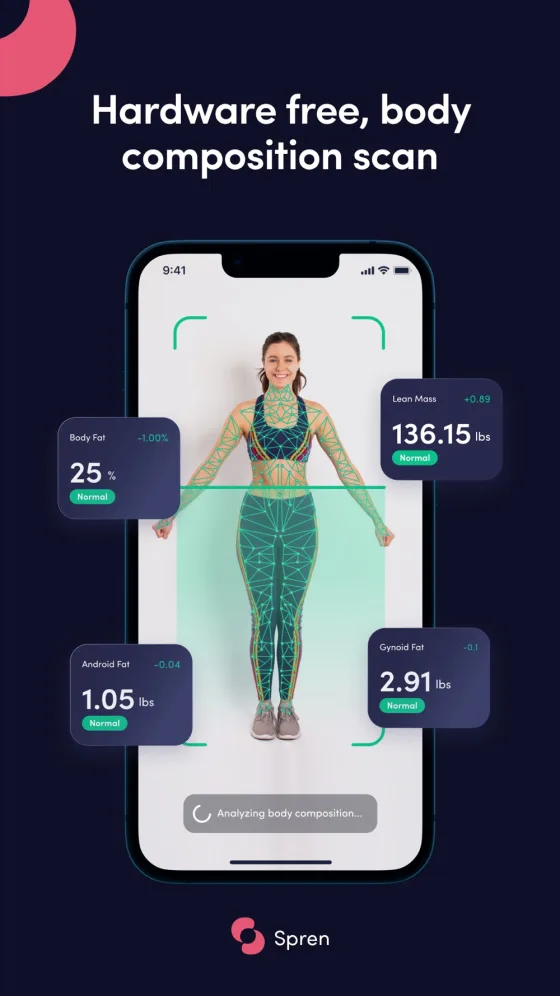
Publisher screenshot checked October 15, 2026. Promotional claims shown in the image belong to the publisher.
Spren advertises a guided camera scan and a report with estimated body fat, fat mass, lean mass and resting metabolic rate. Its site links research, making it a useful option if you want to inspect the evidence behind the approach.
The listing's DEXA comparisons are the publisher's claims. Read the underlying study and its tested population before applying an accuracy figure to yourself. The listing discloses cloud processing and wellness subscriptions.
3. When should you consider trackBod?
Best fit: A guided two-photo workflow. US App Store: 4.75/5 from 1,103 ratings, checked October 15, 2026. App Store listing · Publisher App Store page (the listing did not provide a separate developer website).
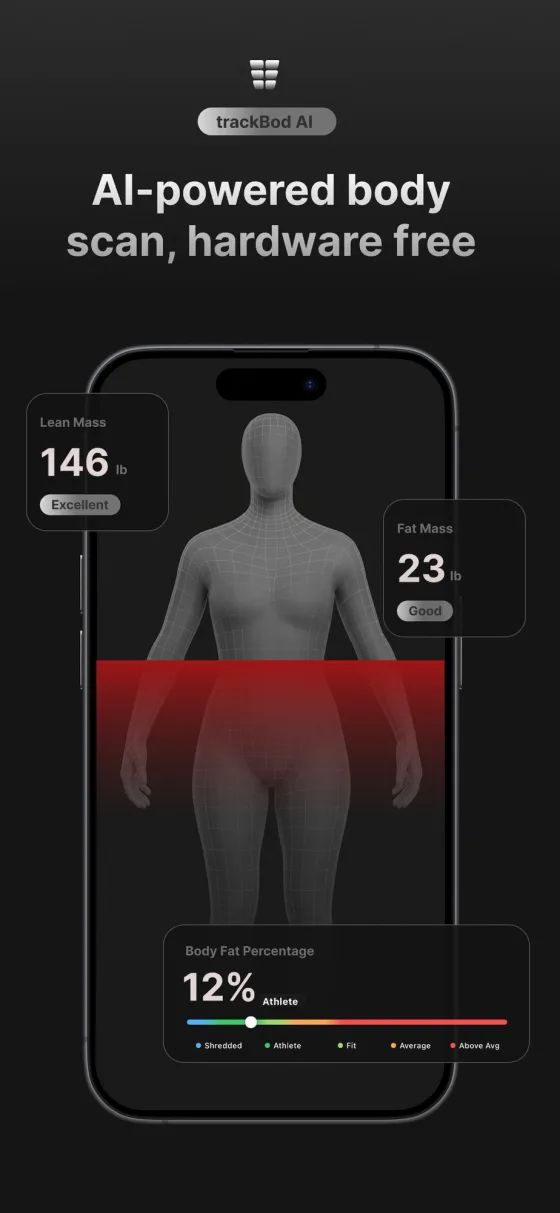
Publisher screenshot checked October 15, 2026. Promotional claims shown in the image belong to the publisher.
The current listing describes a short questionnaire followed by front and side photos. It explicitly says analysis requires an active subscription. That makes the payment boundary clearer than a generic “free download” label.
Choose it if a straightforward scan flow is what you want to evaluate. Verify what the purchase includes before taking photos. A high Store rating describes customer feedback and does not establish the error of a body-fat estimate.
4. When should you consider Recomp AI?
Best fit: 3D model comparisons. US App Store: 4.65/5 from 747 ratings, checked October 15, 2026. App Store listing · Publisher website
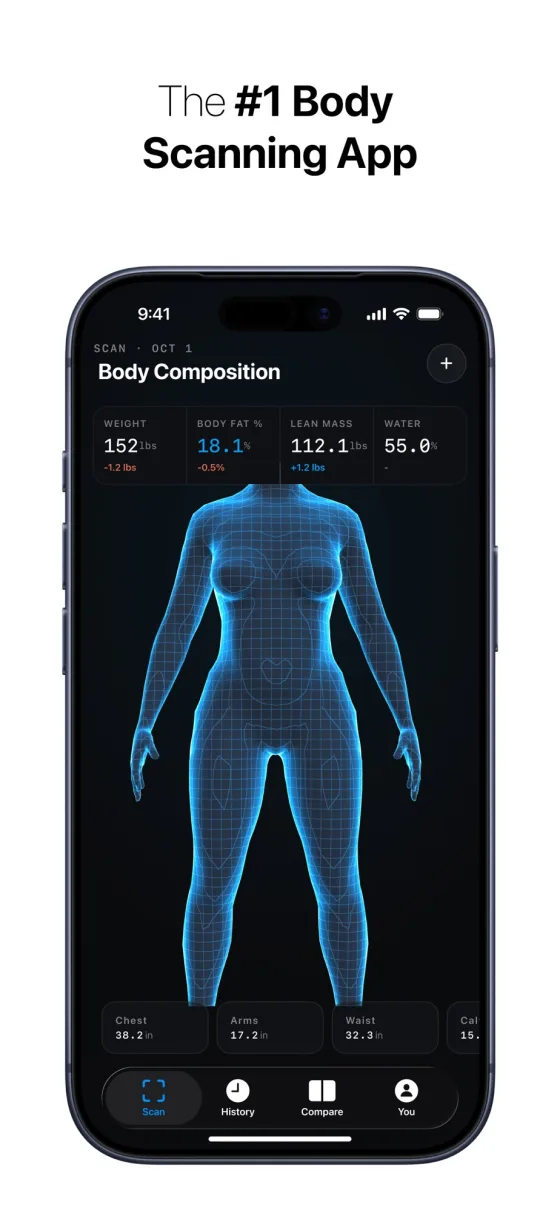
Publisher screenshot checked October 15, 2026. Promotional claims shown in the image belong to the publisher.
The current Recomp AI listing describes camera-based 3D scanning, estimated body composition, circumference outputs and comparisons between body models. It is listed under app ID 6752960004; the older ID used in earlier versions of our guide did not return a current US listing.
It fits a reader interested in model-based progress views. Advanced analysis requires a subscription, and the publisher says its insights do not substitute for clinical composition testing.
5. When should you consider MeThreeSixty?
Best fit: Body-shape and circumference tracking. US App Store: 4.75/5 from 18,419 ratings, checked October 15, 2026. App Store listing · Publisher website
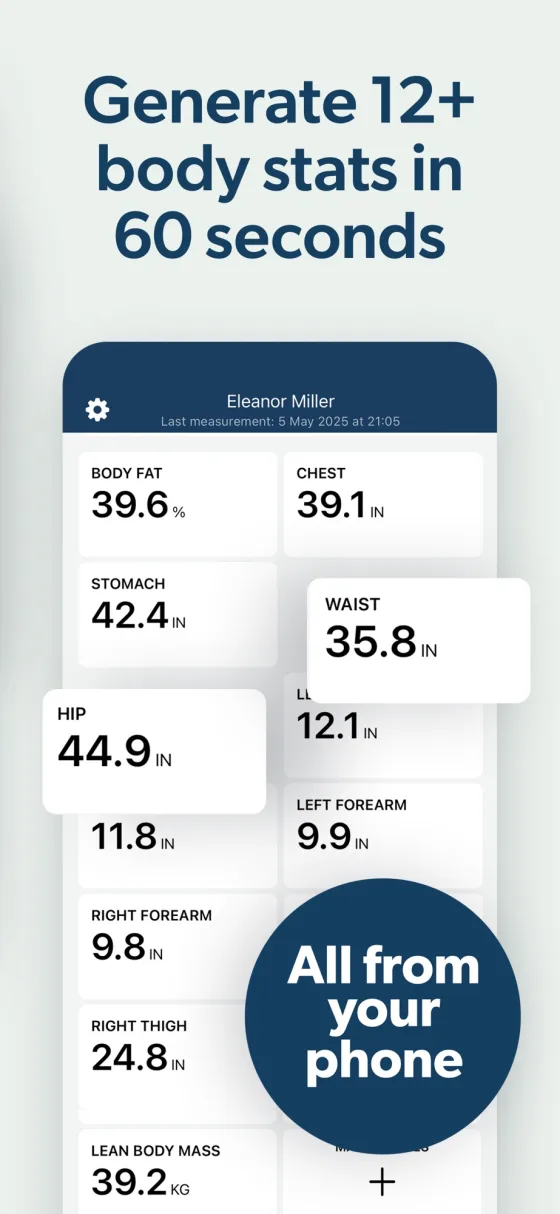
Publisher screenshot checked October 15, 2026. Promotional claims shown in the image belong to the publisher.
MeThreeSixty uses front and side poses to create an avatar and track measurements. Its current listing also includes estimated body composition, including body-fat percentage and lean mass. Treat an estimated percentage and an avatar's shape as separate outputs when choosing what to follow.
The publisher describes core scanning as free and offers a Premium tier for additional capabilities. Check the current feature boundary, especially history and export access. Its privacy description says photos stay on the device.
How should you compare accuracy claims?
Look for the exact app version, tested population, sample size and individual differences against a reference. A single close match is useful as an example but cannot establish expected error for everyone. A study of one imaging method also cannot validate every app that uses the word AI.
Keep lighting, pose, camera distance and clothing consistent. If two apps disagree, avoid averaging their numbers into a supposedly better answer. Retain the separate series and inspect the underlying images. Our measurement-method guide explains the different kinds of evidence.
What should you check before your first scan?
- Confirm that the app is available in your country's Store.
- Check whether analysis, history and export require payment.
- Read what happens to uploaded images and what deletion controls exist.
- Choose one repeatable capture setup.
- Save your baseline and compare later check-ins under similar conditions.
Choose the output first, inspect the purchase screen second, then try the capture process before committing to a longer subscription.
What else should you know?
Which body-fat app should I choose for progress tracking?
Choose the app whose record you will actually revisit. A photo timeline suits visual comparisons, a composition report suits reviewing estimated metrics, and a 3D model suits shape tracking. Check history access, export options and subscription requirements before deciding that the first attractive result is enough.
How should I read the 36-photo DEXA benchmark?
The published internal benchmark used 36 clean front-view photos from a female dataset paired with DEXA results. It describes that test configuration and sample. It does not establish universal accuracy across sexes, poses, devices or app versions, and it does not prove superiority over every other app.
Can a phone app measure body fat directly?
A phone app estimates body composition from images and any information you provide. It does not directly observe every tissue in your body. Keep the original images and standardize capture conditions so you can inspect visible changes alongside the estimates, rather than relying on one precise-looking number.
Does a high App Store rating prove accuracy?
No. A Store rating reflects reviews from customers who chose to rate the app. It does not compare those customers with a reference measurement under a controlled protocol. Use ratings to investigate usability and support, then evaluate accuracy evidence separately for the particular app and method.
Is a free download the same as free analysis?
No. An app can be free to install while charging for a report, history or advanced analysis. Check the current purchase screen before subscribing. In this comparison, trackBod explicitly requires a subscription for analysis, while other apps describe different combinations of free and paid features.
Keep a consistent photo timeline
GainFrame organizes your check-ins and comparisons on iPhone. Free download with limited check-ins. Optional Pro subscription; current price and limits are shown in the app.
Download GainFrame Free