
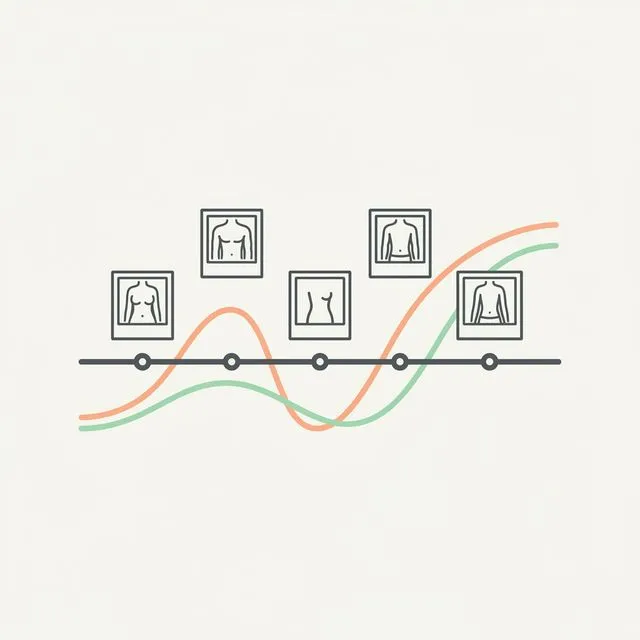
Quick answer: Take progress photos every two to four weeks for a simple routine. Weekly capture also works if you prefer a regular check-in, but judge visible changes across several weeks rather than consecutive days. Keep the pose, lighting and camera setup consistent, and use a schedule you can maintain comfortably.
You compare Monday with Tuesday and spend 10 minutes trying to decide whether anything changed. More frequent photos create more files, but they do not guarantee a clearer answer. Choose separately when to capture and when to evaluate.
If you use Muse to plan your training, the weekly Muse fitness check-in template helps you bring comparable photos and completed sessions into your next review.
How often should you capture progress photos?
Every two to four weeks is a practical starting point. Monthly photos are reasonable if you want a low-effort record. Weekly photos can help you keep a consistent appointment or document a planned training phase.
There is no single scientifically established interval that fits every goal. MacroFactor recommends roughly monthly photos for most situations, because day-to-day visual changes are usually hard to interpret. The schedule below is an editorial planning example.
For photo tracking during 75-day challenges, distinguish the challenge's capture requirement from your review schedule. You can keep required daily photos while comparing a smaller set of consistently framed dates.
How often should you compare them?
If you capture weekly, consider reviewing the wider trend every four weeks. Compare the current front view with the same view from your baseline, then repeat for side and back. You can also review consecutive monthly sets.
Keep weight, workout performance and notes nearby for context. A single photo cannot establish that a training or nutrition change worked. If the lighting or pose changed substantially, mark that comparison as uncertain and improve the next capture.
What does a 12-week schedule look like?
| Week | Simple monthly routine | Optional weekly routine | Review task |
|---|---|---|---|
| 0 | Capture baseline | Capture baseline | Record your camera and pose setup |
| 1, 2, 3 | No scheduled photo | Capture once each week | File photos by date and pose |
| 4 | Capture all baseline poses | Capture usual set | Compare week 0 with week 4 |
| 5, 6, 7 | No scheduled photo | Capture once each week | Keep conditions repeatable |
| 8 | Capture all baseline poses | Capture usual set | Compare weeks 0, 4 and 8 |
| 9, 10, 11 | No scheduled photo | Capture once each week | Note any setup changes |
| 12 | Capture all baseline poses | Capture usual set | Review the whole 12-week record |
You can adapt this to a fortnightly routine by adding captures in weeks 2, 6 and 10. The calendar organizes your record; it does not predict how much your body will change.
Should a cut, bulk or recomp use a different schedule?
The same monthly comparison routine can work across all three. During a cut, compare the visual record with your weight trend. During a bulk, add training performance and avoid treating every increase in size as new muscle.
For recomp, look across several check-ins because weight alone can be uninformative. Weekly capture is optional if it makes the habit easier. You do not need daily photos to make any of these records useful.
What should stay the same at each check-in?
- Use the same relaxed front, side and back poses.
- Keep the camera, lens, distance and height consistent.
- Choose a repeatable light source and time of day.
- Use similar clothing and comparable workout timing.
- Record the date and any change in conditions.
Before you start the calendar, set up your progress photos. The photo setup tool turns your available space and equipment into a repeatable checklist.
What if you miss a photo day?
Take the next set when convenient and keep its real date. Avoid changing the date to make the calendar look complete. A missed week does not erase the value of a longer record.
If taking photos makes you check your appearance repeatedly or feel worse, use a less frequent schedule or take a break. You can still track your training and habits without a weekly image.
First, choose monthly, fortnightly or weekly capture. Second, set a reminder for a repeatable time. Third, keep matching photos together in an album or a progress photo app and review the longer trend.
What else should you know?
How often should you take progress photos?
Every two to four weeks is a practical starting point for a simple record. Weekly capture is optional if a regular check-in helps you maintain the habit. Keep your setup consistent, and evaluate several weeks together because small differences between consecutive days or weeks can be difficult to interpret.
Are monthly progress photos too far apart?
Monthly photos can provide a useful, manageable record of visible change. They are a reasonable choice if you prefer fewer check-ins and can reproduce the same poses and lighting. You can capture more often for your archive while still using monthly comparisons to review the overall direction.
Should you take progress photos every day?
Daily photos are usually unnecessary for a general fitness progress record. Lighting, posture, clothing and workout timing can change how you look from one day to the next. A less frequent routine is easier to organize, while still giving you dated images to compare across a longer period.
How often should you take muscle-gain photos?
You can use the same two-to-four-week capture routine for muscle gain and compare several check-ins alongside your training record. Weekly capture is also an option if you prefer it. Keep flexed and relaxed photos separate, and avoid treating a post-workout pump as evidence of lasting muscle gain.
What if progress photos show no change after a month?
Check whether the two sets are comparable before drawing conclusions. Different light, framing or poses can hide or exaggerate change. Review your training record and other relevant trends, then continue a consistent schedule. One monthly comparison alone is not enough to establish that your entire approach has failed.
Keep a photo history you can compare.
Use GainFrame to organize dated check-ins and review changes across weeks or months. Free access includes a limited capture and import allowance, shown in the app. Available on iPhone.
Download GainFrame Free