

Is the Spren App Worth It? The Short Version
Spren is a solid body composition scanning app for general fitness users — particularly people who want a quick, camera-based scan without needing to take progress photos in the traditional sense. Its scanning approach (using your phone's front camera with guided body scan, not a stored progress photo) is genuinely different from most competitors.
But Spren has real limitations for serious lifters:
- It gives you a body fat estimate and a few metrics — but no muscle group-level breakdown, no FFMI, no lean mass tracking
- Its accuracy claims are based on comparisons to DEXA in controlled conditions — real-world consistency varies significantly by lighting, clothing, and body position
- The subscription cost is meaningful for a tool that provides limited actionable data per scan beyond "body fat went up or down"
- There is no workout integration, no comparison tooling between specific check-ins, and no progress photo archive — it's a scan tool, not a tracking platform
If you want a quick scan and a number, Spren works. If you're a lifter who wants to track composition changes at the muscle-group level and understand FFMI over time, you'll outgrow Spren quickly.
What Is the Spren App?
Spren is an iOS app that uses your phone's camera to estimate body composition via a guided body scan. Unlike progress photo apps, Spren doesn't ask you to take a front photo and save it — instead, it guides you through a scan of your front-facing camera while you stand at a fixed distance. The AI analyzes the scan and returns a body composition report.
Spren was initially launched as a developer SDK for health tech companies, and the consumer app built on top of that technology. The company has significant backing and their research claims are well-documented in peer-reviewed literature. That credibility is real — but it doesn't automatically translate to the accuracy you'll experience as an individual user in your home bathroom.
What Spren measures
Body Fat %
The primary output — an estimated body fat percentage from the front-camera guided scan.
Lean Mass Estimate
Calculates lean mass in pounds or kg alongside fat mass. No breakdown by muscle group.
Trend Tracking
Multiple scans over time build a trend line. Useful for seeing directional change in body fat %.
Scan History
View past scans chronologically with your body fat trend. No visual photo archive — scans are data points, not photos.
How Accurate Is the Spren App?
This is the question that brings most people to a Spren review. The honest answer has three parts.
What Spren's research actually says
Spren has published accuracy data comparing their scan output to DEXA scan measurements. Their research shows correlation coefficients in the range of 0.85–0.95 against DEXA — which is genuinely strong for a camera-based consumer tool. For context: calipers done by an experienced technician land around 0.80–0.90 correlation with DEXA. BIA scales (the kind you step on) typically land around 0.70–0.85.
So in controlled research conditions, Spren performs at or near caliper-level accuracy. That's the best-case headline.
What "accurate in research conditions" actually means for you
The controlled conditions problem
Spren's validation studies were conducted under controlled conditions: standardized lighting, specific clothing (form-fitting, limited), controlled distance and angle, and consistent time of day relative to meals and hydration.
Most users scan in their bathroom with overhead lighting, wearing whatever they happen to have on, at varying distances. The model's accuracy degrades meaningfully when input conditions vary from training conditions. This isn't a Spren-specific problem — it applies to every AI body composition tool including GainFrame. Consistency of your scan setup is the biggest driver of useful results.
The single-scan limitation
A single Spren scan gives you a point estimate. Whether that estimate is 14% or 17% body fat on any given day can be influenced by: hydration (±2–3% apparent body fat), time of day, what you ate the prior day, lighting variance, and whether you held the exact same pose as last time.
This is why trend data over multiple scans — all done under the same conditions — is the metric that actually matters. One scan is a noisy data point. Ten consistent scans over three months is a trend you can trust directionally.
Bottom line on accuracy: Spren is among the better camera-based body composition tools available. It's not DEXA-accurate in everyday use. Neither is anything else you can do at home without a clinic visit. The value is trend data, not single-scan truth.
How Much Does Spren Cost?
Spren uses a subscription model. Pricing evolves — always check the App Store for current rates — but the general structure has been:
| Plan | What you get |
|---|---|
| Free tier | Limited scans per month — enough to try the product, not enough for regular tracking |
| Paid subscription | Unlimited scans, full history access, trend analysis |
| Current pricing | Check App Store listing for current rates |
The cost-value question for lifters: Spren's subscription gives you body fat %, lean mass, and trend data. It does not give you FFMI, individual muscle group scores, workout integration, or the comparison tooling to see what changed between two specific check-ins. Whether that output justifies the ongoing cost depends on what you need from the data.
What Spren Doesn't Do (Important for Lifters)
Spren's feature gaps are significant if you're an intermediate-to-advanced lifter trying to understand composition changes at a meaningful level:
| Feature | Spren |
|---|---|
| Body fat % estimate | Yes |
| Lean mass estimate | Yes |
| Individual muscle group scores (chest, shoulders, arms, etc.) | No |
| FFMI calculation | No |
| Side-by-side comparison between two specific scans with metric deltas | No |
| Progress photo archive (visual timeline) | No — scans are data, not saved photos |
| Workout app integration (Hevy, Strong, Apple Health workouts) | No |
| Future physique projection | No |
| Before/after visual comparison with alignment | No |
The core gap: Spren tells you how much fat you have (approximately). It doesn't tell you where your muscles stand, whether your FFMI is moving, or which areas of your physique are developing versus lagging. For a general fitness or weight loss user, that's fine. For a lifter optimizing body composition, those are the questions that matter.
Spren vs GainFrame: A Direct Comparison
Disclosure up front: GainFrame is my app. I built it. This comparison is honest, but you should weigh that context appropriately.
The key methodological difference
Spren and GainFrame take fundamentally different approaches to body composition scanning:
- Spren uses a guided front-camera scan in real time. You stand at a set distance, follow prompts, and the scan is processed. Photos are not saved as visual records — scans generate data points.
- GainFrame uses progress photos — images you capture and keep over time. AI analyzes each photo and generates a full composition report. Photos become a visual archive you can compare side by side.
Neither approach is objectively superior. Spren's scan-and-discard approach may feel less intrusive (no photo archive building up). GainFrame's photo-based approach gives you a visual record of your physique alongside the data — which is genuinely useful for context.
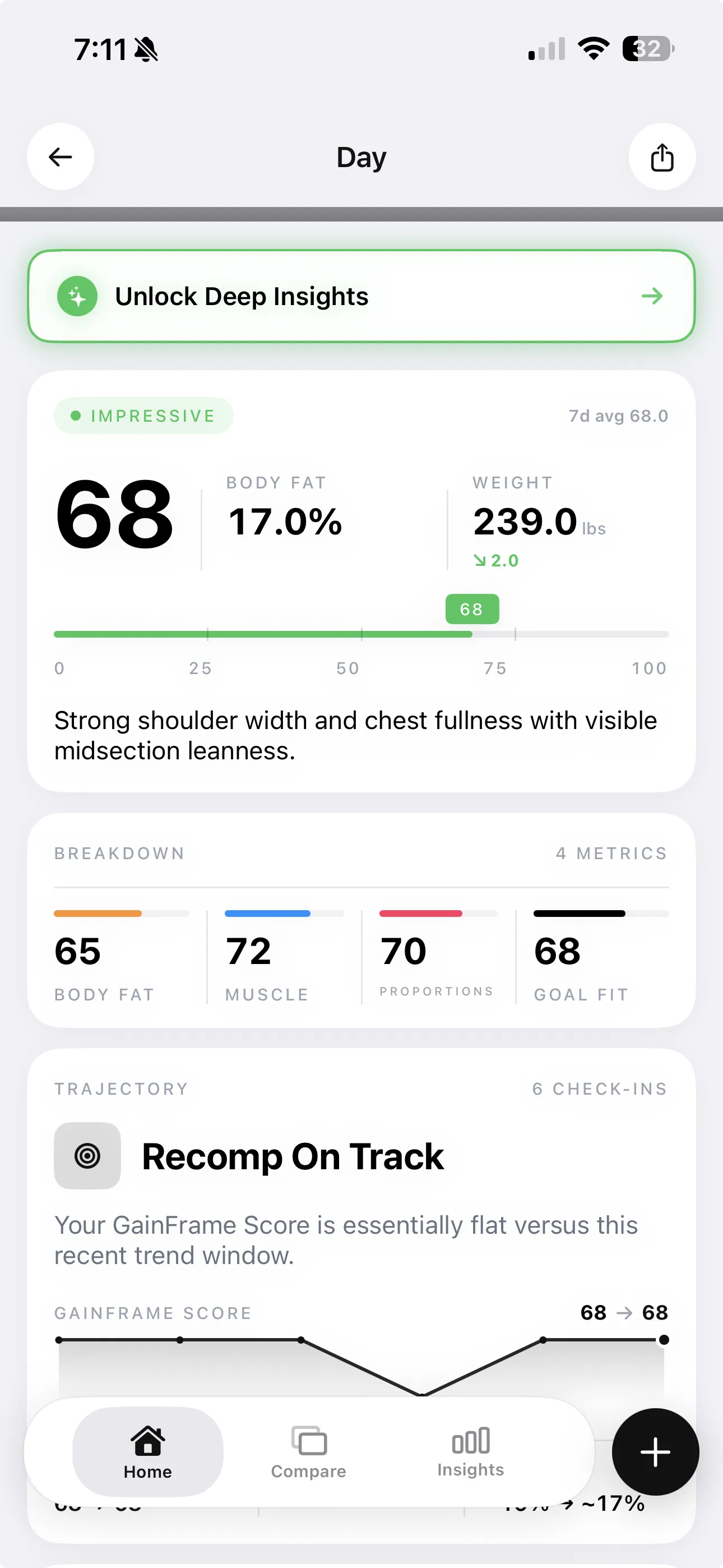
A single GainFrame check-in: body fat %, FFMI, and 12 individual muscle group ratings — data Spren doesn't surface.
Side-by-side comparison
| Feature | Spren | GainFrame |
|---|---|---|
| Body fat % estimate | Yes (guided scan) | Yes (photo-based) |
| Lean mass estimate | Yes | Yes |
| FFMI | No | Yes |
| 12 muscle group scores | No | Yes (per check-in) |
| Overall physique score | No | Yes (1–100) |
| Visual photo archive | No — scans only | Yes — photos + data together |
| Side-by-side comparison with metric deltas | No | Yes (Deep Dive Compare) |
| Future physique projection | No | Yes (3/6/12 month) |
| Hevy workout integration | No | Yes |
| Apple Health sync | Partial | Yes (weight, height, workouts) |
| Accuracy claims | Published research vs DEXA (~0.90 correlation) | Gemini-powered; no published clinical study; consistent trend tracking |
| Privacy | Scans processed; no persistent photo storage | Photos sent to Google Gemini for inference; not stored on server; no account required |
| Platform | iOS | iOS |
| Best for | Quick body fat trend with a scan; research-backed methodology claim | Lifters wanting muscle-group depth, FFMI tracking, and visual photo archive |
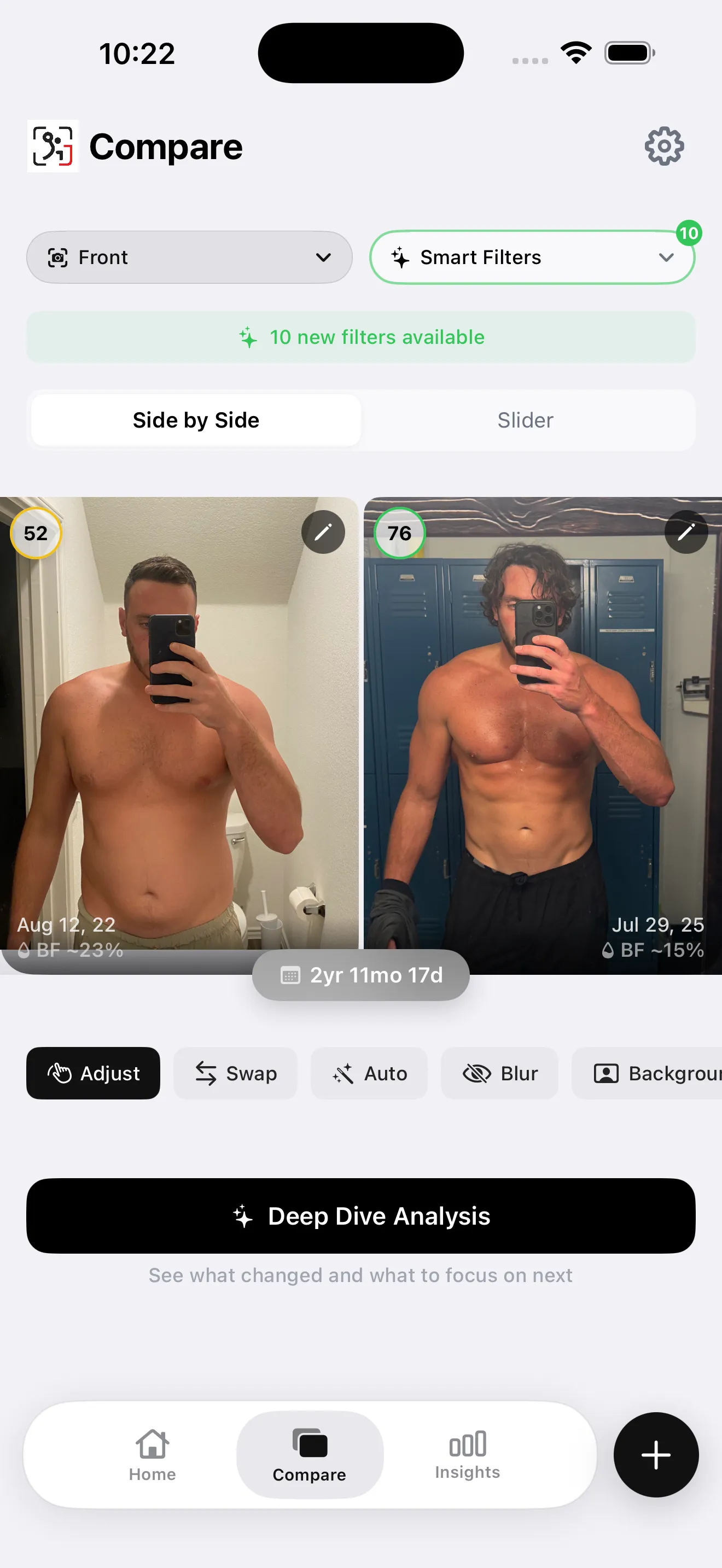
GainFrame's Deep Dive Compare: see exactly what changed between two check-ins — body fat delta, FFMI shift, and muscle group by muscle group.
Who Should Use Spren?
Health-focused general fitness users
If you're tracking body fat for general health reasons — not optimizing muscle development or recomp — Spren's output is sufficient and the scan-based approach feels more clinical than taking a gym selfie.
People who want published accuracy research
If the credential matters to you — peer-reviewed validation against DEXA — Spren has that. It's real research. GainFrame doesn't have a published clinical accuracy study (though we have accuracy articles). If published methodology is the deciding factor for you, Spren has an edge there.
Users who prefer a scan over photos
Some people don't want an app building a photo archive of their body over time. Spren's scan-and-data approach doesn't accumulate progress photos. If that's your preference, it's a genuine differentiator.
Who Should Use GainFrame Instead?
Intermediate to advanced lifters
If you've been training seriously for 1+ years and you're doing a cut, recomp, or lean bulk, you need muscle-group-level data. Knowing your chest went from "Needs Work" to "Developing" over three months is actionable. Knowing body fat went from 16% to 14% is less so when you don't know which muscles contributed.
People doing body recomposition
During recomp, the scale may not move for months. FFMI is the metric that tells you whether muscle is actually accumulating. Spren doesn't calculate FFMI. GainFrame does — in every check-in. See how to track recomp with photos.
Lifters who want a visual record alongside the data
Body composition data without the visual context can be misleading. A photo archive alongside metrics shows you when the body fat drop was real versus when it was a photo angle artifact. GainFrame keeps both together; Spren does not.
The Bottom Line: Spren Review Verdict
Spren: solid science, narrow application
Spren is a well-engineered product with genuine research backing. Its body fat estimates are among the more credible in the consumer space. The subscription cost is reasonable for what it delivers.
The limitation is depth. Spren tells you body fat and lean mass. It doesn't tell you which muscles are developed, what your FFMI is, or what changed specifically between your January scan and your April scan. For a general fitness user, that's fine. For a serious lifter, those gaps are significant.
Spren is the right choice if: you want a quick scan with published accuracy research, you prefer not to build a photo archive, or you're tracking for general health rather than muscle development.
GainFrame is the right choice if: you want FFMI, muscle-group scores, and the visual photo archive alongside the data — the full picture of what's actually changing in your physique.
Try GainFrame Free
Run your first AI analysis — physique score, body fat %, FFMI, and 12 muscle group scores from a single photo. No account required, free to start.
Download GainFrame Free