
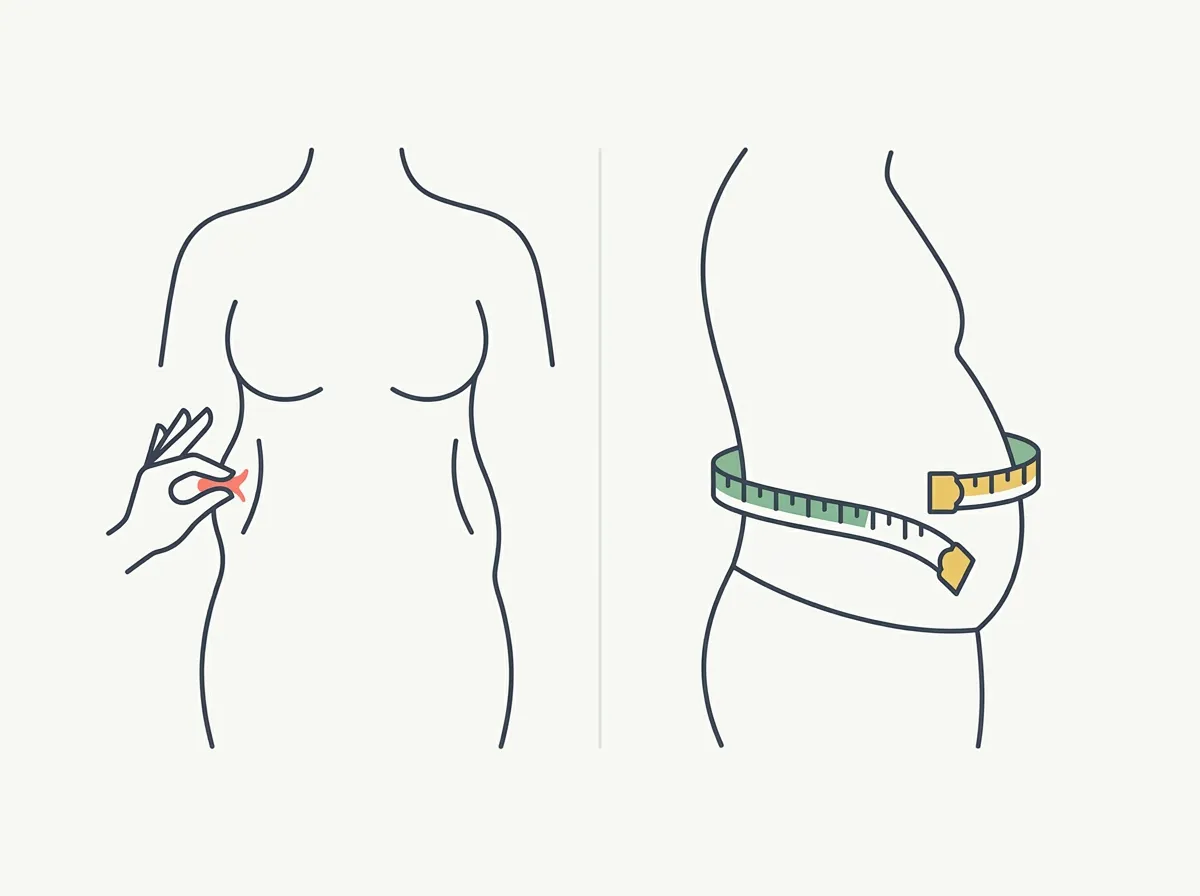
A skinfold pinch and waist measurement are external observations. Neither can measure the fat around your organs.
Quick answer: Visceral fat sits inside the abdomen around internal organs. You cannot identify or measure it from belly shape, firmness, a pinch test, or a progress photo. Waist measurements can help assess central fat and health risk, while clinical assessment and appropriate imaging answer different questions. Photo tracking documents external appearance.
You compare 2 photos and notice your upper belly looks flatter, while the lower part looks much the same. Then you read that a hard belly means visceral fat and start checking how yours feels. Neither observation tells you which fat compartment changed.
The question "what does visceral fat look like?" has an anatomical answer. It is fat inside the abdomen, around internal organs. The shape you see in the mirror combines skin, fat, muscle, posture, and the contents of your abdomen.
Can you identify visceral fat from belly shape or firmness?
You cannot determine an internal fat amount from an upper-belly bulge, a lower-belly pouch, or how easily your abdomen compresses. Subcutaneous fat sits beneath the skin; visceral fat lies deeper around organs. A photograph cannot separate those compartments.
Abdominal muscle tension, distension, and other factors can affect firmness. A soft or lean-looking abdomen also cannot rule out a health concern. Combining several appearance cues does not turn them into a reliable visceral fat test.
A pinch reaches skin and subcutaneous tissue. It cannot tell you how much fat surrounds your organs. Belly firmness and protrusion have multiple causes and should not be used to diagnose visceral fat.
What can each observation actually establish?
Keep the measurement and its meaning together. A waist measurement, a scan result, and a photo answer different questions.
| Observation or method | What it can establish | What it cannot establish |
|---|---|---|
| Tissue you can pinch | You are touching skin and underlying outer tissue | The amount or proportion of visceral fat |
| Waist circumference | Abdominal size for central-adiposity and health-risk screening | An individual visceral fat volume |
| Progress photos | External appearance under the conditions used | How much fat is in either abdominal compartment |
| CT or MRI | Anatomical images that can distinguish internal and outer fat compartments | A complete health assessment from a single fat measurement |
| DXA with compatible VAT software | A software-derived visceral adipose tissue estimate in a defined region | A directly interchangeable result with every other method |
The difference between visceral and subcutaneous fat starts with their location. Neither body shape nor the distribution of visible softness lets you quantify that difference.
What does your waist measurement say about health risk?
Waist circumference is an indirect measure of central adiposity. It can help identify people who may benefit from further assessment, although it cannot isolate the fat around their organs.
NIDDK's adult weight guidance lists waist sizes of 35 inches or more for women and 40 inches or more for men as increasing obesity-related health risk. These are screening values, with interpretation depending on the person and clinical context. They do not diagnose excess visceral fat or mean that every smaller waist carries no risk.
NICE guidance uses waist-to-height ratio alongside BMI to assess central adiposity in adults with BMI below 35. A ratio of 0.5 or more falls into its increased-risk categories. This is still a screening approach; it does not convert your waist into a quantity of internal fat.
If you record your waist, follow a consistent measurement protocol and note where you place the tape. Keep posture and breathing consistent. Bring the readings and your questions to a clinician if you are concerned about what they mean for your health.
Can a DEXA scan or smart scale measure visceral fat?
A DXA scan, also called DEXA, can report regional body composition. Some systems also provide a modeled visceral adipose tissue (VAT) estimate using dedicated software. Total android fat and estimated VAT are different outputs: the android region includes more than the visceral compartment.
A study comparing iDXA with MRI found strong agreement in ranking participants, alongside measurement bias and differences between individual results. Its findings apply to the system and comparison studied. Check the actual field, unit, scanner, and software on your report.
CT and MRI can show anatomical fat compartments. Whether either is useful for you depends on the clinical question, and CT involves radiation. A clinician should help select and interpret imaging; a routine annual scan is not a universal requirement for tracking progress.
A consumer scale's visceral fat rating is another kind of estimate, produced by its own method. If that is the number you are trying to understand, start with what your device's visceral fat level means and its manufacturer guidance. A scale rating is not a CT volume or a DXA VAT result.
Can progress photos reveal internal fat loss?
Photos record external appearance under the conditions used. Lighting, posture, distance, clothing, and abdominal distension can all change how your torso looks. A comparison cannot isolate or quantify either fat compartment.
A flatter upper abdomen or looser trousers may be worth recording, but neither confirms visceral fat loss. An unchanged photo also cannot tell you whether internal fat increased, decreased, or stayed the same. There is no dependable photo-based timetable for which fat depot changes first.
You can compare external changes in consistent photos to keep a visual record. Treat the result as a comparison of appearance, without attaching an internal-fat conclusion to it.
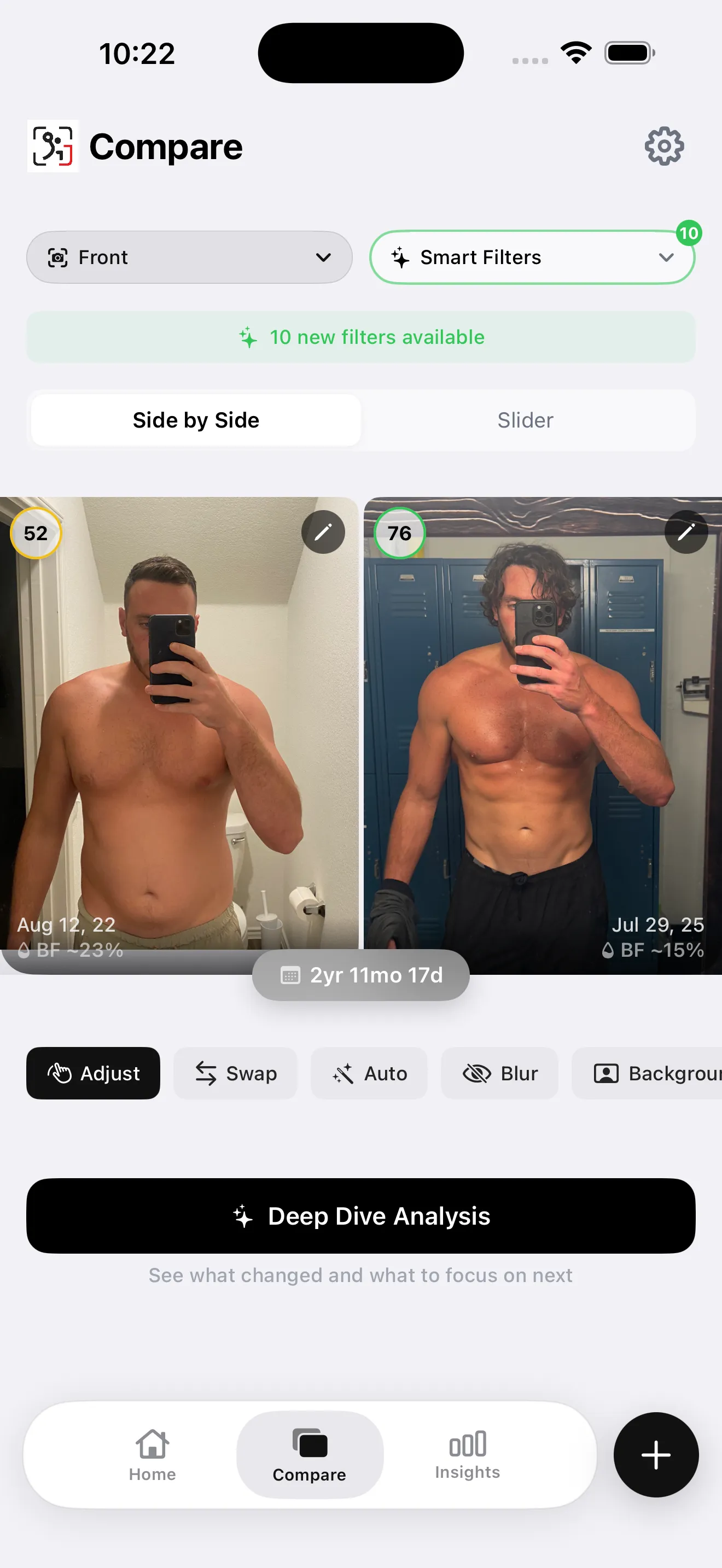
An image comparison shows external appearance. Its estimated body fat values do not measure visceral fat.
GainFrame is an iOS app that organizes progress photos and provides AI estimates from selected images. Those estimates inherit the limitations of the photos and cannot establish a change in fat around your organs.
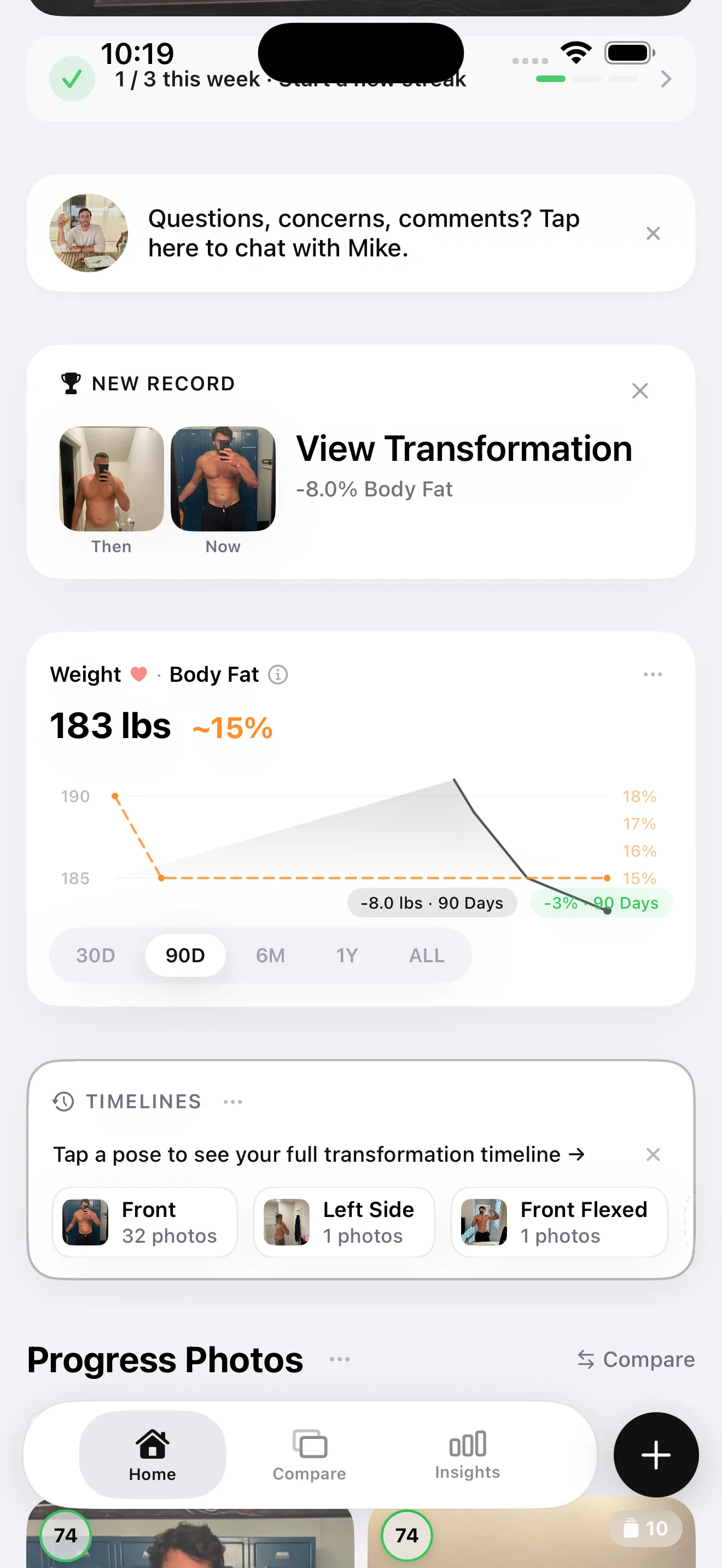
A photo-derived trend is an estimate. A downward line cannot confirm internal fat loss.
How can you keep useful records without overinterpreting them?
Keep the type of evidence beside every entry in your record:
- Waist: use the same tape position and measurement conditions. Record the number as abdominal circumference.
- Photos: match lighting, camera position, clothing, and posture. Describe the visible difference without assigning it to a fat compartment.
- Device readings: record the device, unit, and conditions. Flag any change in equipment or software.
- Clinical results: keep the original report and discuss its interpretation with the clinician who requested it.
If your concern is metabolic health, a clinician can assess your history and other findings alongside these records. Home observations can support that conversation without establishing a diagnosis.
What else should you know about visceral fat?
Can you see visceral fat?
You cannot see visceral fat through your skin or in an ordinary photograph. It sits inside the abdomen around internal organs. Your silhouette reflects several tissues and the conditions of the image. Clinical imaging can distinguish internal compartments, while waist measurements contribute to a broader assessment of health risk.
Does a hard belly mean visceral fat?
A hard or protruding belly does not establish how much visceral fat you have. Firmness can reflect abdominal muscle tension, distension, and other factors. Feeling your abdomen cannot separate those causes or measure fat around organs. Discuss persistent changes or concerns with a clinician rather than interpreting texture as a diagnosis.
Does pinching belly fat reveal visceral fat?
A pinch reaches skin and the subcutaneous tissue beneath it. It cannot reach the deeper fat around your organs or tell you the proportion stored there. The amount you can pinch also does not establish your overall health risk. Both fat compartments can be present regardless of how a skinfold feels.
Can waist size measure visceral fat?
Waist circumference measures the outside of your abdomen and helps screen for central adiposity and related health risks. It includes more than visceral fat, so it cannot provide a specific internal fat amount. Use a repeatable measurement method and discuss interpretation with a clinician who can consider your circumstances and other findings.
Can progress photos track visceral fat?
Progress photos record external appearance and cannot measure the fat around your organs. A flatter-looking waist, looser clothing, or a falling photo-based body fat estimate cannot confirm visceral fat loss. Consistent photos can document visible changes, while decisions about internal fat or metabolic health need an appropriate clinical assessment.