
Quick answer: AI can estimate body fat from a photo by assessing visible muscle definition and fat distribution. Lighting, pose, clothing, and the model affect the result. Use a consistent setup, interpret the percentage as an estimate, and compare repeated photos alongside other measurements rather than treating one scan as a precise measurement.
A body fat from photo AI engine doesn't care if you just had a salty meal. It processes pixels. It looks for the visual boundaries of muscle groupings. It detects the presence (or absence) of subcutaneous fat blunting the separation between your deltoid and your tricep. It evaluates the depth of your abdominal lines.
When you use a photo to calculate body fat, you are measuring the actual, physical result of your hard work, the aesthetic reality of your physique. (If you want to test the method right now without installing an app, our free AI body fat estimator tool runs one scan per day in your browser.)
The "Body Fat from Photo" AI Process
It's not magic; it's trained computer vision. When you upload a gym selfie into a dedicated body transformation app, the AI performs a structured analysis:
- Feature Extraction: The AI maps your body, identifying major muscle groups (chest, shoulders, arms, abdominals, back, and legs).
- Subcutaneous Fat Analysis: It specifically analyzes regions where humans naturally store stubborn fat (the lower abdomen, lower back, and hips) to gauge the smoothing effect over the underlying muscle.
- Definition Scoring: The engine scores the depth and clarity of muscle separation. For example, the visibility of the serratus anterior or the separation in the quadriceps are key indicators of sub-12% body fat in men.
- Score Generation: These visual markers are synthesized into a comprehensive Physique Score and an estimated body fat classification.
Body Fat Percentage Calculator by Photo: How to do it right
A body fat from picture AI is a powerful tool, but its accuracy depends entirely on the data you feed it. GIGO, Garbage In, Garbage Out. To get the most accurate and consistent body fat estimation from your photos, you must standardize your process.
Lock in your lighting
Harsh overhead lighting creates deep shadows that artificially enhance muscle definition. Flat, soft lighting washes you out. Pick one mirror with consistent lighting and use it every time.
Use Ghost Overlay
Apps like GainFrame offer a ghost camera overlay of your previous physique photo. This ensures your distance from the mirror, phone angle, and posture are identical week over week.
Pro Tip for reliable AI Scans: The AI needs skin to analyze body composition. Taking a photo in an oversized hoodie won't yield a body fat estimate. Strip down to the same level of clothing (e.g., just shorts, or a sports bra and leggings) for every single progress photo.
How accurate is body fat from a photo?
Accurate enough to trust the trend, not accurate enough to obsess over a single decimal. A 2025 peer-reviewed study in npj Digital Medicine tested AI 2D-photo body fat estimation against DEXA across 1,273 adults and found a Concordance Correlation Coefficient of 0.98, higher agreement than the bioelectrical-impedance smart scales most people own (which typically land at 0.91 to 0.92).
The honest caveat: a single photo still carries roughly ±4 to 5% absolute error versus DEXA, and lighting, posture, and clothing all move the number. That's why photo estimation shines as a tracking tool, same setup, same time of day, same wardrobe, rather than a one-shot diagnostic. Multi-angle models that combine a front and side photo cut that single-photo error roughly in half. We break down the full methodology, the study data, and where it breaks down in our AI body fat photo accuracy study.
Photo vs. the other ways to measure body fat
No consumer method matches a DEXA scan for a one-time absolute number. But "most accurate single reading" and "best for tracking progress" are different questions, and the method you'll actually use consistently usually wins.
| Method | Single-reading accuracy | Best for | Friction |
|---|---|---|---|
| AI photo | ±4 to 5% (single shot) | Tracking the trend | Very low, one selfie |
| Smart scale (BIA) | ±3 to 5%, swings daily | Daily weight, not composition | Low |
| Calipers | ±3 to 4% (skilled) | Manual spot-checks | Medium, technique-dependent |
| Navy tape method | ~±3% | A no-AI number | Medium, neck/waist/hip |
| DEXA scan | Gold standard | A calibrated baseline | High, ~$150, in person |
For a full ranking of every method, see every way to measure body fat, and if you're chasing the gold-standard number on a budget, our DEXA scan alternatives guide covers the closest substitutes. Prefer a formula over AI? The body fat calculator from a photo breakdown compares the calculator approach head-to-head.
Tracking the trend, not just the number
A common trap is obsessing over the absolute number. Whether the AI says you are at 13.5% or 14.2% body fat today is less important than the trajectory of that number over time.
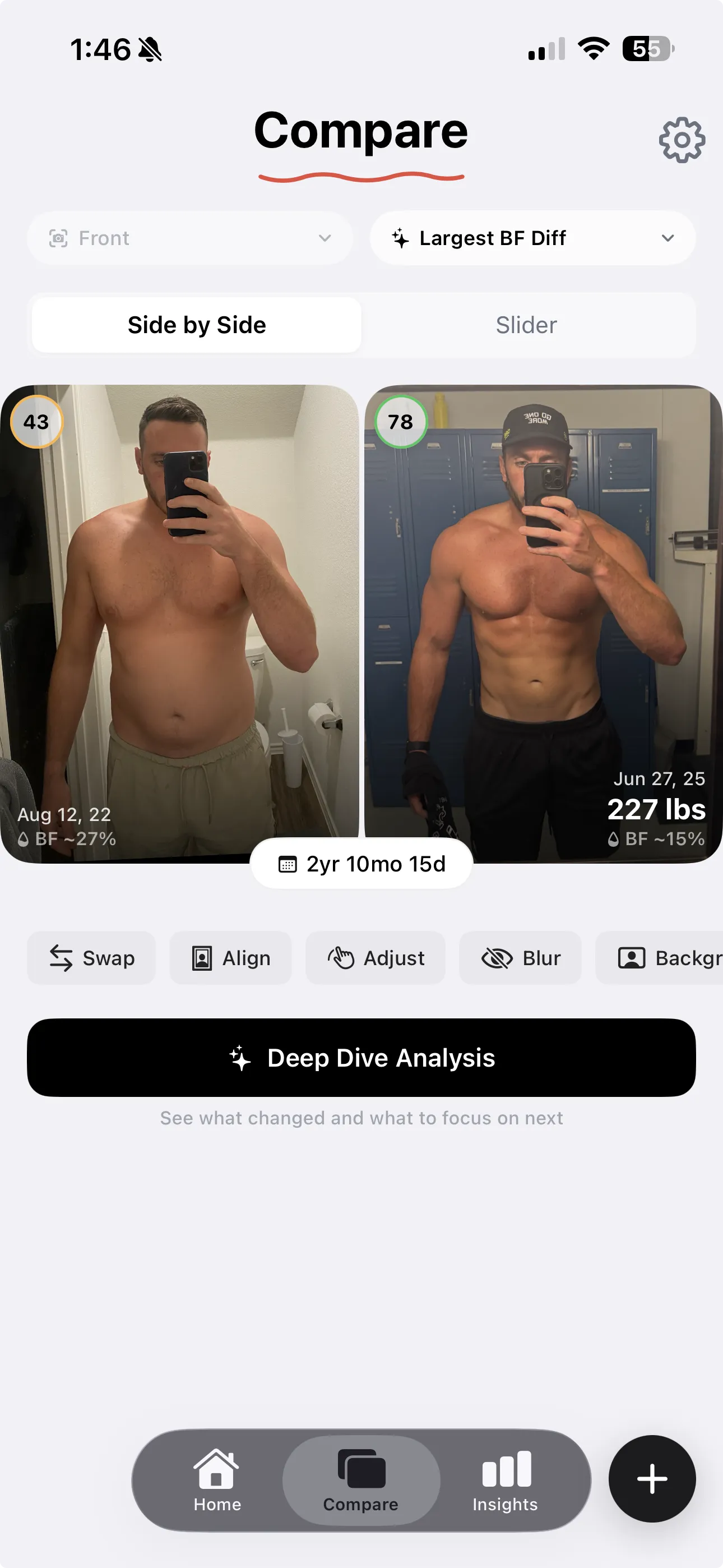
The true power of a body fat from photo app is unlocking an objective, long-term timeline of your body transformation. When you can literally see the visual differences perfectly aligned side-by-side, augmented by an AI body fat analysis that confirms the downward trend, you gain absolute certainty that your diet and training are working.
You stop relying on the unpredictable daily swings of a smart scale, and you start trusting what actually matters: the undeniable visual proof of your progress.
Try it free, then track it for real
The fastest way to understand photo-based estimation is to run one. Our free AI body fat estimator gives you a directional number from a single photo, right in the browser, no signup. When you're ready to track the trend, multi-angle Precision BF, a GainFrame Score, FFMI, a 12-area muscle map, and side-by-side comparisons after every check-in, GainFrame on iOS does it on a free tier.
What else should you know?
Can AI calculate body fat from a photo?
AI can produce an estimate from visible body shape and muscle definition. The result depends on the model, the photo, and how consistently you take it. A study of one method does not validate every app using photos. Use the estimate as one observation alongside weight, measurements, and a consistent photo history.
How accurate is calculating body fat from a photo?
There is no single accuracy figure that applies to every photo estimator. Lighting, pose, clothing, image quality, and the model can all affect the number. Keep your setup consistent and treat small changes cautiously. Published results for a specific research system should not be assumed to describe a different consumer app.
Is there a free way to calculate body fat from a photo?
The browser estimator linked in this guide lets you try a photo estimate without signing up. Follow the current usage limits shown by the tool. Choose a clear image with your torso and limbs visible, read the result as an estimate, and retain consistent conditions if you compare later photos.
Is a photo estimate better than a smart scale for tracking?
Both methods have sources of variation. Smart-scale estimates can change with hydration and measurement conditions; photos can change with lighting, pose, clothing, and the model. Neither method has universal superiority for an individual. Choose a repeatable setup and compare its trend with other observations instead of switching methods between check-ins.
What photo gives the most accurate estimate?
Use a clear photo with consistent lighting, distance, pose, and clothing, and make the relevant body regions visible. Avoid strong shadows or clothing that hides body shape. Repeat the same setup when comparing check-ins. Consistency helps interpretation, but it does not guarantee that the estimated body-fat percentage is accurate.
More on measuring body fat from a photo
- 5 Best AI Body Fat Estimator Apps in 2026 (Tested & Ranked)
- AI Body Fat From Photos: 0.98 CCC vs DEXA (Accuracy Study)
- Best Body Fat Calculator From a Photo
- Every Way to Measure Body Fat, Ranked
- DEXA Scan Alternatives for Body Composition
- The Science of the Before and After
- 5 Tips for Better Progress Photos