
Quick answer: The best DEXA alternative depends on what you need to track. BIA, air displacement and underwater weighing estimate body composition; skinfolds, tape measurements and photos provide different kinds of progress records. None should replace a clinician-requested bone-density assessment. Compare methods by their outputs, repeatability, access and ongoing cost.
If you want to know whether your waist is changing, you do not necessarily need the same test as someone assessing bone health. Start with the question, then choose the measurement.
This guide concerns fitness tracking. For a scan requested to assess bone density, ask the referring clinician about appropriate options. RadiologyInfo, published by radiology professional societies, explains the clinical role of DXA bone densitometry.
Which DEXA alternative fits your goal?
| Method | What it provides | Practical advantage | Main limitation | Cost to compare |
|---|---|---|---|---|
| Bioelectrical impedance (BIA) | Model-based body-composition estimates from impedance and other inputs | Home or facility options | Device, equation and measurement conditions affect the result | Hardware, app plan or visit fee |
| Air displacement, such as Bod Pod | Body-volume-based composition estimate | A facility assessment without submersion | Preparation and model assumptions matter | Local assessment fee |
| Hydrostatic weighing | Body-density-based composition estimate | An established laboratory method | Submersion, breathing procedure and facility access | Local assessment fee |
| Skinfold assessment | Thickness at selected sites, sometimes used in an equation | Portable and repeatable with skilled technique | Assessor, sites and equation influence interpretation | Assessor time and equipment |
| Tape measurements or body-shape scans | Circumferences or shape measurements | Directly addresses changes in dimensions | Does not directly identify the tissue behind a change | Tape, scan fee or subscription |
| Standardized photos or photo AI | Visual record; an AI model may add estimates | Easy to revisit and compare | Pose, lighting and model limitations; no bone-density measurement | Existing camera or app plan |
We do not assign universal error margins or a cheapest-price winner. A category name alone does not identify a device's validation, an assessor's technique or the current local quote.
What does DEXA measure that these alternatives do not?
DXA uses X-ray attenuation to estimate tissue compartments and can provide regional composition information. A lean-mass field is not a direct measurement of skeletal muscle alone. A body-composition scan and a clinically interpreted bone-density exam also serve different purposes.
A review of body-composition assessment methods explains how laboratory and field techniques differ. Their outputs are not interchangeable just because several report a body-fat percentage. For report terminology, see how to read a DEXA body-composition result.
Ask the facility which outputs its service includes. If you need a clinical interpretation, establish that before booking a fitness-oriented assessment. Our BodySpec review gives a provider-specific checklist.
When is BIA a practical alternative?
A compatible home scale can make regular measurements convenient. Facility devices may use different electrode configurations, frequencies and equations. The method estimates composition; it does not directly separate and weigh fat and muscle.
Hydration and measurement conditions can affect impedance-based results. Follow the device's preparation instructions and keep the same device when reviewing a trend. A review of body-composition methods in sports practice discusses these limitations and the importance of standardized assessment.
For an iPhone workflow, our third-party scale-app guide explains how to verify body-fat records in Apple Health before choosing another dashboard. A different chart does not independently validate the measurement underneath it.
When should you consider Bod Pod or underwater weighing?
Both use body density as part of estimating composition, but obtain body-volume information differently. Air displacement uses a chamber; hydrostatic weighing uses an underwater procedure. They require access to a suitable facility and an assessment you can complete according to its instructions.
Ask what preparation is required, who performs the assessment, which model produces the result and how the service handles repeat measurements. Do not assume either method will agree exactly with a previous DXA value. The assessment-methods review describes the different approaches and their roles.
Choose a facility method if its output answers a question you cannot answer adequately with simpler tracking. Convenience only helps if you can repeat the process under comparable conditions.
For the chamber-based option, our BOD POD versus a DEXA scan guide explains the whole-body density estimate, regional-report differences and evidence limits.
When are skinfolds, tape measurements or body scans enough?
If the question is whether a circumference or body shape changed, record that directly. A tape requires consistent landmarks and tension. A scan requires its own capture protocol. Skinfold assessment requires a trained technique and clearly identified sites; any derived percentage also depends on the selected equation.
Avoid converting every measurement into a claim about exact muscle gain. A smaller waist or a changed arm circumference can be useful information without pretending it isolates a single tissue. Use our body-measurement guide for a practical starting point and the coaching-platform comparison for scan and report workflows.
Can photos or AI replace a DEXA scan?
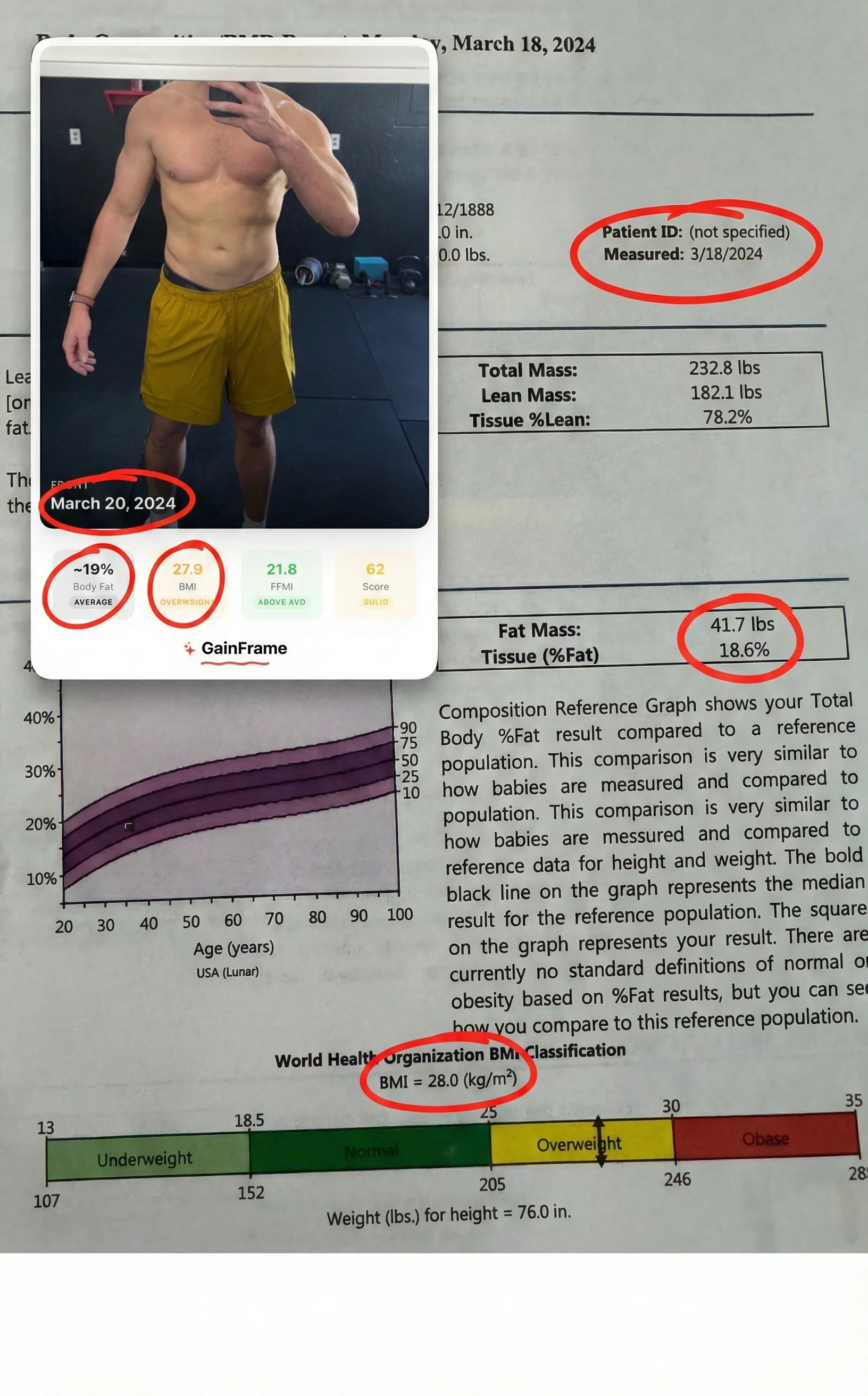
Photos answer a visual-progress question. They cannot directly measure bone density or the amount of fat around internal organs. A photo AI result adds a model's estimate, with uncertainty from both the image and the model. One result close to a DXA scan is not proof of general accuracy across people.
GainFrame organizes photos and provides visual estimates for fitness tracking. The author is its founder. Treat the analysis as an estimate alongside your records, not as a clinically equivalent replacement for DXA. You can try the browser body-fat estimator with the same limitation in mind.
How should you compare cost and accuracy before choosing?
Request the current price for the service you would actually repeat. Include device purchases, required subscriptions, travel and any report review. A free app download does not establish that all ongoing measurements or exports are free.
For accuracy, ask which population and reference method were used in validation. For repeatability, ask how much variation occurs when the same person repeats the measurement under similar conditions. Those are different questions: a consistent estimate can still differ from a reference method.
Keep a dated record of the method, device and preparation. If you change systems, mark the transition and establish a new baseline rather than interpreting the difference between devices as a change in your body.
What else should you know?
What is the best alternative to a DEXA scan?
Choose by the question you need answered. A facility method may suit a periodic body-composition assessment, while consistent measurements and photos can document routine fitness progress. Compare the specific device or service, its limitations and repeatability. A clinician-requested bone-density assessment requires a separate conversation with the referring professional.
Are smart scales as accurate as DEXA?
A smart scale uses a different measurement method and model, so its body-fat estimate should not be assumed equivalent to a DXA result. Accuracy depends on the particular device, population and protocol. Keep measurement conditions consistent and avoid interpreting a difference between methods as an actual change in body composition.
Can AI photo analysis replace clinical body-composition testing?
Photo analysis can add a visual estimate to fitness tracking, but it cannot directly measure bone density or internal fat compartments. A favorable comparison in one person does not validate general clinical accuracy. Choose clinical assessment when that information is needed, and describe photo results as estimates.
Is Bod Pod better than underwater weighing?
Neither is universally better for every person and purpose. They use different procedures to obtain body-volume information and both rely on assumptions when estimating composition. Compare local access, preparation, your ability to complete the procedure and the quality of repeat assessment before choosing a facility.
How often should you measure body composition?
Use a cadence that fits the method and the decision you need to make. Repeating a noisy measurement more often does not automatically make it informative. Keep the setup comparable and review change over time, with the device or facility helping you understand how much variation its method can produce.