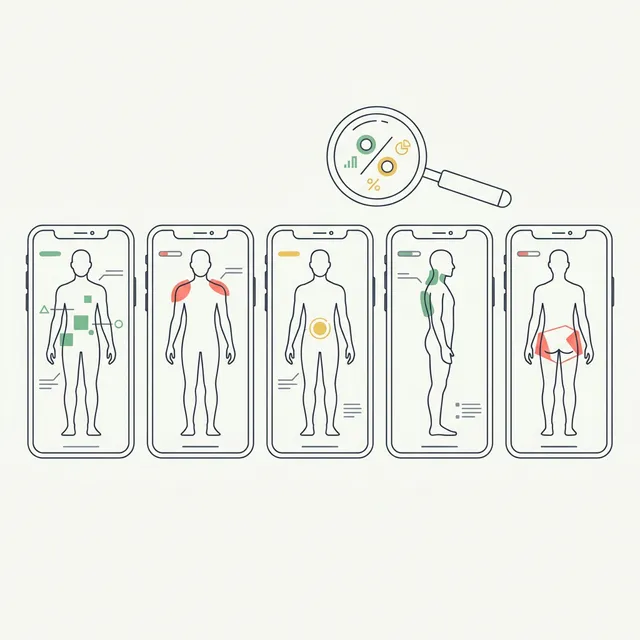
When you search for an AI body scan or AI body composition app, you're probably not looking for a one-shot body fat estimate. You want the full picture: lean mass, fat mass, how your muscles are developing relative to each other, your FFMI, and whether the trend is moving in the right direction over months.
That's a different category than a quick BF% estimator — and most of the apps marketed as AI body scanners don't actually deliver all of it. This comparison covers every app worth evaluating, tells you exactly what each one measures and what it leaves out, and gives you a straight answer on which tool fits which situation.
Filtered out up front: photo-editing apps that put AI filters on your body, weight-loss apps that use "AI" to log meals, and anything that calls itself body composition but only outputs a single number with no context.
What is an AI body scan?
An AI body scan uses your phone's camera to estimate body composition (body fat %, lean mass, muscle group development) from one or more photos. The "AI" is a vision model trained on thousands of bodies paired with DEXA or hydrostatic measurements, so the model learns to map visual features to actual tissue composition. There's no hardware, no electrical current, no rotating scanner — just a photo and a model.
An AI body scan is different from a smart scale, which uses BIA (bioelectrical impedance) — sending a low-level current through your body and estimating fat from resistance. BIA is heavily affected by hydration: drink a glass of water, eat a salty meal, or sweat through a workout and the same scale will give you a different reading hours apart. AI body scans use visual markers — muscle definition, fat distribution, body proportions — that don't change between morning and night.
An AI body scan is also different from a 3D body scan (ZOZOFIT, Naked Labs), which measures shape and circumferences but not the ratio of fat to lean mass. A 3D scan tells you how your body is shaped; an AI body scan tells you what it's made of. The best AI body scan apps validate against DEXA — the medical-grade reference standard. Apps that don't share validation data are guessing.
What "AI body composition" actually means
The phrase gets applied to four very different approaches. Understanding the difference matters because each one has a different accuracy ceiling and different blind spots.
Photo analysis. AI trained on thousands of physique images estimates body fat and muscle development from visual cues — muscle separation, subcutaneous fat visibility, proportions, and shadow patterns. This is what GainFrame and Spren use. Accuracy depends heavily on photo quality and lighting. The advantage is zero friction and zero cost — you take a photo and get a reading. The disadvantage is that the AI is estimating from appearance, not measuring tissue directly.
3D scanning. Apps like ZOZOFIT use your phone camera to build a 3D model of your body, measuring circumferences and body shape. This is not body composition in the tissue-analysis sense — it tells you how your body is shaped and how measurements are changing, not the ratio of fat to lean mass. Accurate for shape tracking, limited for fat/lean mass ratios.
Bioelectrical impedance (BIA). Smart scales and gym machines send an electrical current through your body and estimate fat mass based on resistance. The output looks like body composition data, but readings fluctuate 3–5% based on hydration alone. BIA is not AI, despite how some scales market themselves. Including it here as a contrast to what actual AI analysis offers.
DEXA-based tracking. DEXA (dual-energy X-ray absorptiometry) is the clinical gold standard. It directly measures fat mass, lean mass, and bone density by region. It's not an app — it's a medical scan that costs $100–$200 per session. Some apps exist to track DEXA results over time.
When someone searches "AI body composition app," they want photo or 3D-based analysis — not BIA. Here's how the real options stack up.
What metrics actually matter for body composition
A body composition app that only gives you body fat percentage is giving you one variable out of five you need to make informed training decisions.
Body fat %. The baseline. Tells you what fraction of your weight is fat mass. Useful for categorizing your current state (lean, athletic, average, high), but by itself it doesn't tell you whether you're making progress unless you're tracking it over time.
Lean mass. Everything that isn't fat — muscle, bone, water, organs. Lean mass is the metric that tells you whether you're gaining muscle during a bulk or losing it during a cut. Body fat % alone doesn't capture this. You can lose 5 lbs and gain lean mass if the weight lost is fat — your body fat % improves, but the lean mass increase is the real win.
FFMI (Fat-Free Mass Index). Lean mass normalized to height. This is the number that tells you where you stand relative to natural muscular potential. An FFMI of 20 means something different at 5'8" vs 6'2". For anyone serious about building muscle, FFMI is the most useful single-number indicator of muscle development.
Muscle group breakdown. A high-level body fat number doesn't tell you that your chest is underdeveloped relative to your back, or that your shoulders are the weak link in your upper-body aesthetic. Muscle group scoring gives you actionable information about where to focus — not just whether you're improving, but where.
Longitudinal trends. A single reading is a point. Multiple readings over weeks and months are a trend. The trend is where all the useful information lives. Which direction are you moving? How fast? Did the cut come at the cost of lean mass? Did the bulk add muscle or mostly fat? You can't answer these questions without time-series data.
The apps, ranked
1. GainFrame — $0, iOS
What it measures: Body fat %, lean mass, FFMI, composite physique score (0–100), individual scores for 12 muscle groups, longitudinal trends across all metrics
Method: AI photo analysis (Google Gemini)
DEXA validation: Within 0.4% on published comparison
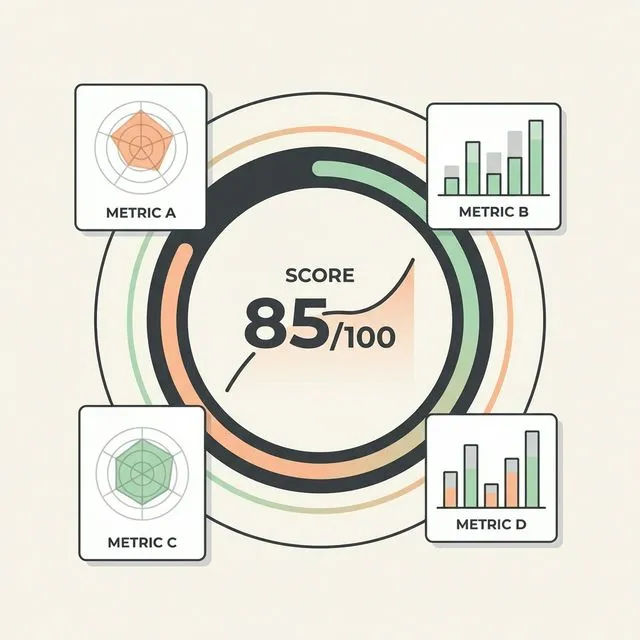
GainFrame is the most complete body composition picture you can get without paying for hardware or a clinical scan. Every photo produces a full Deep Dive: body fat percentage, FFMI, lean mass estimate, and individual scores for chest, shoulders, back, arms, abs, legs, and glutes — 12 groups total. The longitudinal dashboard tracks each of these metrics over time, so you can see exactly how your composition is trending week over week.
The muscle group breakdown is the feature that separates GainFrame from everything else in the free tier. Most photo-based tools give you a BF% and stop there. GainFrame tells you which muscle groups are scoring above average for your body fat level and which are lagging — which changes the conversation from "am I lean enough?" to "where should I actually be training harder?"
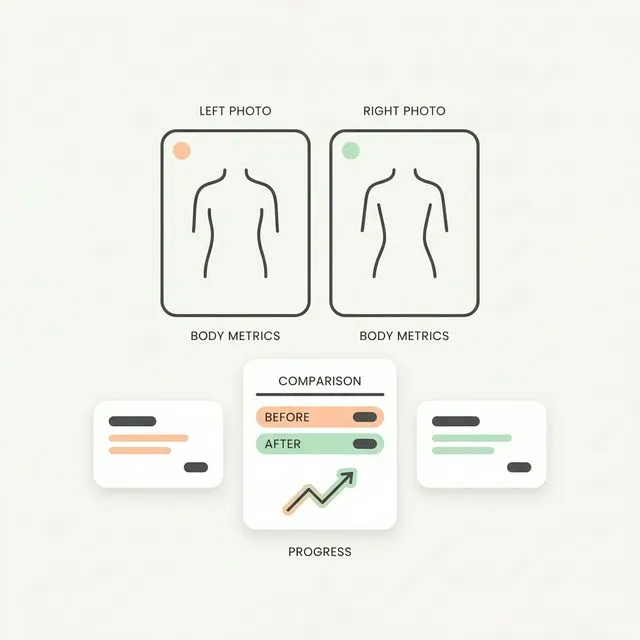
The comparison view quantifies exactly what changed between any two check-ins: body fat delta, FFMI delta, which muscle groups improved, which didn't. This is the longitudinal tracking that makes body composition data actually useful for decision-making.
On accuracy: a published side-by-side with a clinical DEXA scan showed GainFrame's AI within 0.4% on body fat percentage. For a free photo-based tool, that margin is competitive with most bioimpedance devices that cost hundreds of dollars.
Where GainFrame doesn't win: It's iOS only. It doesn't produce circumference measurements or 3D body models — if you specifically need shape data (waist, hip, arm measurements), a tool like ZOZOFIT does that better. And like all photo-based AI, readings are estimates from visual patterns, not direct tissue measurement.
Best for: Anyone who wants the most complete AI body scan and body composition analysis available at zero cost — body fat, lean mass, FFMI, muscle group breakdown, and longitudinal tracking in one free app.
2. Spren — Subscription, iOS/Android
What it measures: Body fat %, estimated VO2max, body composition metrics from front/back photo scan
Method: Front and back photo AI analysis in form-fitting clothing
Spren takes a more clinical approach than GainFrame. The scan protocol is more structured — front and back photos in specific lighting and clothing conditions, rather than a casual progress photo. The output includes body fat percentage and some additional cardiovascular metrics like VO2max estimation.
Spren is designed for periodic assessments rather than daily tracking. Think of it as a quarterly check-in tool rather than something you use every week. The interface reflects this — it's optimized for the structured scan session, not for building a daily habit.
The subscription model is the main friction point. For periodic assessments, paying monthly doesn't match the usage pattern most people have with it. Spren works well in clinical or coaching contexts where someone else is running the assessments — less well as a self-directed daily tool.
Spren does not offer muscle group breakdown. The output is composition-level — fat vs. lean mass — without the granular muscle area scoring that GainFrame provides. For someone primarily interested in whether they're gaining or losing fat, that's probably fine. For someone who wants to know how their physique is developing across specific muscle groups, it's a significant gap.
Best for: Structured, periodic body composition assessments in a coaching or clinical workflow. Cross-platform users (Android included).
3. trackBod — Subscription
What it measures: Body fat % estimate, before/after photo comparison
Method: Photo-based AI analysis
trackBod is focused on progress photo tracking and visual comparison rather than deep composition analysis. It estimates body fat percentage from photos and lets you build a timeline of your physique changes. The interface is clean and the workflow is straightforward.
What trackBod doesn't have: muscle group breakdown, FFMI calculation, lean mass tracking, or the depth of composition data that GainFrame and Spren provide. It's a progress photo app with a BF% estimator layered on top — useful for documenting a transformation, less useful for making data-driven training decisions.
The subscription model is harder to justify here than for tools with deeper analysis. If you're paying monthly for a body composition app, you should be getting more than a before/after comparison and a body fat estimate.
Best for: People who primarily want a clean visual record of their transformation and a rough BF% check-in, without needing FFMI or muscle group data.
4. ZOZOFIT — $80/yr (suit + app), iOS/Android
What it measures: 3D body shape, circumference measurements (waist, hips, chest, arms, thighs), body fat estimate derived from circumferences
Method: 3D body scan via phone camera + physical dot-marker suit
ZOZOFIT solves a different problem than photo-based AI tools. Where GainFrame tells you the ratio of fat to lean mass in your body, ZOZOFIT tells you how your body is shaped and how those measurements are changing over time. That's a genuinely different and valuable data type.
The circumference measurements are where ZOZOFIT excels. If you're tracking waist size during a cut, arm development during a bulk, or hip-to-waist ratio as a physique metric, ZOZOFIT's dot-marker approach produces reliable numbers that you can track month over month. The 3D model visualization is compelling — you can see where your body is changing in ways that a flat photo can obscure.
The body fat percentage ZOZOFIT outputs is derived from circumference measurements using population-based formulas. This is not the same as photo-based AI analysis or DEXA. It's a reasonable estimate, but the headline value of ZOZOFIT is the shape data, not the BF% number.
The setup friction is real. You need the physical suit, the scan takes several minutes in a specific environment, and the process isn't something you do daily. Monthly scanning is realistic; weekly is a stretch for most people.
Best for: Shape tracking — circumference measurements, 3D visualization, and how your body is changing in specific areas. Not a substitute for composition analysis on fat vs. lean mass ratios.
5. Naked Labs 3D Scanner — $1,400+ hardware
What it measures: 3D body shape, circumferences, weight, body fat estimate from 3D model
Method: Dedicated 3D scanning hardware (rotating scale + sensor array)
Naked Labs makes the most accurate body shape scanner you can buy for home or gym use. The hardware consists of a scale platform that rotates you through a full 360-degree scan while a sensor tower captures your shape. The result is the most detailed 3D body model available outside a clinical setting.
The accuracy on shape and circumference data is genuinely excellent — better than ZOZOFIT for the precision of individual measurements and smoother as a 3D model. If a gym wanted to offer members the best possible body tracking tool short of a DEXA machine, this would be the recommendation.
The price is the obvious barrier. At $1,400+ for the hardware, this is a gym installation or a serious physique competitor purchase, not a personal fitness tool for most people. It doesn't belong in the same category as app-based tools for the vast majority of users.
Best for: Gym owners looking to offer a premium body scanning service, or physique athletes who want the most accurate shape data available outside a clinical environment.
6. Smart scales (Withings, Renpho) — $30–$150 hardware
What they measure: Weight, estimated body fat % via BIA (bioelectrical impedance analysis)
Method: Not AI — single-frequency electrical current through your feet
Smart scales are included here specifically to address a misconception: several brands market their scales as "AI-powered body composition" tools. They are not. BIA is a four-decade-old measurement method, and the AI branding in most cases refers to the app's trend analytics, not the body composition measurement itself.
The fundamental problem with BIA-based body fat readings is that they measure electrical resistance, and electrical resistance in your body is primarily determined by your hydration level. Drink a glass of water before stepping on the scale: your body fat reads lower. Eat a salty meal: it reads higher. Sweat during a workout: different number again. The same person can legitimately get readings of 18% and 24% on the same scale on the same day.
Smart scales are useful for one thing: weight trend tracking. Daily weigh-ins logged over weeks produce useful data about weight direction. The body fat percentage number should be ignored for absolute measurement purposes — it's not comparable across sessions in ways that allow reliable trend analysis.
Best for: Weight tracking. Nothing else.
Comparison table
| App | Price | BF% Accuracy | Muscle Breakdown | Longitudinal Tracking | Best For |
|---|---|---|---|---|---|
| GainFrame | Free (iOS) | DEXA-validated, ±0.4% | 12 muscle groups | Full timeline + comparison | Full AI composition at $0 |
| Spren | Subscription | Good, no published validation | No | Session-based | Clinical/coaching workflow |
| trackBod | Subscription | Basic estimate | No | Before/after only | Simple visual progress |
| ZOZOFIT | $80/yr + suit | Circumference-derived | No | Shape measurements | 3D shape + circumferences |
| Naked Labs | $1,400+ hardware | Best 3D shape accuracy | No | Shape measurements | Gym installation |
| Smart Scales | $30–$150 | Unreliable (±3–5%) | No | Weight only | Weight trend tracking |
Who should use what
Budget ($0) and want full composition data: GainFrame. Body fat %, lean mass, FFMI, muscle group breakdown by area, longitudinal trends — all free on iOS. There's no other tool at this price that gives you all five of the metrics that matter for body composition tracking.
Need Android support or a structured clinical workflow: Spren. The front/back scan protocol is more rigorous than a casual progress photo, the VO2max estimation adds a performance layer, and it runs on Android where GainFrame currently doesn't. You're trading depth of muscle analysis for cross-platform availability and a more clinical assessment format.
Primarily want shape and circumference data: ZOZOFIT. If your goal is tracking waist size during a cut, arm development during a bulk, or the visual shape of your physique in 3D, ZOZOFIT's circumference measurements are the right tool. It doesn't give you fat vs. lean mass ratios the way AI photo analysis does, but it tracks something different that has real value — how your body is physically shaped and how that's changing.
Running a gym or training serious physique athletes: Naked Labs. The hardware cost puts it out of reach for personal use, but for a gym looking to offer the best possible body scanning service, the accuracy and visual quality of a Naked Labs scan is the premium option.
Want to track DEXA results: Get a DEXA scan first, then use an app like FitTrace to log results over time. DEXA is still the gold standard for absolute accuracy on fat mass, lean mass, and bone density — if you can afford quarterly scans ($100–$200 each), the data quality is unmatched.
Currently using a smart scale for body fat: Stop using it for BF%. Keep using it for weight tracking. Add GainFrame or ZOZOFIT for the composition data.
The Most Complete AI Body Composition App — Free on iPhone
GainFrame gives you body fat %, lean mass, FFMI, and individual scores for 12 muscle groups after every check-in. Longitudinal tracking shows your trends over time. DEXA-validated accuracy. No account required, no photos stored on a server.
Download GainFrame Free