
Quick answer: AI fitness apps split into two camps. Planners like Fitbod, GymStreak, and Freeletics write your routine. Trackers like GainFrame measure whether it worked, estimating body fat, FFMI, and muscle development from photos. Most lifters end up stacking one from each camp, since few apps do both well.
If you searched "best AI fitness app" this year, you got a list of workout planners. Fitbod, FitnessAI, Freeletics, GymStreak, Ray — apps that use AI to write your next workout based on what you lifted last week. They're good at that. They are not what this article is about.
This is the other camp: AI fitness apps that scan your body and tell you whether your routine is actually working. Body composition. Muscle development. Symmetry. Posture. Per-muscle-group scoring. The stuff a smart scale can't tell you and a workout planner doesn't track.
Most lifters end up needing one app from each camp. The planner tells you what to do today. The body tracker tells you whether the last 12 weeks of doing it actually moved the needle. This list covers the seven body-tracking AI fitness apps worth installing — ranked honestly, with external links so you can evaluate each one yourself.
The AI fitness app split
The "AI fitness" category has bifurcated. It's worth understanding the split before you pick anything, because most people install a planner and think they're done — and then have no data on whether their physique is actually changing.
Camp 1: Workout planners. Fitbod, FitnessAI, Freeletics, Ray, GymStreak, Flex AI. These apps use AI to generate your routine based on goals, equipment, and lifting history. Some adapt week-to-week based on what you completed and how hard it felt. They're legitimately useful — especially for people who don't want to design their own program. But they don't tell you anything about your body composition. They track lifts, not muscle gain.
Camp 2: Body trackers. GainFrame, Thelo, Zing Coach, trackBod, TrueForm AI, FitnessAI BodyScan, ZOZOFIT. These apps scan your body — through photos, video, or 3D capture — and produce composition data: body fat %, lean mass, muscle group scores, circumferences. They tell you whether the work is working.
Workout planners and body trackers solve different problems. Both camps have legitimate apps. The mistake most people make is owning a planner and assuming that covers them — then six months later wondering why they don't know if they actually gained muscle or just got better at the bench press.
Why "AI" matters in body tracking
It's worth being precise about what AI actually adds to body tracking, because the term gets thrown on everything from smart scales to fitness watches.
Smart scales (BIA) are not AI. Bioelectrical impedance has been around for forty years. It sends a small electrical current through your body and estimates fat mass from electrical resistance. The big problem: resistance is dominated by hydration, not fat. Drink a glass of water and your body fat reading drops. Eat salty food and it climbs. Same person, same day, ±3–5% noise. Some scale brands now stick "AI" on the marketing because the companion app does trend analysis — but the underlying measurement is unchanged.
AI photo analysis is genuinely different. Vision models trained on tens of thousands of physique images learn to recognize visual markers of body composition: muscle definition, fat distribution patterns, subcutaneous tissue thickness, proportional development. This isn't measuring tissue directly the way a DEXA scan does — but it is reading signals that are unaffected by hydration, time of day, or what you ate this morning. A photo of your physique looks the same whether you drank water or not.
DEXA validation is the test that matters. A few apps in this list have published comparisons against DEXA scans (the clinical gold standard for body composition). DEXA validation is the one credible accuracy claim available outside a research lab. If an app says "medical-grade" or "clinically accurate" without showing DEXA comparison data, treat that the same way you'd treat any unverified marketing copy.
The 7 AI body-tracking fitness apps, ranked
1. GainFrame — $0 + Pro, iOS
What it scans: Body fat %, lean mass, FFMI, composite physique score (0–100), individual scores for 12 muscle groups, longitudinal trends
Method: AI photo analysis (Google Gemini)
Validation: Within 0.4% of clinical DEXA on published comparison
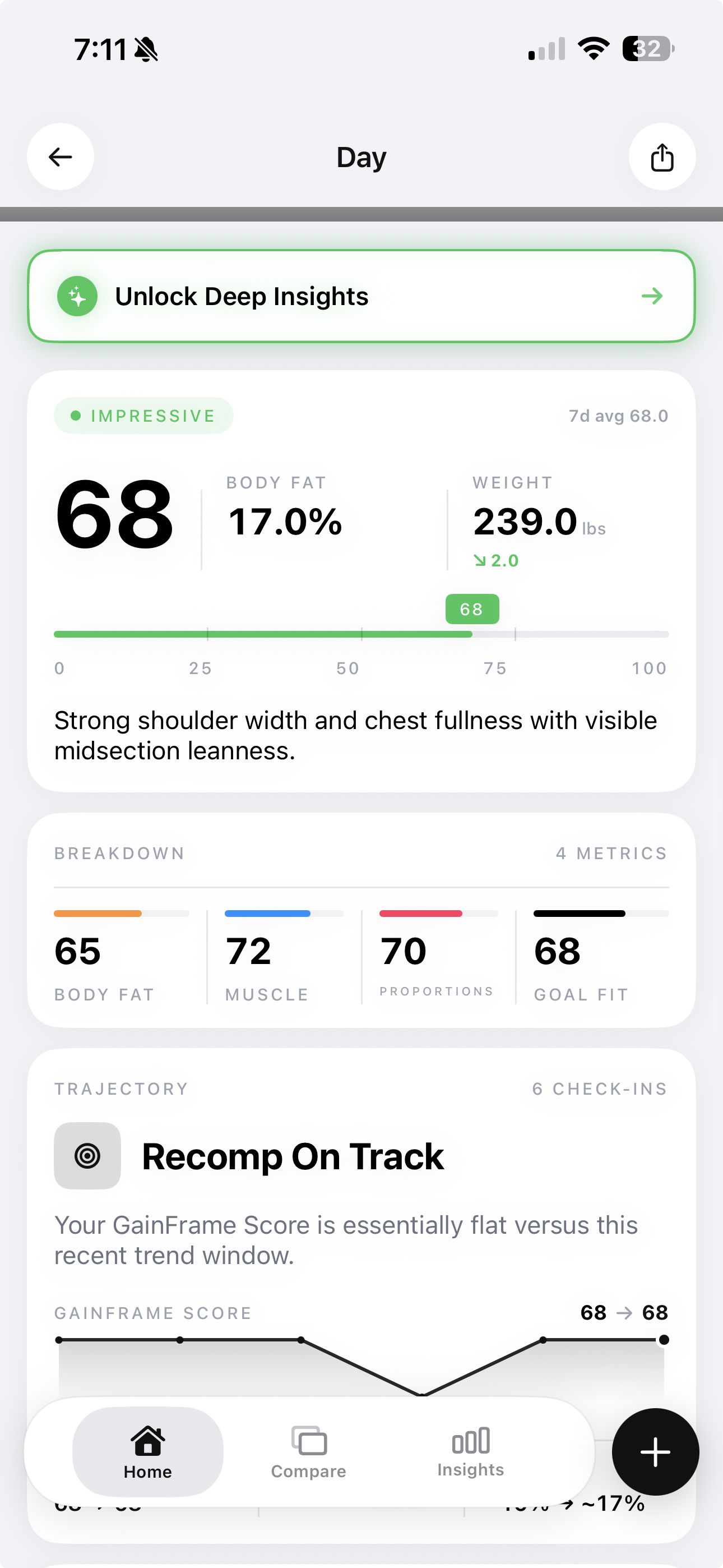
GainFrame is built for lifters who want both the visual record (progress photos) and the data layer (body composition + per-muscle-group scoring). Every check-in produces a Deep Dive: body fat %, lean mass, FFMI, and individual scores for chest, shoulders, back, arms, abs, legs, and glutes — 12 groups total. Free tier covers the core analysis; Pro unlocks longitudinal comparisons and unlimited scans.
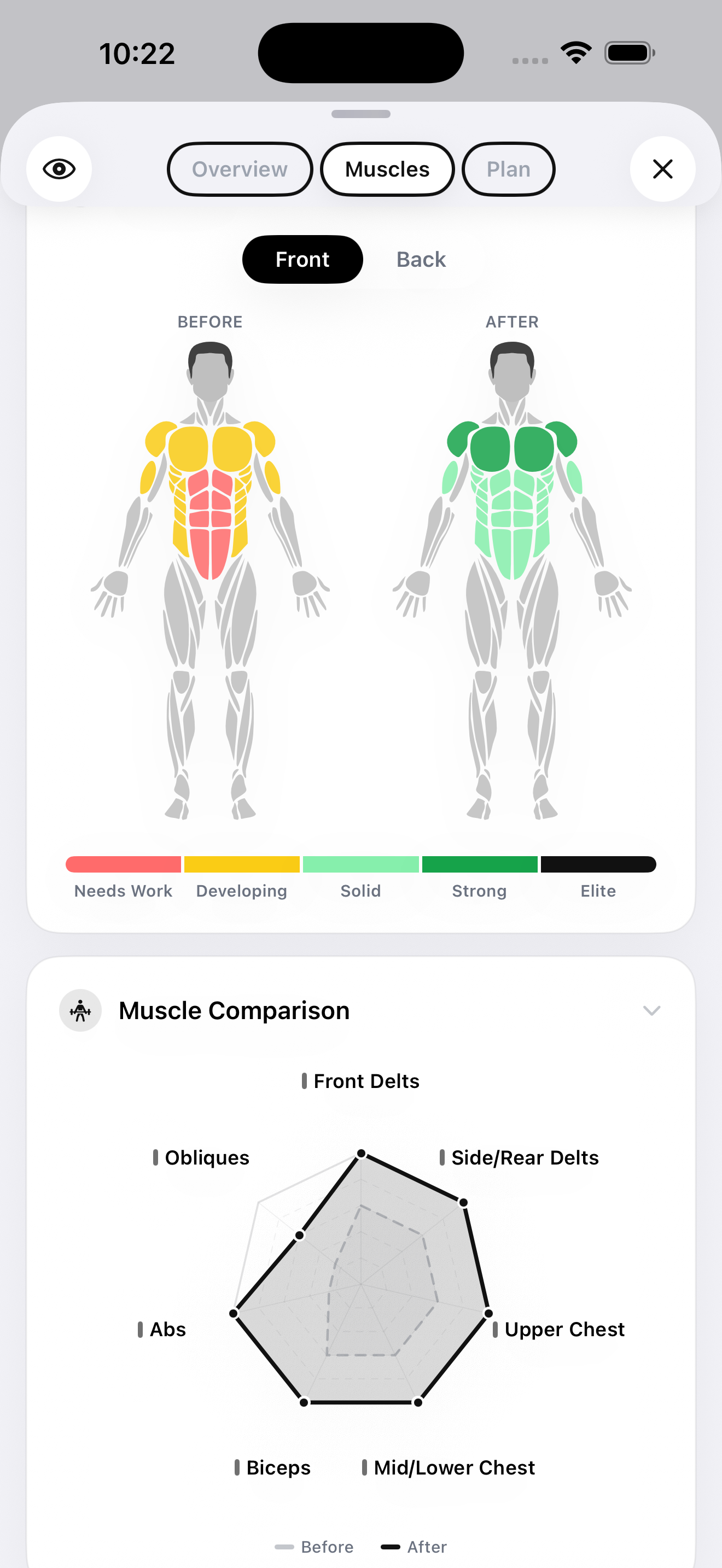
The muscle group breakdown is what separates GainFrame from most of the other body trackers in this list. Where most apps stop at "your body fat is X%," GainFrame tells you which muscle groups are above average for your body fat level and which are lagging — converting the data from "am I lean enough?" to "where should I be training harder?"
Accuracy: a published side-by-side with a clinical DEXA scan showed GainFrame's AI within 0.4% on body fat percentage. That's competitive with bioimpedance hardware that costs hundreds of dollars.
Where it doesn't win: iOS only. No 3D body model, no circumference measurements (use ZOZOFIT for that). It's a body composition + photo tracker, not a workout planner — pair it with a planner for full coverage.
Best for: Serious gym-goers who want photos, body composition, FFMI, and muscle group scoring in one app — with DEXA-validated accuracy at $0 base price.
Want to check the claim before installing? The browser-based AI body fat scanner runs the same engine on one photo per day, free, no signup — and the free AI physique rater returns the composite 1–100 score from the same photo.
2. Thelo AI — Subscription, iOS
What it scans: Full-body BioScan via phone camera, plus dynamic workout plan based on scan results
Method: Phone-camera body scan + AI workout generation
Thelo is the rare app that genuinely sits in both camps — body scanner and workout planner in one. The BioScan reads your body via phone camera and feeds the results into a workout plan that adapts as your physique changes. If you cut and lose lean mass, the plan responds. If you bulk and the scan shows imbalance, the program shifts.
The integration is the value here. Most stacks force you to manually translate body scan data into routine adjustments. Thelo does that translation automatically. The downside: you're locked into Thelo's planner. If you already use Fitbod or have a coach writing your program, the planner side becomes redundant.
The scan output is less granular than GainFrame's per-muscle-group breakdown, and Thelo hasn't published DEXA validation data, so accuracy is harder to verify.
Best for: People who want planner + scanner in one app and don't already have a routine they're committed to. Our standalone Thelo review goes deeper on the pricing tiers and the scan's limits.
3. Zing Coach — Freemium, iOS/Android
What it scans: Body composition via photo, plus AI form check via video during workouts
Method: Photo-based body scan + computer vision form analysis
Zing's pitch is the form-check feature. You point your phone at yourself during a set, and the AI watches your reps and flags form breakdown — bar path drift, knee cave on squats, hip rise on deadlifts. The body composition scan is secondary, but it's a real feature, not a checkbox.
The form check is genuinely novel and useful for solo lifters who don't have a coach watching them. The body composition output is less detailed than GainFrame or Thelo — closer to a basic BF% estimate than a multi-metric breakdown. If form is your priority and body comp is secondary, Zing fills a slot no one else does. If you're using it primarily for body tracking, the data layer is thinner.
Cross-platform availability is a win — Zing runs on both iOS and Android, where most of the apps in this list are iOS-only.
Best for: Lifters who want AI form correction as their primary feature, with body comp as a secondary check-in tool.
4. trackBod — Subscription, iOS
What it scans: Body composition from front + side photo scan
Method: Two-photo AI analysis (front + side)
trackBod keeps it simple. Two photos — front and side — and you get a body composition reading. No FFMI, no per-muscle-group scoring, no symmetry analysis. Just clean before/after with a body fat estimate layered on.
The minimalism is the design decision. If you find GainFrame's depth overwhelming or you don't want to look at a 12-muscle-group breakdown every check-in, trackBod is a stripped-down alternative. The downside: you're paying a subscription for a feature set that's narrower than what GainFrame offers free.
Best for: People who want a simple AI body comp scan without analytics overhead and don't mind a subscription for the simplicity.
5. TrueForm AI — Subscription, iOS
What it scans: Full body scan with chest, back, arms, abs, legs ratings + symmetry + posture analysis
Method: Multi-angle AI photo analysis
TrueForm leans into per-body-part physique scoring. The output is closer to a bodybuilding judge's scorecard than a clinical body composition report — it grades your chest, back, arms, abs, and legs individually, then layers in symmetry and posture analysis on top.
If you're physique-focused — getting ready for a photoshoot, a competition, or just optimizing how your body looks rather than what your body fat number is — TrueForm's per-part scoring is the most aligned tool in this list. Symmetry analysis especially is a feature most other apps don't offer.
The trade-off is that TrueForm's body composition data layer is shallower than GainFrame's. You get part-by-part aesthetic scoring; you get less data on absolute body fat % or FFMI. Pick based on what you actually care about: how you look, or what your composition is.
Best for: Physique-focused users who want per-body-part aesthetic scoring, symmetry, and posture analysis.
6. FitnessAI BodyScan — Subscription companion, iOS
What it scans: Smartphone-based body scan claiming medical-grade accuracy
Method: Phone camera body scan, companion to FitnessAI workout planner
FitnessAI is one of the original AI workout planners — it's been generating routines from lifting history since 2019. BodyScan is the body-tracking companion product, designed for FitnessAI users who want their physique data alongside their workout data.
The integration with the FitnessAI workout app is the main reason to pick this over a standalone tracker. If you're already using FitnessAI for your routine, BodyScan keeps everything in one ecosystem. If you're not a FitnessAI user, there are stronger standalone body trackers in this list — the "medical-grade accuracy" claim is marketing language without published DEXA comparison data to back it up.
Best for: Existing FitnessAI workout planner users who want to add body tracking inside the same ecosystem.
7. ZOZOFIT — $80/yr suit + app, iOS/Android
What it scans: 3D body shape, circumference measurements (waist, hips, chest, arms, thighs), 12 zones
Method: 3D body scan via phone camera + dot-marker spandex suit
ZOZOFIT solves a different problem than every other app in this list. It doesn't estimate body fat from a photo — it builds a 3D model of your body using a phone camera plus a dot-marker spandex suit, then tracks circumference measurements over time across 12 body zones.
If you're tracking waist size during a cut, arm development during a bulk, or shape changes that a flat photo obscures, ZOZOFIT's circumference data is the right tool. The 3D visualization is genuinely compelling — you can rotate your model and see exactly where your body is changing month over month.
Where ZOZOFIT doesn't fit: it's not a body composition tool in the fat-vs-lean-mass sense. The body fat number it produces is derived from circumferences using population-based formulas, not direct AI photo analysis. Use it for shape; pair it with GainFrame or another photo-based tool for composition.
Setup friction is real — you need the physical suit, scans take a few minutes, and it's not something you do daily. Monthly is realistic.
Best for: Shape and circumference tracking — not body fat % or muscle group composition.
Comparison table
| App | Price | What It Scans | Workout Plan? | Accuracy Validation | Best For |
|---|---|---|---|---|---|
| GainFrame | Free + Pro (iOS) | BF%, lean mass, FFMI, 12 muscle groups | No | DEXA-validated ±0.4% | Photos + body comp + DEXA accuracy |
| Thelo AI | Subscription (iOS) | Full-body BioScan | Yes (dynamic) | No published | Planner + scanner in one app |
| Zing Coach | Freemium (iOS/Android) | Body comp + AI form check | Yes | No published | Form correction + body tracking |
| trackBod | Subscription (iOS) | Front + side photo BF% | No | No published | Simple BF% without overhead |
| TrueForm AI | Subscription (iOS) | Per-part ratings + symmetry + posture | No | No published | Physique scoring & aesthetics |
| FitnessAI BodyScan | Subscription companion (iOS) | Phone-based body scan | Via FitnessAI app | No published | Existing FitnessAI users |
| ZOZOFIT | $80/yr + suit | 3D shape + 12-zone circumferences | No | Shape, not composition | Circumference & shape tracking |
Honest cross-camp picks (planner + tracker stacks)
Most lifters need one app from each camp. Here are the stacks that make sense:
Best all-around stack: Fitbod + GainFrame. Fitbod is the most polished AI workout planner — it adapts your routine based on equipment, recovery, and lifting history. Pair it with GainFrame for body composition and per-muscle-group scoring. Total cost: Fitbod subscription + $0 for GainFrame's free tier.
Single-ecosystem stack: FitnessAI + FitnessAI BodyScan. If you want planner and scanner from the same brand and don't want to bridge two apps, FitnessAI's ecosystem is the cleanest option. Less granular body data than GainFrame, but everything lives in one account.
ChatGPT-as-planner stack: ChatGPT-generated routine + GainFrame. If you don't want a planner subscription, ChatGPT can generate a periodized routine from a one-paragraph prompt — and modify it weekly based on your check-in data. Pair it with GainFrame for the body comp data layer. Cost: $0 if you use the free ChatGPT tier and GainFrame's free tier.
Form-focused stack: Zing Coach standalone. If your priority is fixing your form on compound lifts, Zing handles both the planner and the tracker side in one app — though the body comp depth is shallower than a dedicated tracker.
Shape-focused stack: Fitbod + ZOZOFIT. If you care more about waist size and circumference changes than body fat %, this stack covers planning + shape tracking. Add GainFrame separately if you also want composition data.
Who needs an AI body scan, and who doesn't
Not everyone needs body composition data. Be honest about which group you're in.
You probably need it if: You're bulking, cutting, or recomping and want to know whether the routine is actually changing your composition (vs. just changing your weight). You're past the beginner stage where everything works and you need data to figure out what's actually moving the needle. You're tracking a 12-week or 16-week phase and want to know if it produced lean mass gain or just fat gain.
You probably don't need it if: You're a pure strength athlete and only care about lift numbers — your composition will follow your training stimulus regardless. You have a coach who eyeballs you weekly and adjusts based on what they see. You're a beginner who hasn't built an adherence streak yet — focus on showing up to the gym 4x/week for 12 weeks first; add data tracking once the habit is in place.
The rule of thumb: if you can't answer "did the last 12 weeks of training and eating the way I'm doing it actually change my composition?" — you need body tracking. If you can answer that without an app, you don't.
Photos + AI Body Composition + DEXA Accuracy. Free on iPhone.
GainFrame gives you body fat %, lean mass, FFMI, and individual scores for 12 muscle groups after every check-in. Longitudinal trends, side-by-side comparisons, and DEXA-validated accuracy within 0.4%. No subscription required — Pro is optional. This is what we built for the body-tracking side of your AI fitness stack.
Download GainFrame Free