
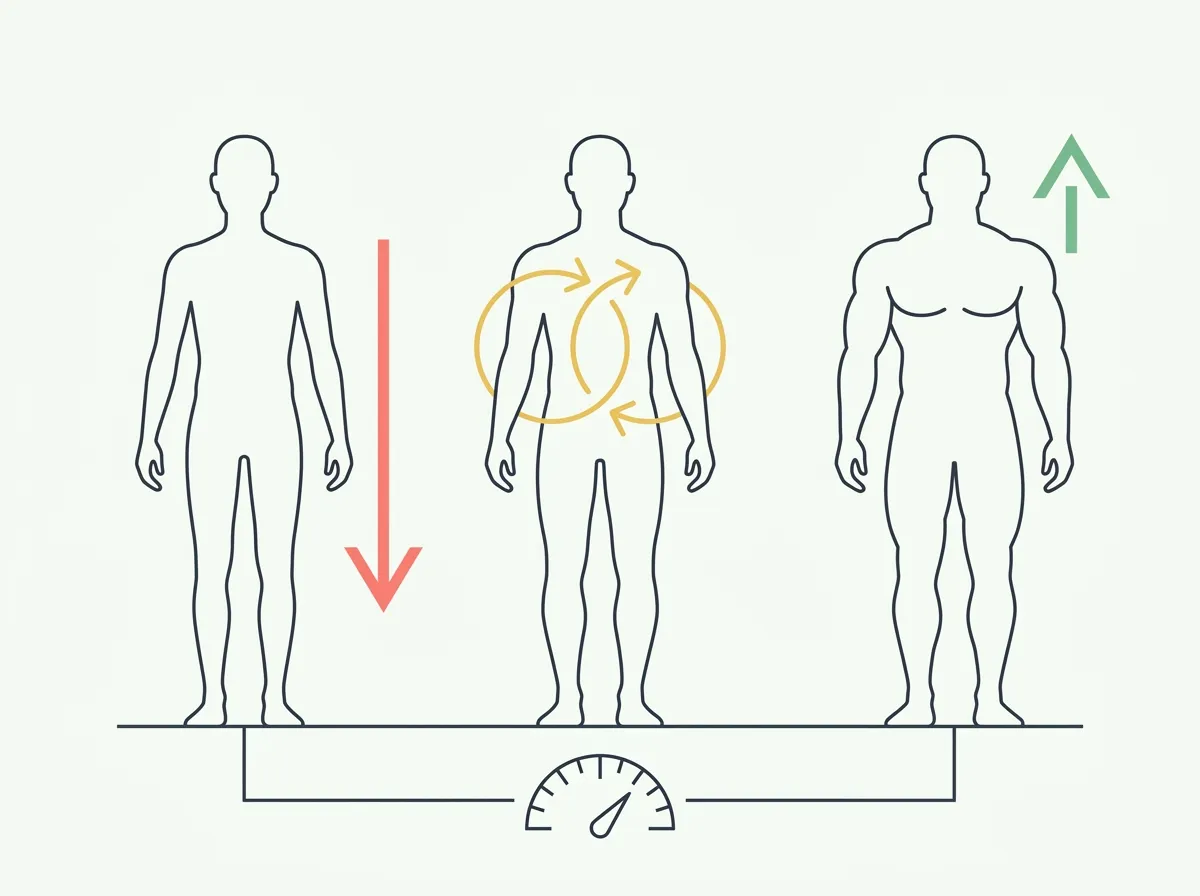
Quick answer: Choose a cut when fat loss is your main goal, a modest surplus when muscle gain is the priority, or recomp when you can progress in training while body weight stays fairly stable. Body fat estimates alone cannot pick your phase. Review strength, waist, photos, recovery, and personal preferences together.
You spend 8 weeks training, then see the same number on the scale and wonder whether you picked the wrong phase. Your waist seems smaller, a few lifts have improved, and yesterday's photo looks different from last week's. You still cannot tell which change to trust.
Choosing a bulk, cut or recomp starts with the outcome you want and the routine you can sustain. A body fat estimate can add context, but it cannot make that decision for you. You need a way to choose your priority and review several signals without treating one number as a verdict.
What is the difference between a bulk, cut and recomp?
Cutting prioritizes fat loss through an energy deficit. Resistance training, adequate protein and attention to recovery help support the goal of retaining muscle. The appropriate deficit depends on your circumstances; a fixed calorie number cannot identify the point where you personally start losing muscle.
Bulking prioritizes muscle gain, often using a modest energy surplus alongside resistance training. Some weight gain may be fat, and eating more does not guarantee faster muscle growth. Review your waist, weight trend and training performance together so you can adjust the pace.
Body recomposition means gaining muscle while losing fat. Maintenance intake can be one approach, and some people improve their body composition during a deficit. Hitting an exact maintenance number every day is not a requirement, and neither approach guarantees the outcome.
How should your goal guide the decision?
Use your priority to choose a starting approach. Training history and recovery help you judge whether the plan is working; an estimated body fat percentage does not create a universal boundary between phases.
| Your main priority | Phase to consider | What to review |
|---|---|---|
| Fat loss | A cut with resistance training | Body-weight and waist trends, training performance, energy and recovery |
| Muscle gain | A modest surplus | Training progress alongside the pace of weight and waist change |
| Both goals, with room to progress in training | Recomp with a manageable eating and training routine | Several weeks of waist, photos, weight averages, performance and recovery together |
You do not need to reach a prescribed percentage before considering a muscle-gain phase. Body fat estimates vary by method, and a number on its own cannot tell you whether you are eating enough to support training. If recovery is already poor, address that before making the plan more demanding.
What does research suggest about calorie deficits and surpluses?
A meta-analysis of resistance training in an energy deficit found smaller lean-mass gains than training without a deficit, while strength gains were broadly comparable. That distinction matters: you can improve a lift without proving that you added muscle. Its findings describe groups of participants and do not establish a personal calorie threshold for muscle loss.
A small eight-week trial of energy surpluses in trained lifters had 17 completers. Faster weight gain was associated mainly with increased skinfold thickness, while the muscle-thickness and strength findings varied. The study supports caution about pushing weight gain faster; it does not supply one ideal surplus for every lifter.
Your practical starting point is an intake that fits your goal while allowing you to train consistently. If fatigue accumulates or performance repeatedly drops, review food intake, training demands and sleep together. Avoid escalating a deficit simply because a photo estimate has stalled.
Can experienced lifters recomp?
Recomp can occur in trained people, though your training response and pace will vary. A 2026 trial of nutrition and resistance training followed 30 participants for 10 weeks. It reported increases in DXA-assessed fat-free mass in both the maintenance and moderate-deficit diet groups, with a reduction in fat mass in the deficit group.
The trial was small, short and predominantly male. DXA fat-free mass also includes tissue and fluid beyond skeletal muscle. These results support the possibility of improving body composition in trained people, without promising a particular monthly muscle gain or validating a photo-based recomp diagnosis.
If you are new to a structured program or returning after a break, assess how you respond to consistent training before assuming you need a large surplus. Improvement is not automatic. Years spent lifting and an FFMI score cannot tell you exactly how much progress remains available to you.
Which signals should you track during a recomp?
Stable weight alone cannot prove success or failure. A flat average could accompany changes in fat and muscle, or it could reflect little tissue change. Short-term water, glycogen and food-content changes also complicate the picture.
Keep a small set of repeatable observations:
| Signal | How to make it useful | What it cannot establish alone |
|---|---|---|
| Body weight | Compare averages from similar weigh-in conditions | How much of a change came from muscle, fat or fluid |
| Waist | Use the same tape placement and technique each time | The amount or location of fat lost |
| Progress photos | Repeat pose, distance, lighting and flexing state | A precise body fat percentage or amount of muscle gained |
| Training performance | Record load, repetitions, technique and effort | Whether improved skill or muscle growth drove the change |
| Recovery | Note sleep, fatigue and readiness alongside training | A diagnosis or a complete explanation of a plateau |
You can compare your recomp tracking signals to organize these observations. Treat the result as a prompt for review; it cannot confirm tissue change or diagnose why progress slowed.
For the visual record, compare standardized progress photos taken under similar conditions. A better pump or different lighting can change the comparison. Repeat the setup before interpreting a difference as progress.
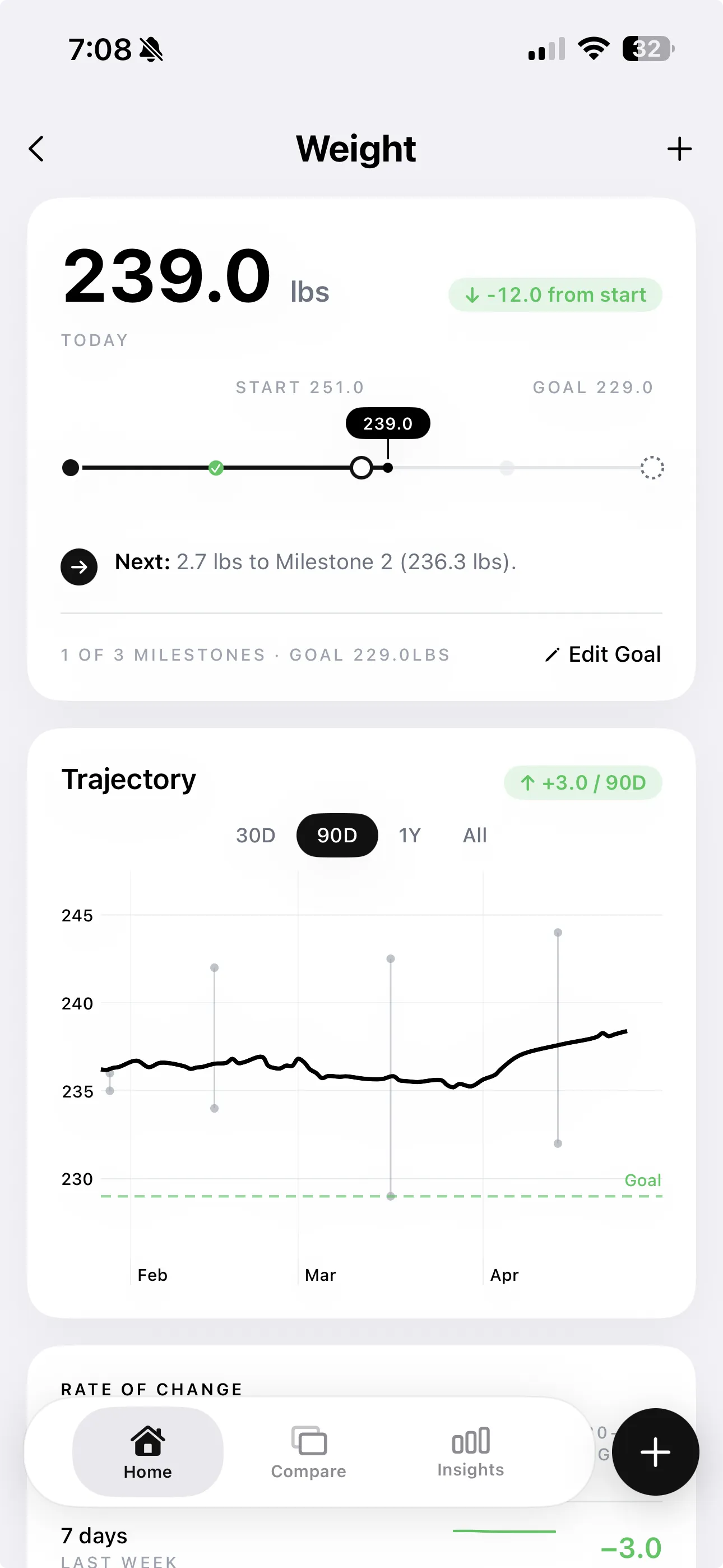
A weight trend helps you see direction across repeated weigh-ins. It cannot separate muscle, fat and fluid changes.
Does a rising FFMI prove that you gained muscle?
No. FFMI expresses estimated fat-free mass relative to height: fat-free mass in kilograms divided by height in metres squared. Fat-free mass includes water, bone, organs and muscle. When you calculate it from a body fat estimate, the uncertainty in that estimate carries into the result.
Consider an arithmetic example: keep weight and height unchanged, then enter a lower estimated body fat percentage. Calculated fat-free mass and FFMI will rise even though you have supplied no independent evidence that muscle changed. Two numbers moving in opposite directions can come from the same uncertain input.
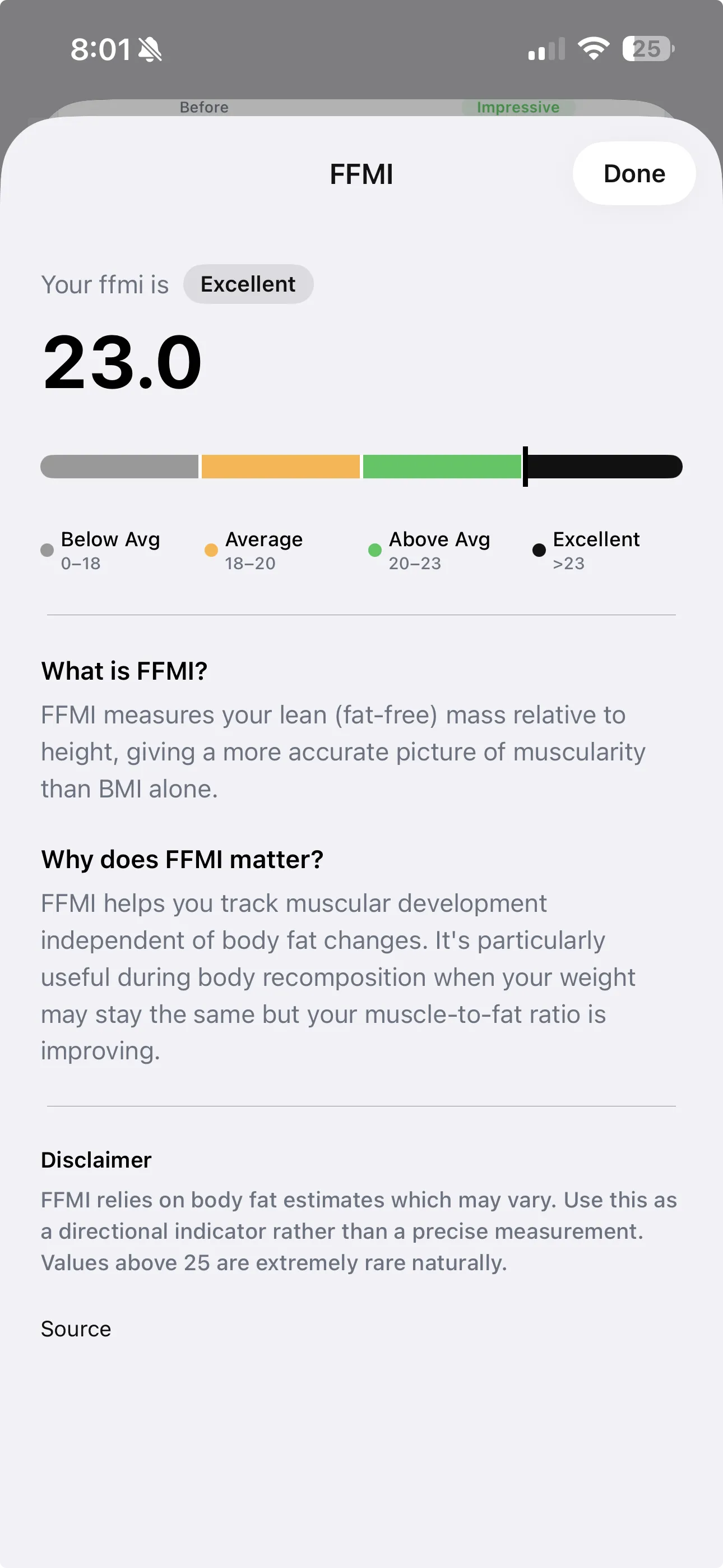
The score and category shown are app outputs. They cannot establish muscle gain, a genetic ceiling or the right training phase.
GainFrame can keep photos and estimated composition metrics together on iOS. Review those estimates alongside your waist, training log, weight averages and recovery. Neither an FFMI increase nor a trajectory label confirms a successful recomp.
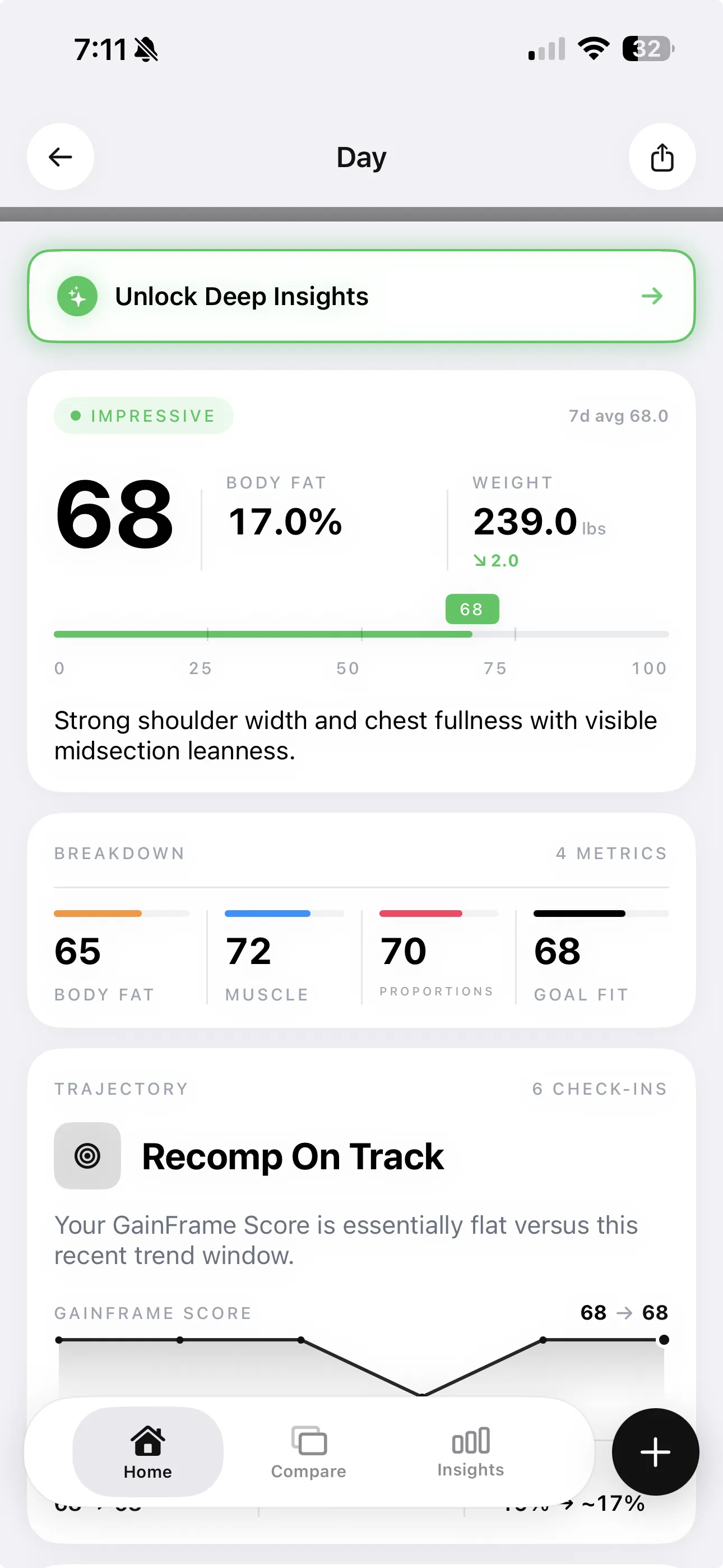
A trajectory label summarizes an app's inputs. It is not an independent measurement of fat loss or muscle gain.
What are the limits of this approach?
Home tracking helps you make a more informed decision, but it cannot precisely isolate muscle from fat or water. Repeated measurements reduce some noise without removing every source of error. Even research findings from supervised training and measured intake do not predict your exact response at home.
The studies above did not validate the tools or photo estimates on this page. The tracking workflow below is a practical way to review your own observations. If you need a health assessment or persistent fatigue is disrupting training, seek individualized advice rather than relying on a physique score.
How can you choose a phase and review it?
- Choose the goal. Write down whether fat loss, muscle gain or pursuing both matters most right now. Include what you are willing to change about eating and training.
- Establish a repeatable baseline. Record a body-weight average, waist measurement, standardized photos and recent training performance. Note sleep, energy and recovery so you can compare the same things later.
- Follow a sustainable plan. Use a resistance-training routine you can repeat and an eating pattern that supports the chosen goal. Include adequate protein and enough energy to train and recover.
- Review several signals over multiple weeks. Compare your averages, waist, photos and training log together. Check measurement conditions before interpreting a small change. You do not need to wait for an arbitrary deadline to address poor recovery.
- Adjust for the trend and your recovery. If the pattern repeatedly conflicts with your goal, review intake, training and consistency. Make a manageable adjustment and observe again. Seek individualized support for persistent fatigue, injuries or other health concerns.
What else should you know about bulking, cutting and recomp?
How do I choose between bulking, cutting and recomp?
Choose the outcome you care about most. A cut prioritizes fat loss; a modest surplus can support a muscle-gain phase; recomp aims to improve muscle and fat together. Consider your training progress, recovery, preferences and ability to follow the plan. Review several weeks of consistent measurements before deciding whether to adjust.
Do I need a particular body fat percentage before bulking?
There is no universal body fat percentage that gives everyone permission to bulk. Estimates vary by method, and the same number does not describe your training history, health or recovery. Start with your goal and current progress. If health or ongoing fatigue is a concern, get individualized advice before changing your intake.
Can trained lifters build muscle and lose fat?
It can happen, although the amount and pace vary. Studies in resistance-trained adults have reported improvements in fat-free mass alongside fat loss under structured training and nutrition. Those results do not guarantee your response, and fat-free mass includes more than muscle. Assess training progress and repeated measurements while keeping expectations flexible.
Does a rising FFMI prove muscle gain?
No. FFMI expresses estimated fat-free mass relative to height. Fat-free mass includes water, bone, organs and muscle, and errors in body fat estimates flow into the calculation. A photo-derived FFMI increase may reflect estimation changes or fluid shifts. Use it as supporting context alongside other observations, without treating it as confirmation of muscle growth.
How should I track a recomp?
Keep a repeatable record of body-weight averages, waist measurements, progress photos, training performance and recovery. Use similar conditions each time, including the same pose and lighting for photos. Look for a pattern across several weeks. Stable weight alone cannot tell you whether fat and muscle changed, and no home tracking signal proves the tissue change.
Keep your progress photos together
Use GainFrame on iOS to organize check-ins and compare your visual record. Photo-based composition estimates have uncertainty. Free download with limited check-ins. Optional Pro subscription; current price and limits are shown in the app.
Download for iOS