
With GainFrame, you tap a photo and get all of this in seconds. Do it monthly and you have a data-driven timeline of your muscle gain — not just a feeling that things are improving.
Body fat dropping while weight stays the same? That's recomposition — you're gaining muscle and losing fat simultaneously. AI body composition from a photo is the easiest way to confirm this is happening.
Method 3: AI physique predictions
Once you have enough progress photos (three or more of the same pose), AI can do something a scale never could: predict where your muscle gain is headed.
GainFrame's Future Physique feature analyzes your rate of change across photos and generates:
- An AI-generated image of your predicted physique at 3, 6, or 12 months
- Projected stats — body fat %, weight, FFMI, and physique score
- Key improvement areas — which muscle groups will change the most
- Specific training recommendations to accelerate your results
This is what the prediction export looks like — a side-by-side of "You Now" vs. your projected self, with the data to back it up:
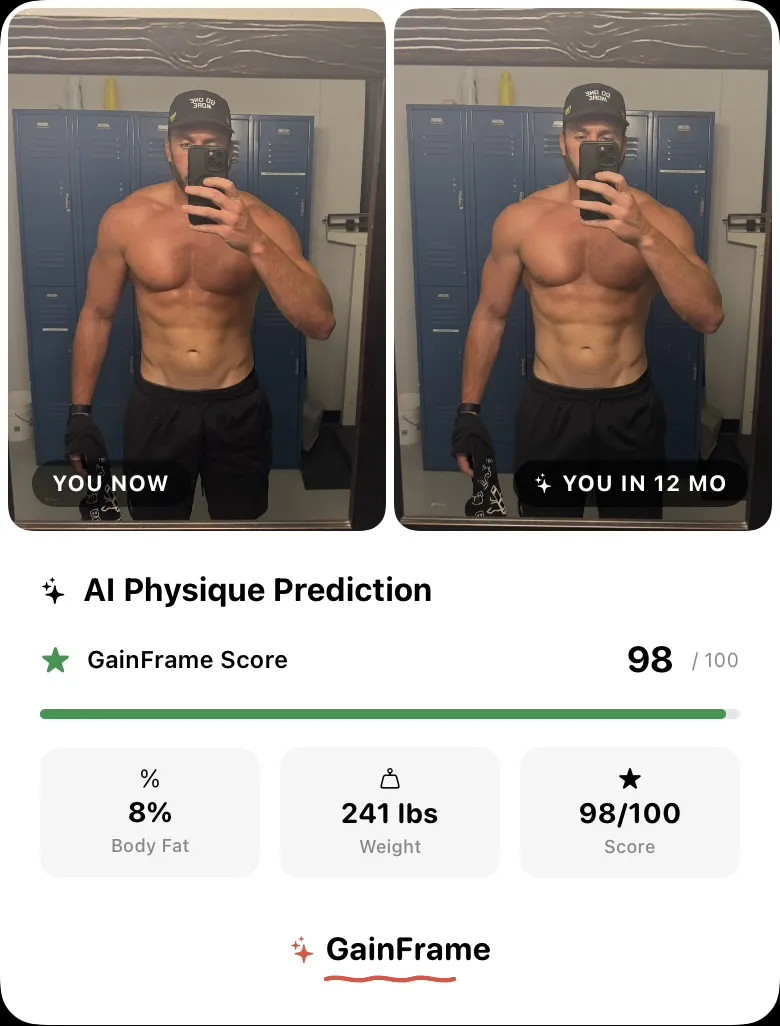
The value here isn't pixel-perfect accuracy — it's trajectory confirmation. Is your current program actually building muscle at a rate that will get you where you want to be? Or do you need to adjust?
Method 4: Strength progressions
If your big lifts are going up, you're almost certainly gaining muscle. Progressive overload is the driver of hypertrophy — so tracking your lifts is an indirect but reliable muscle gain indicator.
The limitation: strength gains can come from neural adaptations (especially in beginners), better form, or improved recovery — not just muscle growth. Strength alone doesn't tell you where you're gaining or whether you're also losing fat.
That's why the best approach combines strength tracking with visual evidence. Apps like Hevy track your workout volume, and GainFrame auto-attaches that data to the progress photo taken on the same day — so you can correlate volume increases with visible changes.
Method 5: Clothing fit and visual cues
Don't underestimate the basics. If your shirts are tighter in the shoulders but looser in the waist, you're gaining muscle and losing fat. If your watch band needs loosening because your forearms grew — that's real progress.
The problem with this method: it's imprecise and hard to track over time. But combined with photos and AI data, it's a useful gut check.
The best approach: combine methods
No single method tells the full story. Here's what we recommend:
- Take weekly progress photos. Same pose, same lighting. This is your primary data source for tracking muscle gain.
- Run AI body comp monthly. Tap your photo and get body fat %, FFMI, and muscle group scores. Track the trend, not individual readings.
- Weigh yourself daily, average weekly. The scale isn't useless — it just needs context. A weekly average removes water noise.
- Track your lifts. Progressive overload confirms you're stimulating growth. Pair with photo data for the complete picture.
- Check your predictions quarterly. Run an AI physique prediction every 3 months. Compare your actual progress to the projection and adjust your program.
The scale measures gravity's pull on your body. Your phone camera, combined with AI, measures what your body is actually made of — and where it's headed.
Start tracking what matters
Your gym selfies aren't vanity — they're data. Import them into GainFrame, get AI body composition on every photo, and build a timeline that shows exactly how your physique is changing — no scale required.