
Quick answer: Your natural muscle potential varies with genetics, training history, and measurement error. FFMI describes fat-free mass relative to height, but a single score cannot identify your personal ceiling or establish steroid use. Track strength, body measurements, and consistent photos over time, and treat estimated body fat as an uncertain input.
An FFMI calculator gives you 22.0, and an online chart puts a ceiling at 25. How much muscle does that leave you to gain? Those two numbers cannot answer that on their own.
The "natty limit" is shorthand for how much muscle someone can build without performance-enhancing drugs. Lifters often want a number that tells them how close they are. FFMI can describe their current estimated fat-free mass relative to height, but it cannot provide that personal forecast.
The useful numbers here are the calculation, its sensitivity to your inputs, and the observations from the original study. They give you context without labeling a physique or promising a final size.
What did the original FFMI study find?
Kouri and colleagues' 1995 study examined 157 male athletes: 83 steroid users and 74 nonusers. The researchers calculated fat-free mass index and applied a height adjustment to normalize values to a 1.8-meter man. The nonuser group reached a normalized FFMI of 25.0.
That observation is the source of the familiar "FFMI 25" reference. The same abstract also reports estimated normalized FFMI averaging 25.4 among 20 Mr. America winners from 1939 to 1959. The authors described their findings as preliminary.
A value observed in a limited male sample cannot establish every person's maximum. The study does not supply a universal female ceiling, a schedule of remaining muscle gains, or a reliable way to infer an individual's drug use from a photograph. Treating 25 as a personal pass/fail line goes beyond those data.
How do you calculate FFMI?
First estimate fat-free mass by subtracting estimated fat mass from body weight. Then divide that fat-free mass in kilograms by height in meters squared. Fat-free mass includes more than skeletal muscle, so a change in FFMI cannot be read directly as pounds of new muscle.
FFMI formula
Fat-free mass = body weight × (1 - body fat percentage ÷ 100)
FFMI = fat-free mass in kilograms ÷ height in meters squared
At 82 kg, 1.78 m, and an estimated 15% body fat: fat-free mass = 82 × 0.85 = 69.7 kg. FFMI = 69.7 ÷ 1.78² = approximately 22.0.
You can calculate FFMI with your own inputs and change the body fat estimate to see how much the result moves. The full FFMI explainer covers the underlying metric.
Raw FFMI and height-adjusted FFMI are different outputs. Kouri's adjustment adds 6.3 × (1.80 - height in meters) to raw FFMI. Identify which version you are comparing before interpreting an example or a research reference.
How much does the body fat estimate affect the result?
A calculator can be arithmetically correct while its inputs remain uncertain. The following examples keep weight at 82 kg and height at 1.78 m, changing only the assumed body fat percentage. These hypothetical calculations demonstrate how the input changes the result.
| Assumed body fat | Calculated fat-free mass | Raw FFMI, rounded |
|---|---|---|
| 15% | 69.70 kg | 22.0 |
| 18% | 67.24 kg | 21.2 |
| 21% | 64.78 kg | 20.4 |
The 1.6-point difference between the first and last rows comes entirely from the assumed input. It does not represent a training gain or loss. That is why a precise-looking score needs the measurement method and conditions attached to it.
If your body fat estimate comes from a photo, changes in pose, lighting, or framing can affect the input. Using similar conditions helps the comparison, but cannot establish that the estimate is accurate. Avoid interpreting a small calculated movement as proof of muscle growth.
Can an FFMI score reveal someone's natural ceiling or drug use?
FFMI describes estimated fat-free mass relative to height. It does not contain a person's training history, health history, or verified drug-use history. The original study's group comparison cannot fill those gaps for an individual.
A photograph provides even less information. It cannot establish accurate fat-free mass, and appearance varies with posing, lighting, camera distance, and temporary muscle fullness. Assigning an "enhanced" label from a picture or one calculated score is unsupported.
Use the number to ask narrower questions: Were the inputs collected consistently? Did the calculation change because body weight changed, the estimated body fat changed, or both? Those are questions your record can help answer.
How long does it take to reach your natural limit?
There is no validated countdown from your current FFMI to your personal maximum. A table that promises a particular annual muscle gain or a ceiling after six years would require more information than this score provides. The 1995 study compared athletes at the time of assessment. It did not follow beginners to their eventual maximum.
Training history still matters when reviewing progress. A period with interruptions, a new program, or a change in measurement method needs different interpretation from a long, consistent training block. Record that context before treating a slower rate of change as a permanent limit.
If progress has slowed, review the program and your recovery with a qualified coach. Persistent unexplained weakness or other health concerns deserve clinical attention. Neither situation can be diagnosed from an FFMI plateau.
What should you track when progress slows?
Start with records that describe what happened. You can track performance on a few repeatable exercises, training consistency, body weight under comparable conditions, selected circumference measurements, and photos with similar framing.
- Training performance: Record load, reps, and relevant changes in technique or exercise selection. A different movement is a different comparison.
- Body measurements: Note the method and conditions. Keep the original observations instead of retaining only a derived score.
- Photo check-ins: Use a consistent setup to document external appearance. Images cannot certify drug use or remaining muscle potential.
- FFMI calculations: Keep the underlying weight, height, body fat estimate, and calculation version alongside each result.
GainFrame can keep photo check-ins and estimated metrics together over time. Treat the chart as a record of estimates: it does not measure your remaining genetic potential or establish that a plateau is your ceiling.
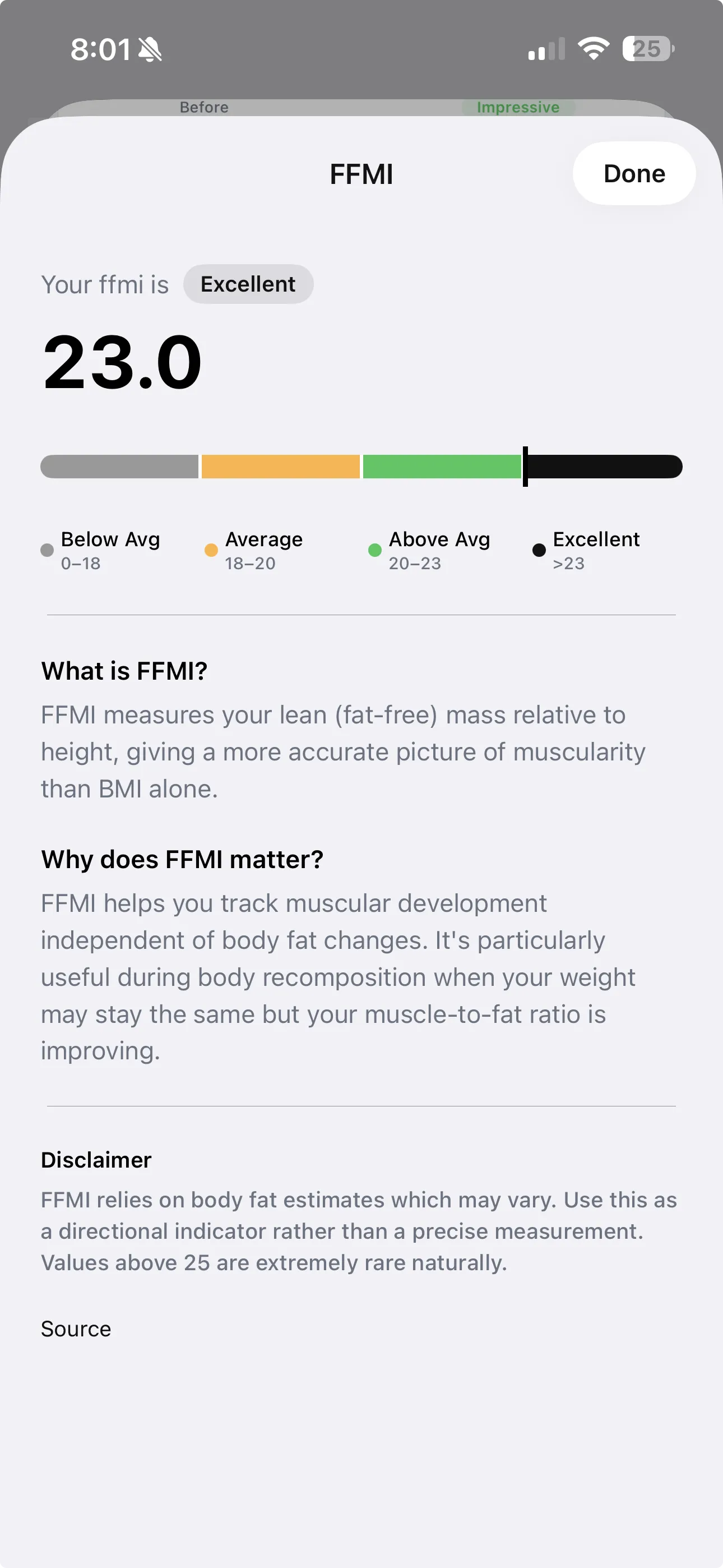
An FFMI history inherits uncertainty from each body fat estimate. Any app category is a heuristic; the screen cannot establish a personal natural limit.
How should age and individual variation affect your expectations?
The same score can arise in people with different frames, training backgrounds, and circumstances. A small reference sample cannot map every combination to an individual ceiling. In particular, the male sample in the original paper cannot supply a universal cutoff for women.
Age-related changes in muscle and function also deserve context. The National Institute on Aging's guide to strength training discusses maintaining strength and function as people get older. It does not provide an FFMI cutoff for a particular birthday.
Set goals you can evaluate directly: practicing a movement consistently, improving a repeatable performance measure, or sustaining a routine that works in your life. FFMI can sit alongside that record without defining its value.
What else should you know?
What FFMI is near the natural limit?
The often-cited value of 25 comes from normalized FFMI in a limited 1995 sample of male athletes. It is a research reference with limited relevance to an individual ceiling. Your calculation also depends on the body fat input and whether height adjustment is applied. A single score cannot establish how much muscle you can still gain.
Can I tell just by looking at someone if they're enhanced?
No reliable conclusion about drug use follows from a photograph. Lighting, posing, camera distance, and temporary muscle fullness affect appearance, while the image does not establish accurate fat-free mass. Even a calculated FFMI cannot verify an individual's drug history. Avoid using a physique photo or score to label another person.
What about "enhanced naturals" - test boosters, prohormones, SARMs?
The label does not define a scientifically consistent group. Products sold under those terms can have very different ingredients and effects, so an FFMI threshold cannot resolve their status. The FDA warns that SARMs are unapproved drugs with potentially serious harms. Discuss performance-enhancement products and any prescribed treatment with a qualified clinician.
Does the natty limit decline with age?
Age can affect muscle and physical function, but there is no validated FFMI table that assigns your personal ceiling by birthday. Training history, health, and measurement method also affect the interpretation. Track your own strength and function over time, and discuss persistent unexplained changes with a clinician rather than diagnosing them from a score.
Is it worth training naturally if the limit is "only" FFMI 24?
FFMI 24 is not an established personal limit, and a score does not determine whether training is worthwhile. Goals can include strength, physical function, enjoyment, and a routine you can sustain. Use body-composition estimates as one piece of feedback alongside those outcomes, with room for measurement uncertainty and your own preferences.
The FDA's guidance on SARMs explains why products marketed for muscle growth require more scrutiny than a "natural" label provides.
Keep a consistent progress record
Review photo check-ins and estimated FFMI over time, with the underlying measurement limitations in mind.
Download GainFrame Free