
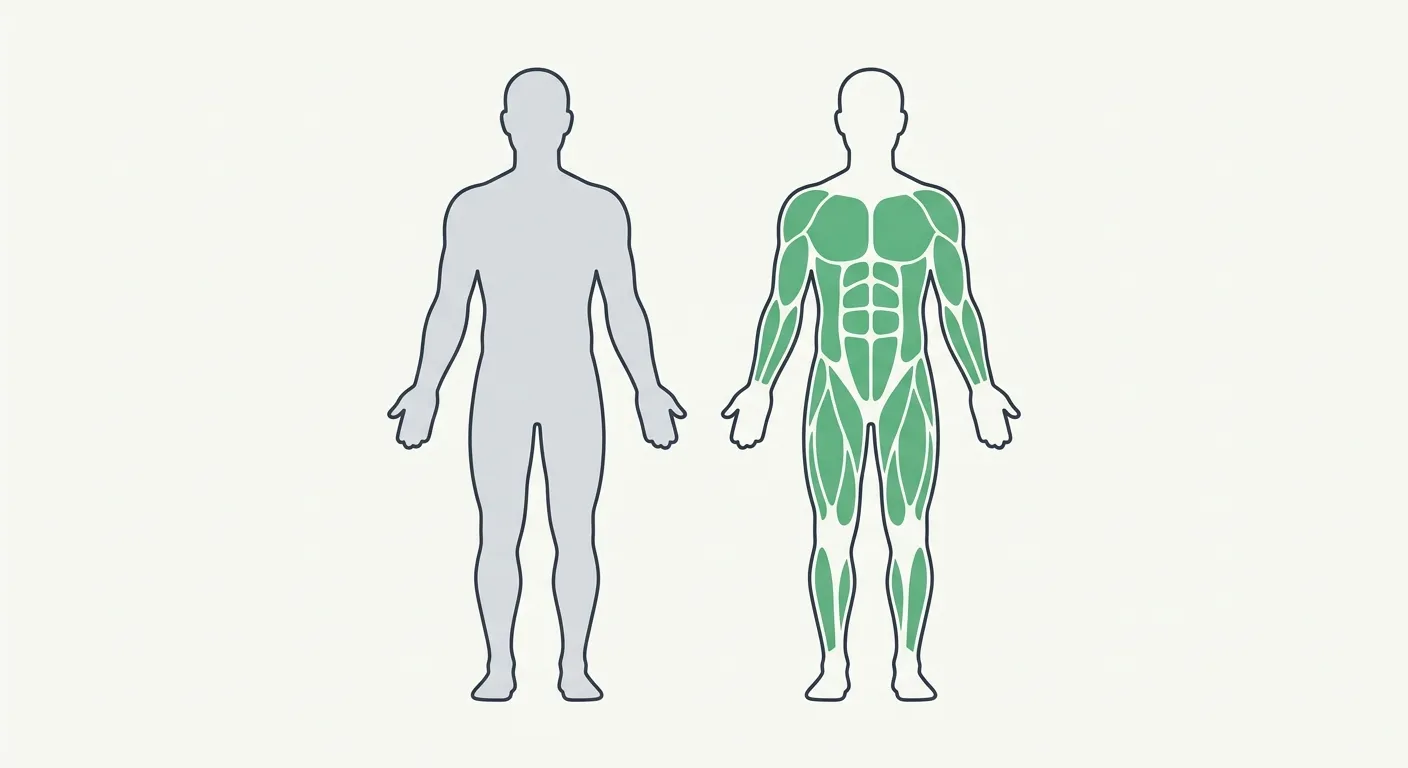
Quick answer: Lean mass is a broad body-composition category that includes muscle, water, organs, and other tissue. Muscle mass refers specifically to muscle. Fitness tools often use lean mass as shorthand for fat-free mass, which includes bone. A change in that combined estimate cannot tell you exactly how much muscle you gained or lost.
You ran a 12-week cut. The scale dropped 8 lbs. Your body composition app says you lost lean mass. Panic sets in, did you just burn through the muscle you spent two years building? Maybe not. Lean mass and muscle mass are not the same number, and confusing them leads to bad conclusions exactly when accurate interpretation matters most.
Most fitness apps, scales, and tracking tools use the terms interchangeably. They're not interchangeable. Here's the actual distinction, why it matters during a recomp, and how to know which one you're actually tracking.
Lean Mass vs Muscle Mass: The Short Answer
| Property | Lean Mass | Muscle Mass |
|---|---|---|
| Definition | Everything in your body that isn't fat | Specifically skeletal muscle tissue |
| Includes | Muscle, bone, water, organs, connective tissue, glycogen | Skeletal muscle only (the tissue that contracts and grows with training) |
| How fast it changes | Can shift 3 to 5 lbs in 24 hours (mostly water and glycogen) | Accrues at ~0.5 to 2 lbs per month maximum with optimized training |
| What a cut does to it | Decreases (water loss, glycogen depletion, some fat-free tissue) | Should stay stable if training stimulus and protein intake are maintained |
| What a bulk does to it | Increases significantly (muscle + water + glycogen) | Increases slowly, most scale gain during a bulk is lean mass, not muscle |
| What BIA scales measure | Lean mass (estimated), the default readout | Not directly measured by any consumer scale |
| Metric that tracks it | FFMI (Fat-Free Mass Index) | Per-muscle group scores, circumference measurements, visual progress |
What Is Lean Mass?
Lean mass, also called fat-free mass, is a catch-all category. It's the weight of everything in your body that isn't stored body fat: skeletal muscle, bone mineral, organ tissue, connective tissue, water (both intracellular and extracellular), and the glycogen bound in your muscles and liver. It's measured by subtraction: total body weight minus fat mass equals lean mass.
Lean mass is a useful metric precisely because it's easy to estimate. Body fat percentage tells you the fat side of the equation; everything else is lean. But that simplicity hides real complexity, the number is a composite of tissues that behave very differently under training, dieting, and daily life. Water alone can shift lean mass by 3 to 5 lbs from morning to evening depending on hydration, sodium intake, and carbohydrate storage.
You can calculate your lean body mass from weight and a supplied body-fat percentage. The result is fat-free mass; the optional sensitivity range shows what changes when your percentage estimate shifts.
What Is Muscle Mass?
Muscle mass refers specifically to skeletal muscle, the contractile tissue that attaches to bone and produces movement. It is a subset of lean mass. Not all lean mass is muscle. Your bones are lean mass. Your kidneys are lean mass. Your blood is lean mass. None of those respond to progressive overload.
True muscle mass is difficult to isolate without advanced imaging. MRI is the research standard. DEXA scans report a "lean soft tissue" estimate that correlates well with muscle mass but still includes non-contractile soft tissue. Most consumer-facing tools, including body fat scales and AI photo estimation, report lean mass, not muscle mass directly.
Why This Distinction Matters During a Recomp
Consider a 12-week comparison where weight stays at 180 lb and the supplied body-fat estimate falls from 20% to 17%. Calculated fat-free mass rises from 144 to 149.4 lb. Those inputs cannot produce a falling fat-free-mass result under the same formula.
If a device instead reports a decrease, check its definitions, timestamps, and method before comparing the fields. The arithmetic describes a change in the combined fat-free compartment. It does not establish that the change was muscle.
This is why experienced coaches track multiple signals simultaneously rather than relying on a single lean-mass number: scale weight, body fat percentage trend, strength performance, and visual progress photos. Each signal captures a different part of the picture.
The BIA Scale Problem
Bioelectrical impedance analysis (BIA) scales, the consumer body composition scales from Withings, Garmin, Tanita, and InBody, all report lean mass, not muscle mass. The measurement works by passing a low electrical current through the body and estimating fat-free mass from how the signal travels through different tissue types. Water is highly conductive; fat is not.
The problem: hydration status dominates the reading. Measure yourself before a workout versus after, or first thing in the morning versus after a big meal, and you can see 2 to 4 lb swings in "lean mass" that have nothing to do with muscle. BIA lean mass readings are meaningful when trended over weeks, not when compared day-to-day.
| Tool | What It Actually Measures | Muscle Mass Accuracy |
|---|---|---|
| BIA scale | Lean mass (estimated from conductivity) | Poor, heavily influenced by hydration |
| DEXA scan | Lean soft tissue mass (close to muscle) | Good, best available outside a lab |
| MRI | Skeletal muscle volume directly | Excellent, research standard |
| AI photo estimation | Body fat % → lean mass calculated indirectly | Moderate, useful for trend tracking, per-muscle visual scoring |
| Tape measurements | Circumference of limbs and torso | Directional, arm and leg circumference tracks well with muscle growth |
Tracking Both: FFMI for Lean Mass, Muscle Scores for Muscle
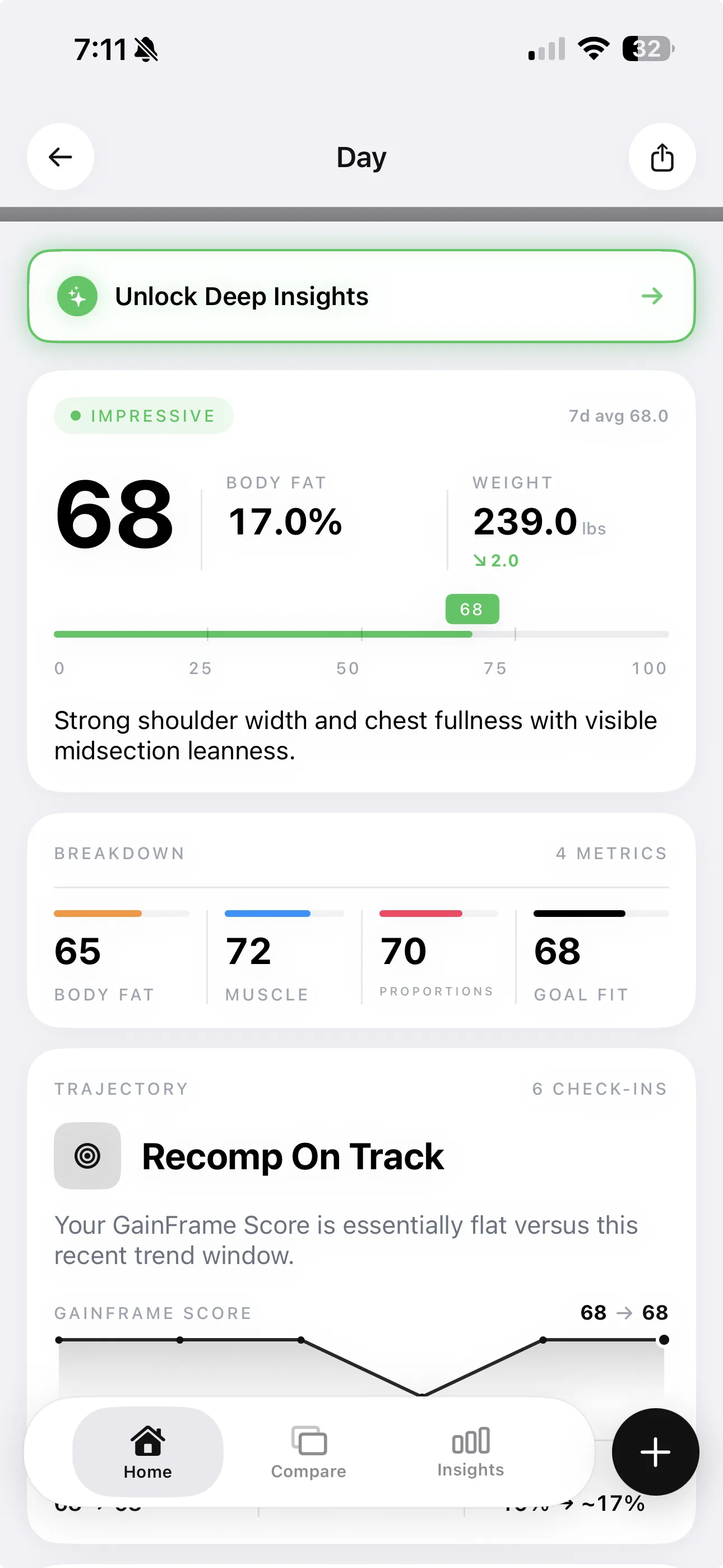
GainFrame's AI Deep Dive calculates both sides of this equation from a single photo. FFMI, the Fat-Free Mass Index, gives you a lean mass number relative to your height, updated each check-in. It tells you whether your overall lean tissue is holding, growing, or shrinking as you train.
The muscle scores go one level deeper. Rather than a single aggregate, GainFrame rates 12 individual muscle groups, Front Delts, Side/Rear Delts, Upper and Lower Chest, Biceps, Abs, Obliques, and more, each on a Needs Work → Developing → Strong → Elite scale. These scores are based on visual assessment of the photo, not conductivity or body weight, so they're not affected by hydration shifts the way BIA readings are.
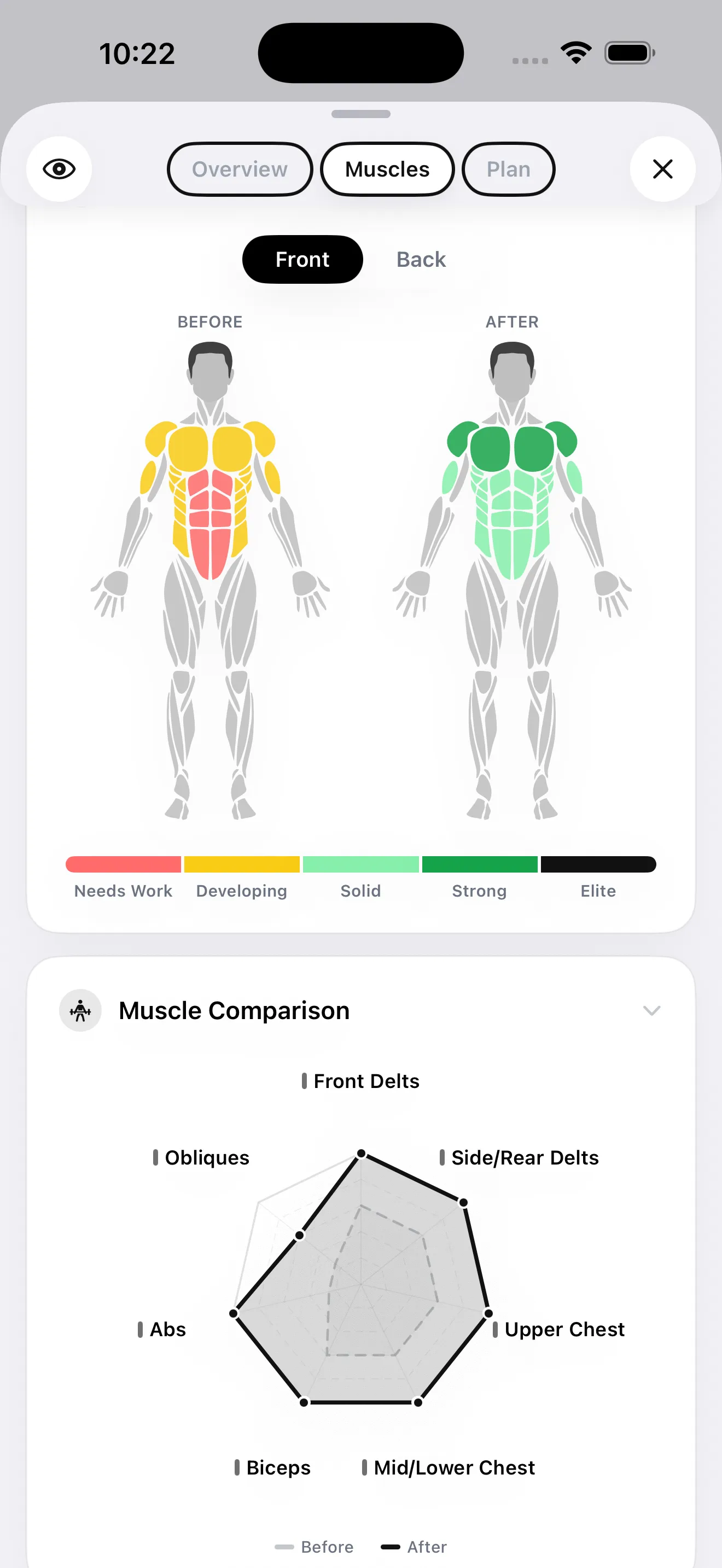
The combination answers the question BIA scales can't: not just "how much lean mass do you have" but "where is the muscle, and which groups are lagging." An FFMI that's flat alongside muscle scores that are improving is a recomp working correctly, lean mass held while the composition inside that lean mass shifted toward more contractile tissue.
How to Track the Right Thing: A Simple Framework
- Stop interpreting single lean-mass readings. Lean mass fluctuates with hydration by 3 to 5 lbs daily. One low reading after a hard training session or a salty meal means nothing. Only 4-week averages or longer are signal.
- Use lean mass (FFMI) to track the bulk, and muscle scores to track the recomp. During a caloric surplus, FFMI rising confirms you're adding lean tissue alongside fat. During a recomp, stable FFMI alongside improving muscle scores confirms the internal composition is shifting correctly.
- Anchor to strength performance as an independent signal. If your lean mass number drops during a cut but your lifts stay the same, or improve, you almost certainly held your muscle mass. Strength is the most direct evidence that contractile tissue is intact.
- Pair any scale number with a visual check every 4 to 6 weeks. Photos catch what numbers miss. A flat FFMI with visible shoulder development emerging is not a stall, it's a recomp. A rising scale weight with no visible change is fat gain, not muscle.
What else should you know?
Is lean mass the same as muscle mass?
Muscle is one part of the broader lean-tissue category. Water, organs, and connective tissue also contribute, and the fitness shorthand fat-free mass includes bone mineral. Read the definition used by your device or report. A single combined value does not isolate skeletal muscle or show which tissue changed between measurements.
How do you calculate fat-free mass from body fat?
Multiply body weight by one minus body-fat percentage divided by one hundred. At 180 pounds and 20 percent body fat, the result is 144 pounds of fat-free mass. The calculation inherits uncertainty from the supplied body-fat estimate. It cannot turn an uncertain input into a precise muscle measurement.
Does losing lean mass during a cut mean losing muscle?
It can reflect several changes, including body water, glycogen, measurement variation, or tissue loss. The combined estimate cannot identify the cause on its own. Review the same measurement method under similar conditions alongside your training performance and other observations. Avoid changing your whole plan because of one unexpected consumer-device reading.
Why can DEXA lean mass differ from fat-free mass?
DEXA usually separates fat mass, lean soft tissue, and bone mineral content. Fat-free mass includes both lean soft tissue and bone mineral. A report may also use a different denominator for its fat percentage. Read the labels and method definitions before comparing a scanner field with the result of a simple calculator.
Can FFMI show exactly how much muscle you have?
FFMI relates estimated fat-free mass to height. It gives context for the combined fat-free compartment, which includes more than skeletal muscle. It also depends on the body-fat estimate used in the calculation. Follow a consistent method over time and use training performance and other measurements to interpret what may have changed.