
Why "scale success" is misleading — and dangerous
Here's the scenario that plays out thousands of times a day: someone on Ozempic steps on a scale, sees a number they haven't seen in years, and feels a rush of progress.
But the scale measures one thing: total mass. It cannot distinguish between fat tissue and the lean muscle that powers your metabolism, protects your joints, and determines how your body looks and functions.
If you lose 20 lbs but 8 of those pounds are muscle, your resting metabolic rate drops significantly. You now burn fewer calories at rest, making weight regain almost inevitable if the medication is ever discontinued.
This is the cycle that medical researchers have flagged as a major concern with GLP-1 therapy: the body adapts to a lower metabolic baseline. Stop the medication without having preserved your muscle mass, and you've set the stage for rapid fat regain — often surpassing the original weight.
The frustrating reality is that most people on these medications have no way to know this is happening. They see the scale dropping and assume everything is going right. By the time the consequences show up — weakness, a softer appearance despite lower weight, slower metabolism — the damage is already done.
The muscle preservation protocol
The good news: muscle loss on GLP-1 medications isn't inevitable. With the right interventions, you can dramatically shift the ratio of fat-to-muscle in the weight you lose. The clinical literature converges on three pillars:
| Strategy | Why It Works | Daily Target |
|---|---|---|
| High Protein Intake | Provides amino acids to stimulate muscle protein synthesis and prevent catabolism during severe caloric restriction. | 0.8 – 1.2g per pound of lean body mass |
| Resistance Training | Creates the mechanical tension necessary to signal the CNS to retain skeletal muscle tissue. | 2 – 4 sessions/week, compound movements |
| Creatine Supplementation | Supports cellular hydration and ATP production, aiding strength maintenance during low energy availability. | 3 – 5 grams daily |
These aren't optional add-ons. If you're taking a GLP-1 medication and not hitting a high protein threshold or performing resistance training, the research strongly suggests you're losing meaningful amounts of muscle.
The challenge is knowing whether your protocol is actually working. Are you successfully preserving muscle while losing fat? Or does the scale just look good while your body composition deteriorates underneath?
How to actually detect muscle loss
This is where traditional tracking methods fall apart. The scale is useless for this specific question. Tape measurements are imprecise. And DEXA scans — while accurate — cost $100–$200 per session and aren't practical for the kind of frequent monitoring this situation demands.
What you actually need is a way to track body composition changes over time — not just total weight. You need to see whether you're losing fat from your midsection or losing circumference from your arms and thighs.
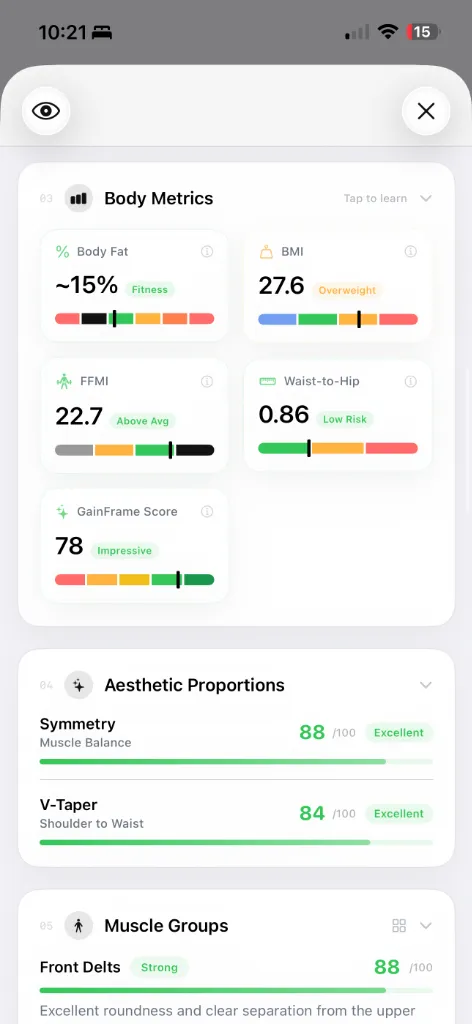
AI body composition analysis from progress photos can fill this gap. Instead of a single number on a scale, you get body fat percentage trends, muscle group scores, FFMI (fat-free mass index), and waist-to-hip measurements — all from a photo taken on your phone.
The practical application for someone on GLP-1 medication is straightforward: take consistent progress photos on a weekly or biweekly schedule, run body composition analysis, and watch the trends — not individual readings. If your body fat is dropping while your FFMI holds steady or rises, your preservation protocol is working. If FFMI is declining alongside body fat, you're losing muscle and need to adjust.
What to watch for: the warning signs
Beyond body composition data, there are physical and performance signals that suggest muscle loss is outpacing fat loss:
- Strength is declining despite consistent training. If your working weights are dropping on compound lifts (squat, bench, deadlift), your body is likely breaking down muscle tissue for energy.
- You look "softer" at a lower weight. This is the hallmark of muscle loss — a lower scale number, but a less defined, less toned appearance. The shape of your physique changes when muscle mass decreases.
- Arm and thigh circumference is decreasing. Fat loss concentrates around the trunk — the midsection, love handles, and lower back. If your limbs are shrinking faster than your waist, that's muscle disappearing.
- Persistent fatigue beyond normal drug side effects. Some fatigue is expected on GLP-1 medications. But ongoing exhaustion that worsens over weeks may indicate your body is metabolizing muscle for fuel.
Tracking what the scale can't see
Progress photos solve the visibility problem. A scale tells you how much you weigh. A progress photo — especially when analyzed consistently over time — tells you what that weight is made of and where your body is changing.
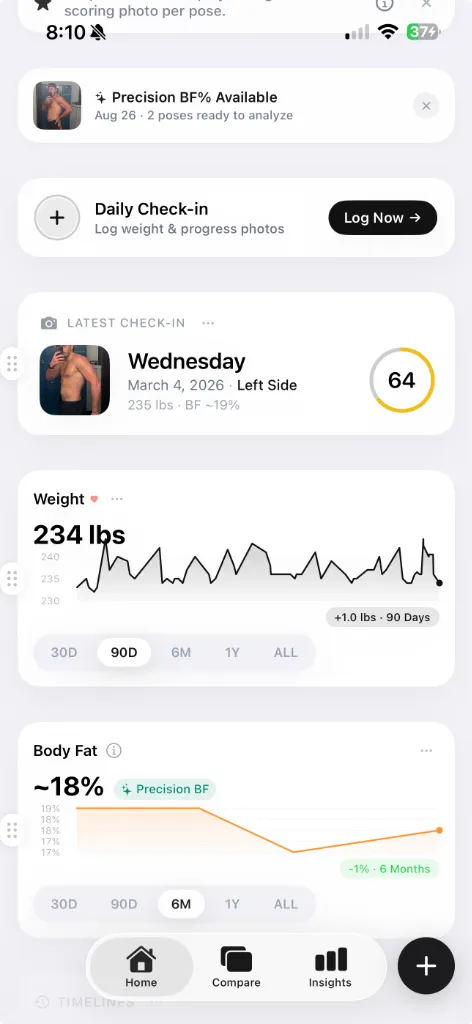
For someone on GLP-1 medication, this distinction is everything. You need to see:
- Body fat trending down — confirming the medication is driving fat loss
- FFMI holding steady or rising — confirming your protein and training protocol is preserving muscle
- Muscle group scores remaining stable — confirming you're not losing mass in specific areas like arms, shoulders, or legs
- Waist-to-hip ratio improving — the clearest indicator that you're losing fat from the right places
This is the kind of data that makes the difference between a GLP-1 journey that ends in a healthy, sustainable body composition — and one that ends in metabolic damage and eventual regain.
The bottom line
GLP-1 medications work. The weight loss is real. But the quality of that weight loss matters just as much as the quantity — and a bathroom scale cannot tell you anything about quality.
If you're on Semaglutide, Tirzepatide, or any GLP-1 agonist, you owe it to yourself to track your body composition, not just your weight. Hit your protein targets. Lift heavy things. Take consistent progress photos. And watch the data — not just the scale — to make sure your transformation is building the body you actually want, not just making it lighter.
Your scale will celebrate every pound you lose. Your body composition data will tell you whether that celebration is deserved.
More on GLP-1
- Ozempic Before-and-After Photos for Men: How to Take Them So Yours Show Progress
- Ozempic and Bodybuilding: How to Cut Without Losing Muscle
- How to Track Body Composition on Ozempic (Beyond Just Weight)
- Best Apps to Track Weight Loss on Ozempic in 2026
- How to Track Body Recomposition with Photos
- How to Measure Muscle Gain Without a Scale
- Is AI Body Fat Analysis Accurate? A 2025 Study Says Yes
- Best Body Fat Calculator from Photo: Why AI Beats Smart Scales