
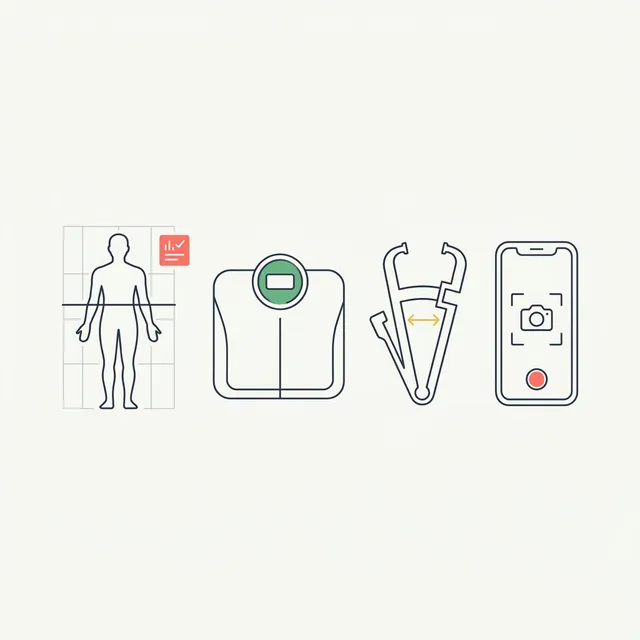
Your prescriber told you to weigh yourself once a week. They are not wrong, exactly — weight is a useful number — but on a GLP-1 (Ozempic, Wegovy, Mounjaro, Zepbound) it is also dangerously incomplete. The scale is the only metric most patients are told to track, and it is the metric most likely to mislead them about whether the drug is working the way they want it to.
This page is for the GLP-1 user who already suspects "track your weight" is an incomplete answer. It walks through every realistic body composition tracking method — DEXA, Bod Pod, hydrostatic, smart scales, and AI photo — and ranks them by cost, cadence, accuracy, and what they actually catch.
Why "Track Your Weight" Is the Wrong Advice on a GLP-1
The published data on GLP-1 weight loss without intervention is sobering. Studies of semaglutide and tirzepatide users who lost weight without resistance training or high-protein intake found the lost weight was roughly 60% fat and 39% lean mass — meaning nearly 4 out of every 10 pounds came from muscle, not fat. (See our pillar piece on GLP-1 muscle loss tracking for the full study breakdown.)
Now consider what that means for the scale. Imagine three different patients each lose 30 pounds on Ozempic over six months. The scale shows the same outcome for all three. The actual outcomes are wildly different:
The scale shows all three as "30 pounds lost." It cannot tell you which one happened to you. Body composition tracking is the only way to differentiate — and on a drug that pushes you toward the disaster scenario by default, knowing which one you got is not optional.
The 5 Ways to Track Body Composition on a GLP-1
Each method below trades cost against frequency against accuracy. There is no single best tool — the right answer is a stack. The ranking starts with what is most accessible for ongoing tracking and works toward what is best for medical-grade reference checks.
Method 1: AI Photo Body Composition — best for weekly tracking
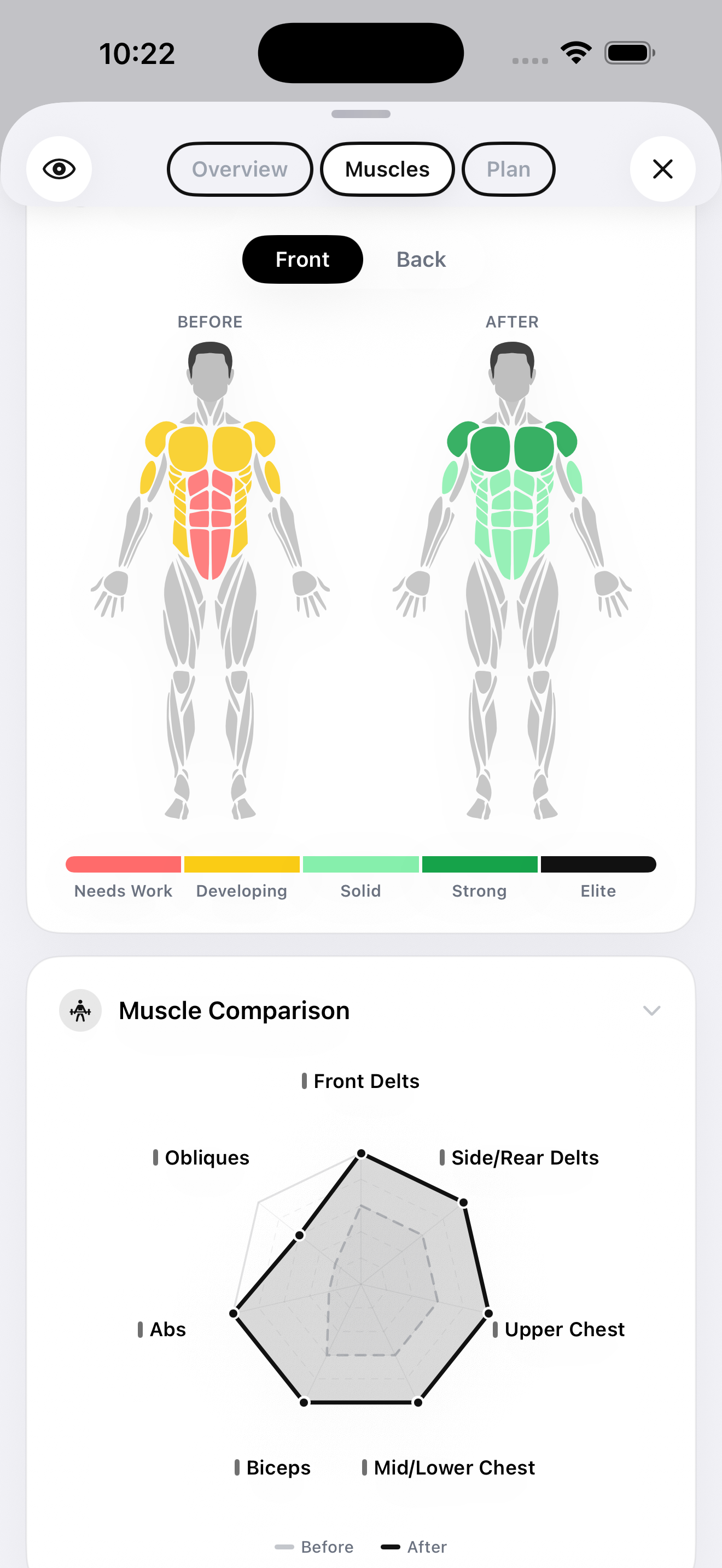
Cost: $0–$10/mo | Frequency: Weekly | Accuracy: ±1–3% body fat (DEXA-validated for top apps)
You take a standard front-facing progress photo, the app analyzes it, and you get back a body fat percentage estimate, lean mass, FFMI, and (in better implementations) a per-muscle-group score across roughly a dozen regions. The two most credible tools in this category right now are GainFrame and Spren.
What it catches: body fat percentage, lean mass, FFMI trend, asymmetric muscle loss (one shoulder cap shrinking faster than the other, quads thinning while glutes hold). The per-muscle-group scoring matters here because GLP-1 muscle loss is rarely uniform — it tends to hit the legs and posterior chain first because most people don't train those as hard.
What it misses: bone mineral density (only DEXA does this) and a precise visceral fat number. AI photo can flag a distended abdomen with low subcutaneous fat as a visceral fat warning, but that's an inference, not a measurement.
Why it matters on a GLP-1: the cost is low enough and the friction is low enough that you can do it weekly. Every other body composition method in this list is either too expensive or too logistically heavy for weekly cadence. The whole point of weekly tracking on a GLP-1 is that you catch a bad trend (BF% not dropping despite weight loss = fat and muscle going down equally) within 2–4 weeks instead of waiting for a quarterly DEXA to reveal it.
Method 2: DEXA Scan — gold standard for baseline + milestone checks
Cost: $50–$150 per scan | Frequency: Quarterly | Accuracy: ±1–2% body fat — the medical-grade reference
DEXA (dual-energy X-ray absorptiometry) passes two low-dose X-ray beams through your body at different energies and calculates fat mass, lean mass, and bone density compartment by compartment. National providers like DexaFit have facilities in most major US metros, and BodySpec runs mobile vans that visit gyms on a schedule for the same price point.
What it catches: total body fat, total and appendicular lean mass (so you can see arm-vs-leg-vs-trunk muscle separately), bone mineral density, visceral fat estimate. The appendicular breakdown is the killer feature for GLP-1 users — it's the only way to see whether you're losing leg muscle faster than arm muscle, which is the most common pattern in people who don't lift their lower body.
What it misses: the cost is the issue. At $100/scan you cannot do this weekly. Quarterly is the realistic cadence, which means there are 12 weeks of drift between data points. On a GLP-1 with a dose escalation every 4 weeks, that's three escalations of unknown body composition change between scans.
Why it matters on a GLP-1: as a baseline before you start the drug, and as a quarterly check-in, DEXA is unmatched. It also settles disputes — if your AI photo app and your smart scale disagree, a DEXA scan is the tiebreaker. We've covered the broader DEXA-vs-alternatives question in DEXA Scan Alternative: 6 Options Ranked if you want the longer comparison.
Method 3: Bioelectrical Impedance Smart Scales
Cost: $30–$200 hardware, free per reading | Frequency: Daily | Accuracy: ±3–5% (heavily affected by hydration)
Brands like Withings, Renpho, Eufy, and Fitbit Aria run a low-amperage current through your feet and measure resistance to estimate body fat. The technology is real — fat resists electrical current more than lean tissue does — but the readings drift by 3–5% within a single day depending on hydration, sodium intake, time of day, and what you've eaten.
What it catches: weight trend. The weight number itself is reliable. Sync it to Apple Health or your equivalent and you have a smooth weight curve over weeks, which on a GLP-1 is genuinely useful — you want to know if weight loss has plateaued before deciding whether to push for a dose escalation.
What it misses: a body fat percentage you can trust. The daily noise from hydration is larger than the weekly fat-loss signal. If you weigh in on a low-carb day after a hard workout vs. a high-sodium day after a salty meal, the same body will read 4% different in body fat. Comparing readings day to day is unreliable for composition; the weight reading is fine.
Why it matters on a GLP-1: use it for weight only. The body fat percentage number these scales display is the one piece of "data" that actively misleads people on GLP-1s — they see the BF% drop on a dehydrated morning and conclude their composition is fine, when in reality their water weight just shifted.
Method 4: Bod Pod (Air Displacement Plethysmography)
Cost: $50–$100 per session | Frequency: Monthly at most | Accuracy: ±2–3%
You sit in an egg-shaped chamber that measures how much air your body displaces. Combined with your weight, the machine calculates body density, then body fat percentage. Bod Pods live at universities, larger sports performance centers, and some higher-end gyms.
What it catches: total body fat percentage and total lean mass at a respectable accuracy.
What it misses: regional breakdown (whole-body only, no arms-vs-legs differentiation), bone density, and the per-session cost prevents weekly tracking. If you have access to a DEXA, choose DEXA — it gives you everything Bod Pod gives plus regional lean mass plus bone density at the same price.
Why it matters on a GLP-1: primarily as a substitute when DEXA isn't accessible. If your gym has a Bod Pod and the nearest DEXA is two hours away, this is a reasonable monthly check-in.
Method 5: Hydrostatic (Underwater) Weighing
Cost: $50–$100 per session | Frequency: Monthly | Accuracy: ±2–3%
You submerge yourself fully in a tank, exhale completely, and a scale measures your underwater weight. Fat floats; lean tissue sinks. The displacement reveals composition. It's a research-grade method that has been used in exercise science for decades.
What it catches: total body fat percentage at high accuracy when done correctly.
What it misses: regional breakdown, bone density, and almost any meaningful access. Hydrostatic tanks are mostly at university kinesiology labs. Few consumers can find one. Mobile hydrostatic trucks visit gyms on a schedule in some areas but they're rare.
Why it matters on a GLP-1: mostly historical interest at this point. If you're a college athlete with free access to the kinesiology lab, by all means use it. For the average GLP-1 patient, this method is functionally unavailable, and Bod Pod or DEXA covers the same use case with better access.
The Full Comparison
| Method | Cost | Frequency | BF% Accuracy | Catches | Best For |
|---|---|---|---|---|---|
| AI Photo (GainFrame, Spren) Weekly | $0–10/mo | Weekly | ±1–3% | BF%, lean, FFMI, muscle groups | Mid-cycle course-correction |
| DEXA Gold Standard | $50–150 | Quarterly | ±1–2% | BF%, regional lean, bone, visceral | Baseline + milestone check |
| Smart scale (BIA) Weight only | $30–200 hw | Daily | ±3–5% (unreliable) | Weight trend | Weight curve only |
| Bod Pod | $50–100 | Monthly | ±2–3% | Whole-body BF%, lean | DEXA substitute |
| Hydrostatic | $50–100 | Monthly | ±2–3% | Whole-body BF%, lean | University lab access only |
The Honest Stack for a GLP-1 User
No single tool covers all five dimensions you actually need: weight trend, body fat percentage, regional muscle, bone density, and strength. The realistic answer is a stack that combines high-frequency cheap tools with periodic medical-grade reference checks. Here is what it looks like:
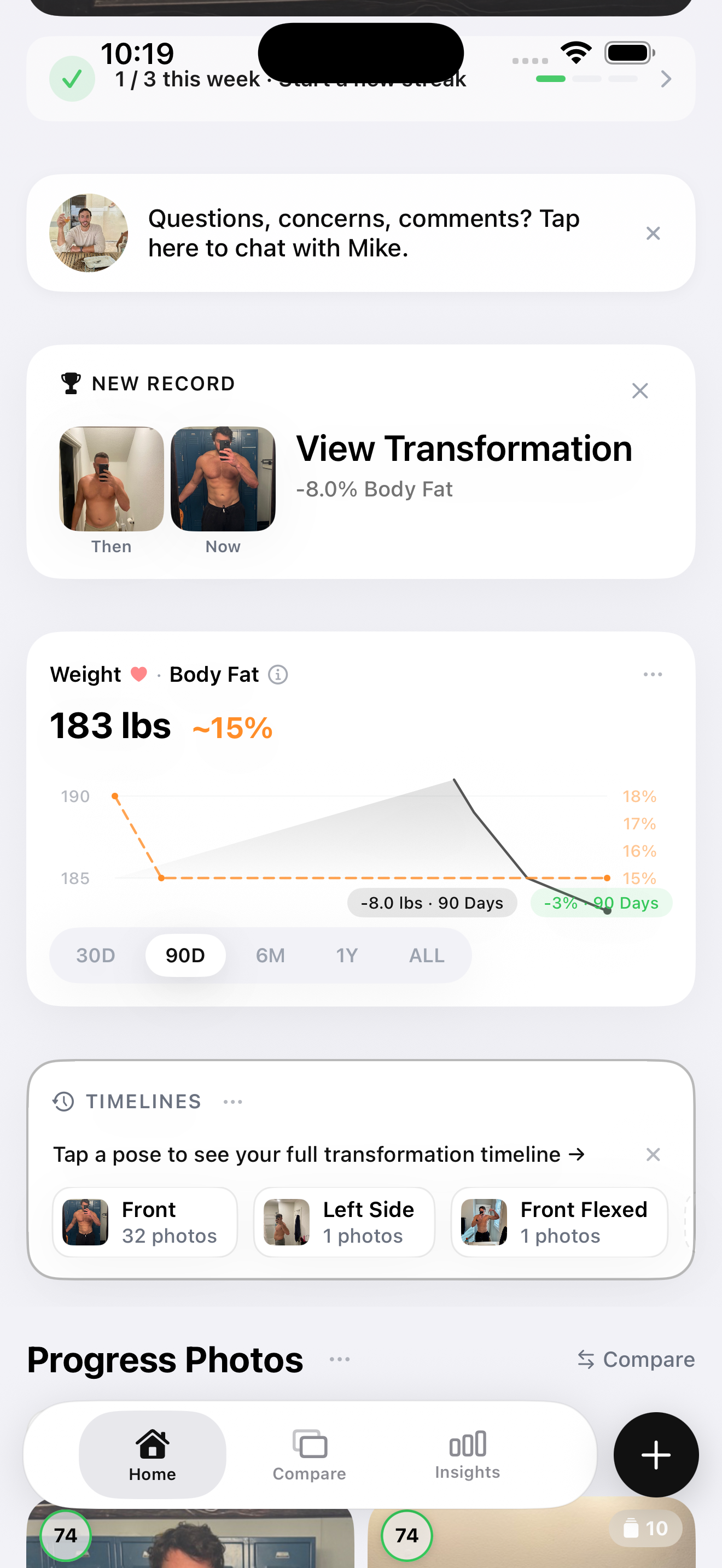
The stack covers what no single tool can: daily weight, weekly composition, monthly visual, quarterly medical-grade, and continuous functional strength. Pulling any one of these out leaves a gap. The most commonly skipped layer is strength tracking, which is a mistake — if your bench, squat, and deadlift hold while you lose 30 pounds, you almost certainly preserved muscle, regardless of what any scan says.
Cadence Aligned With GLP-1 Dose Escalation
Standard Ozempic and Wegovy protocols escalate the dose every 4 weeks (0.25mg → 0.5 → 1.0 → 1.7 → 2.4mg, with similar steps for tirzepatide). Each escalation can trigger a new wave of appetite suppression and a new wave of weight loss — and a new opportunity for muscle loss to outpace fat loss if your protein intake or training volume hasn't kept up.
Align your tracking with the dose cycle:
- Pre-escalation week: full re-measure — weight, BF%, lean mass, FFMI, plus log your strength PRs across the major lifts. This is your baseline for the new dose.
- Mid-cycle (week 2): spot check — weight on the scale, one quick AI photo. If BF% isn't dropping or muscle group scores are sliding, you have two weeks to adjust protein intake or training before the next escalation compounds the problem.
- Pre-next escalation: full re-measure again. Compare against the previous cycle's baseline. If muscle group scores or strength dropped meaningfully, talk to your prescriber about staying at the current dose for an extra cycle.
This cadence catches a bad escalation before it stacks on top of the next one. The most common mistake is escalating the dose because the scale is still moving, not realizing the weight coming off is now mostly muscle.
The Minimum Stack for Someone Who Doesn't Want to Spend Money
If budget is genuinely tight, the stack collapses to four tools, three of them free:
- Apple Health (free) for weight trends, manual entry from any bathroom scale you already own
- Phone camera + a free progress photo app for weekly photos. See Best Free Progress Photo Apps for credible options.
- Free tier of a workout logger (Hevy and Strong both have generous free tiers) for strength tracking
- One DEXA scan at month 3 ($100–150) to verify the trend
That's $100–150 across an entire 12-week cycle. It catches roughly 80% of what a paid stack catches. The thing it misses is weekly BF% precision — without an AI photo body comp tool, you're tracking weight and visual change only, with one DEXA reality-check at the end. For most people that's enough; for people who've already had a bad GLP-1 muscle loss experience, it isn't.
When to Escalate to Medical-Grade Tracking Immediately
Some signals mean you don't wait for the next quarterly DEXA — you book one this week. Watch for:
- Strength dropping faster than expected. A 10%+ drop in any compound lift (bench, squat, deadlift, overhead press) over 4 weeks while in caloric deficit is a red flag. Some strength loss is normal in a cut; that much that fast usually means muscle, not just glycogen.
- "Deflated" appearance in photos. The body looks slimmer but flat — muscle volume gone, not just fat. This is the visual signature of muscle loss.
- BF% not dropping despite weight loss. If your weight is down 8 pounds but your BF% is unchanged, fat and muscle are coming off at roughly equal rates — the disaster scenario from the table at the top of this page.
- Visible asymmetric atrophy. One shoulder cap visibly smaller than the other, or quads that look noticeably thinner while glutes are unchanged. AI photo body comp tools catch this in their per-muscle scores; a DEXA confirms it with appendicular lean mass numbers.
If two or more of these show up at the same time, get a DEXA inside the next 7–14 days, then bring the results to your prescriber. The data shifts the conversation from "the drug is working, your weight is down" to "the drug is working but muscle loss is outpacing fat loss, so we need to slow the dose escalation and increase protein/training before continuing."
The Honest Verdict
Tracking body composition on a GLP-1 is the difference between "I lost 30 pounds" and "I lost 30 pounds and kept my muscle." The scale alone hides which one you got. The minimum credible answer is an AI photo body comp tool plus one quarterly DEXA. The full answer is the five-layer stack above.
None of this is medical advice — talk to your prescriber about the medication itself. The tracking framework here is for anyone already on a GLP-1 who wants better data on what's actually changing inside the weight number.
The Home Equivalent of Weekly DEXA, Without the Weekly $100 Bill
GainFrame ties weekly progress photos to AI body composition — body fat percentage, lean mass, FFMI, and muscle group scores — at $0 base. Pair it with a quarterly DEXA at DexaFit or BodySpec and a workout logger and you have the full GLP-1 tracking stack. The drug does its job. You make sure the weight coming off is the weight you want gone.
Download GainFrame Free